Ooh boy, folks, we are back with another museum entry and it is a doozy! Because it has already(!) been four years, and North America’s longest-running contemporary international art exhibition is back again at CMOA for its fifty-ninth iteration! I actually went at the start of the month during opening week, but as that was the same week that I decided to attempt Brie-pocalypse, I put this entry off for today. After the dynamism and breadth of the 2022 International, I wasn’t sure if this curation team would be able to top it, but I am happy to report that this year’s International is bigger and bolder than ever. More and new spaces utilized! More a/v installations! Just more of everything! So much so that I’m genuinely glad that the International is live for another eight months because there is simply too much to take in during a single visit.
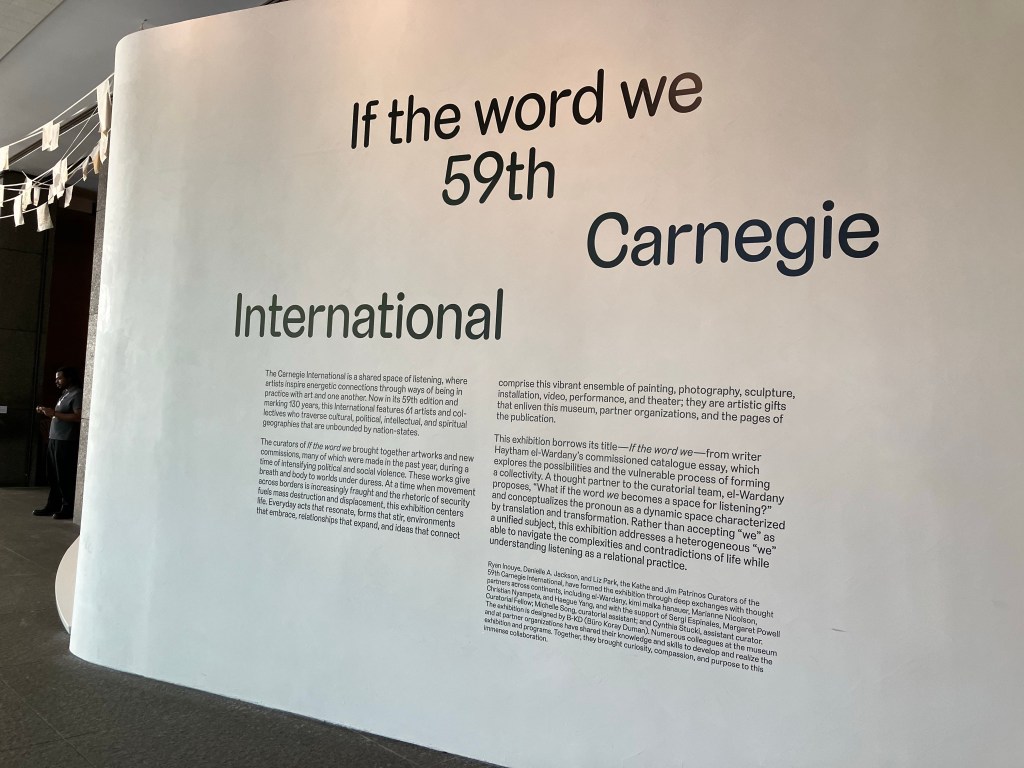
[Though shoutout to my best friend/college roommate’s dad for being my museum buddy on this walkthrough. Thanks, Mr. H!]
Somewhere along the line, one of the docents remarked that I must be liking what I was seeing because I had the biggest smile as I walked around. And while unbeknownst to her that that’s kind of my default Museum Face, she wasn’t wrong. I was simply electrified by everything around me—a state that’s usually difficult for me to get to at all but the largest museums, where there’s just so much to take in. I get to a point where I’m almost vibrating on a different wavelength, and though I don’t pretend to have understood everything that I saw (one of the intellectual beauties of modern art), I wanted to do what I did the last time and just highlight some pieces that put that stupid grin on my face so that all of you can get a taste.
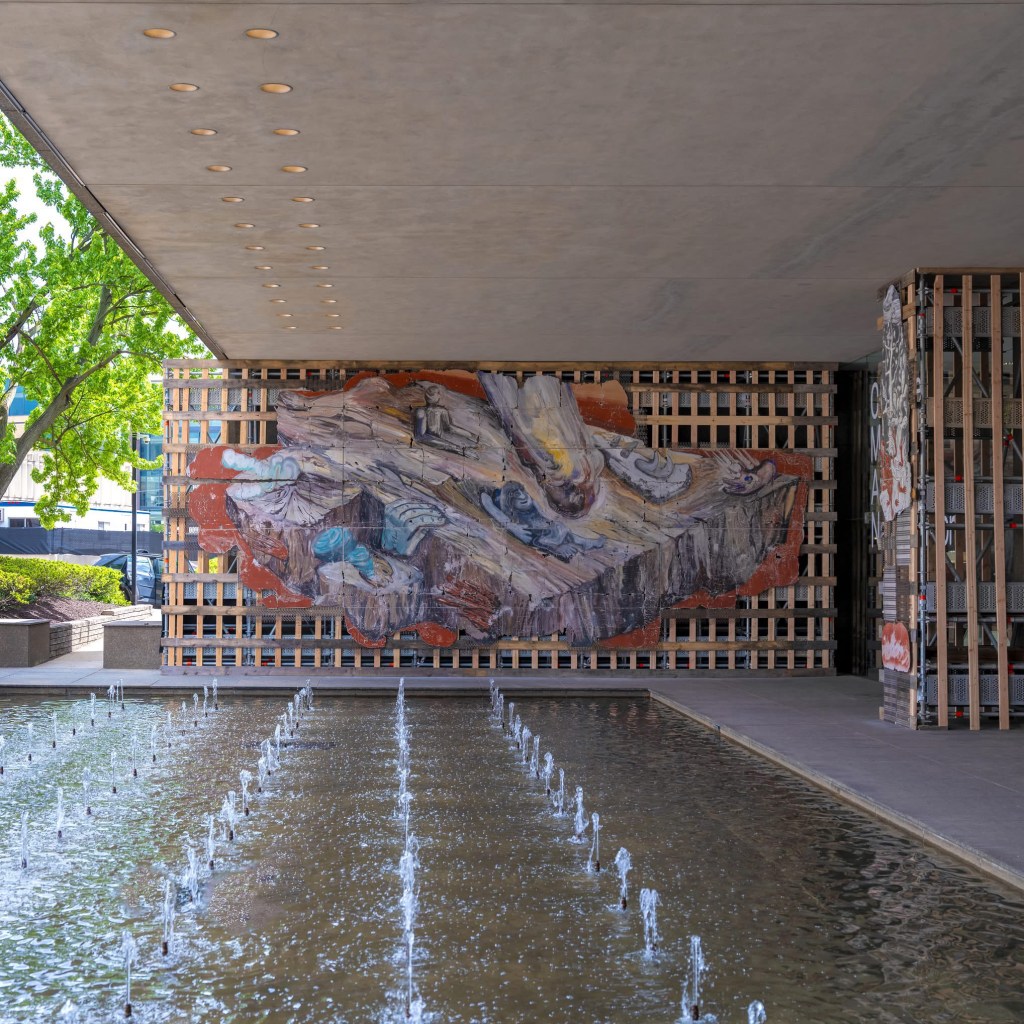
[Omg, let’s get started! (Orogenic, Abraham González Pacheco (2026))]
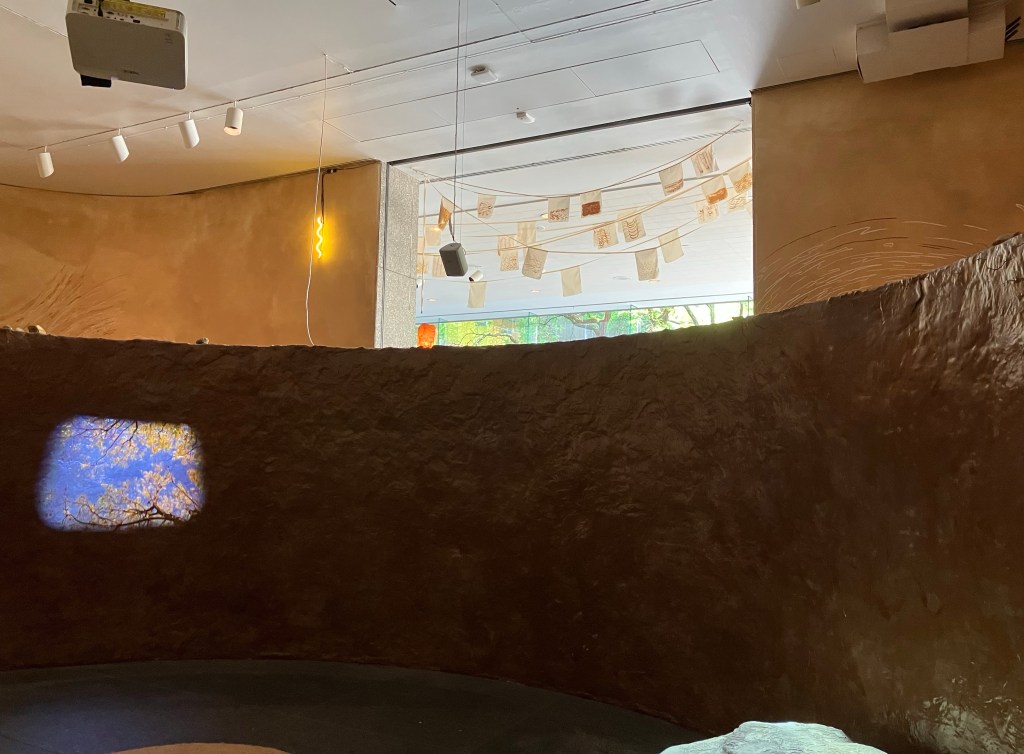
[Fiela, fiela (I’ve come to take you home), Dineo Seshee Bopape (Raisibe), 2026]
It took us over half an hour to get out of the entrance hallway, because there was so much to look at right away. South African artist Dineo Seshee Bopape’s multimedium installation Fiela, fiela (I’ve come to take you home) has taken over the Forum Gallery, dominated by a small maze of mud sculpture walls and projected images of trees and flowers. One of the interesting features of the International is that some pieces will provide you with details about how to interpret them, and others won’t, so you have to come to your own conclusions. Fiela is one of the latter, and that’s ok. I think it’s more important to stop and sit with art sometimes, rather than coming to some particular interpretative endpoint with it.
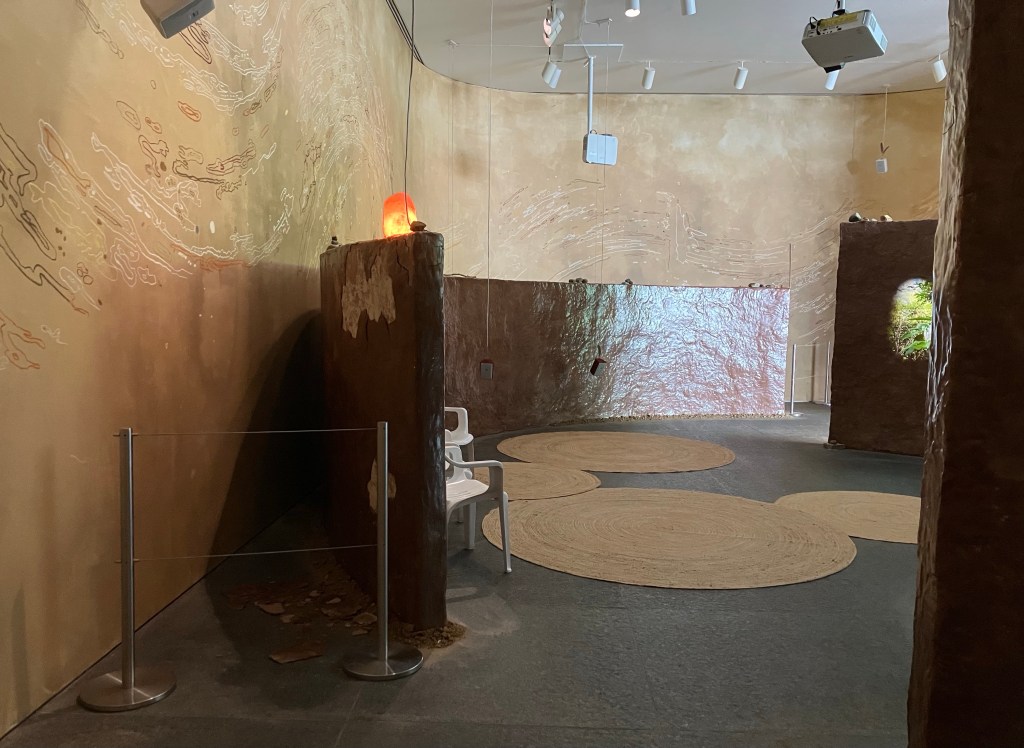
[Though maybe not literally here—I’m not sure if we were allowed to sit in these chairs…]
Fiela was one of those pieces that I was simply drawn to beyond specific ideas; if there had been fewer other people, I could have wandered back and in forth in the cramped Forum Gallery for another half an hour probably, just soaking in the ambience. Maybe it triggered my subconscious’s memories of being in South Africa, or perhaps it reminded me of mud-wall rooms I stayed at in Kenya. It’s hard to see, but the mud and dirt are partially designed to flake and fall off (there are posted warnings to watch out for falling mud). One interpretation of Fiela is as a record, as the vast majority of International pieces are for one reason or another, of fragility and impermanence. Be that environmental, social, or both.
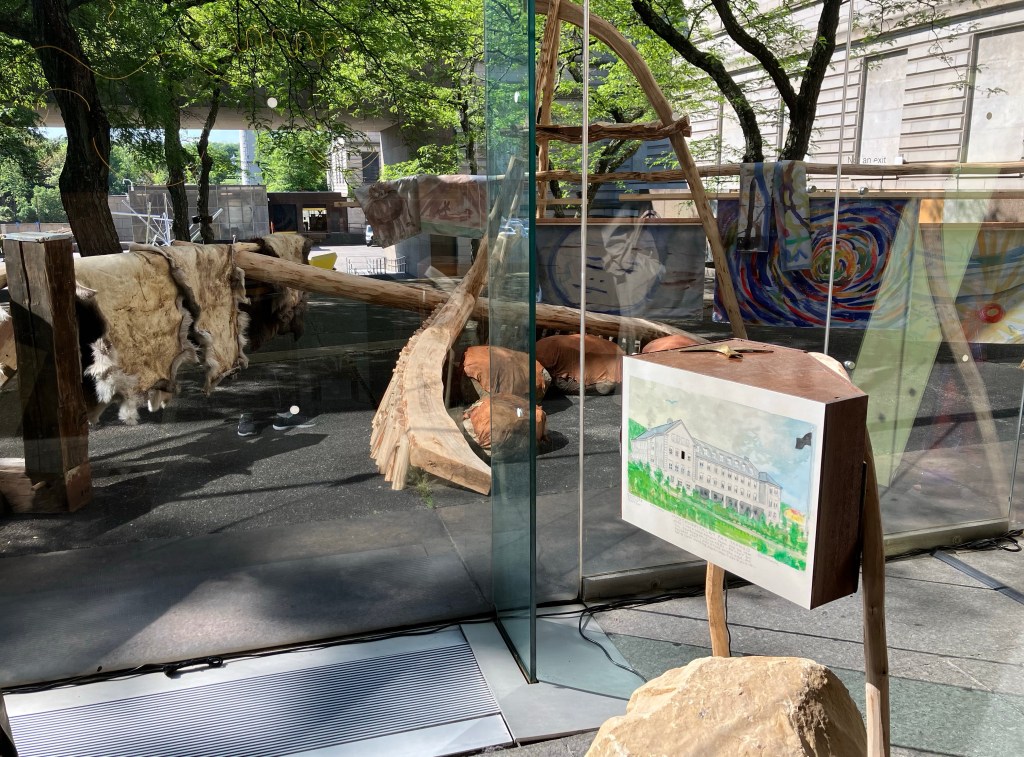
[Inuit-Canadian artist asinnajaq’s installation that straddles CMOA’s front hallway and the sculpture courtyard outside, much as their art bridges the worlds of Canada and the First Nation. We were blessed with a gorgeous day when we went, so I’m not sure how rain and the elements are handled on the outdoor portion, but considering the native materials involved and the aforementioned general impermanence of the International, I’m guessing that those parts are meant to weather if necessary.]
The title of this year’s International is If the word we, where ‘we’ is not only a unifying word, but also a “porous” and “complex” term that reflects a current geopolitical reality that seems to want to place firm boundaries on who or what is encompassed by it. Like the 2022 International, the 2026 version sees art as a force of, if not unity, at least a puncture point in the plans of those who look to build barriers between us.
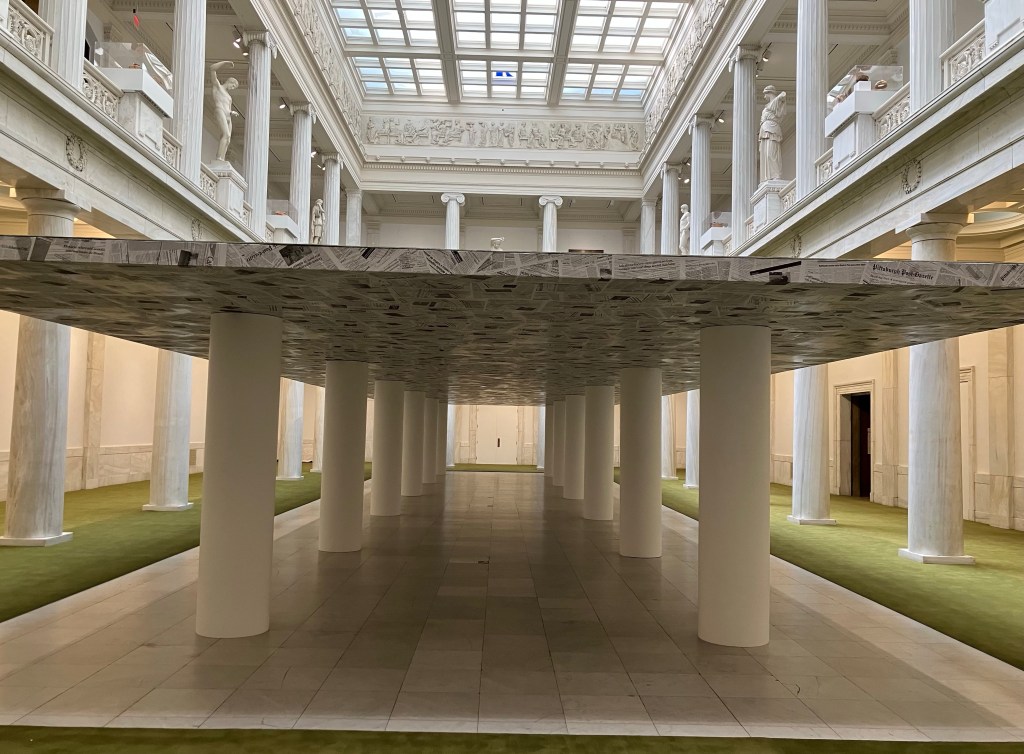
[Green Hall Annex, Cinthia Marcelle (2026)]
We move fifty feet forward to the Hall of Sculpture and to one of the few pieces that I was “spoiled” on before I arrived, but a preview glimpse of Brazilian artist Cinthia Marcelle’s Green Hall Annex only whet my appetite to see it in person. I couldn’t believe that they managed to top the balloon and photography installation of right? and Hiroshima Triology from four years ago as a dynamic use of this wonderful space, but here we are. Marcelle uses architecture within architecture to comment on violence and power, using green carpet of the model used in Chamber of Deputies and the Ministry of Foreign Affairs of Brazil, recently renovated following damage from antidemocratic protests, which covers an underside plastered with pages from the Jornal da Câmara, the Pittsburgh Post-Gazette, and other American and Brazilian media talking about this event, January 6th, and other fascist violence.
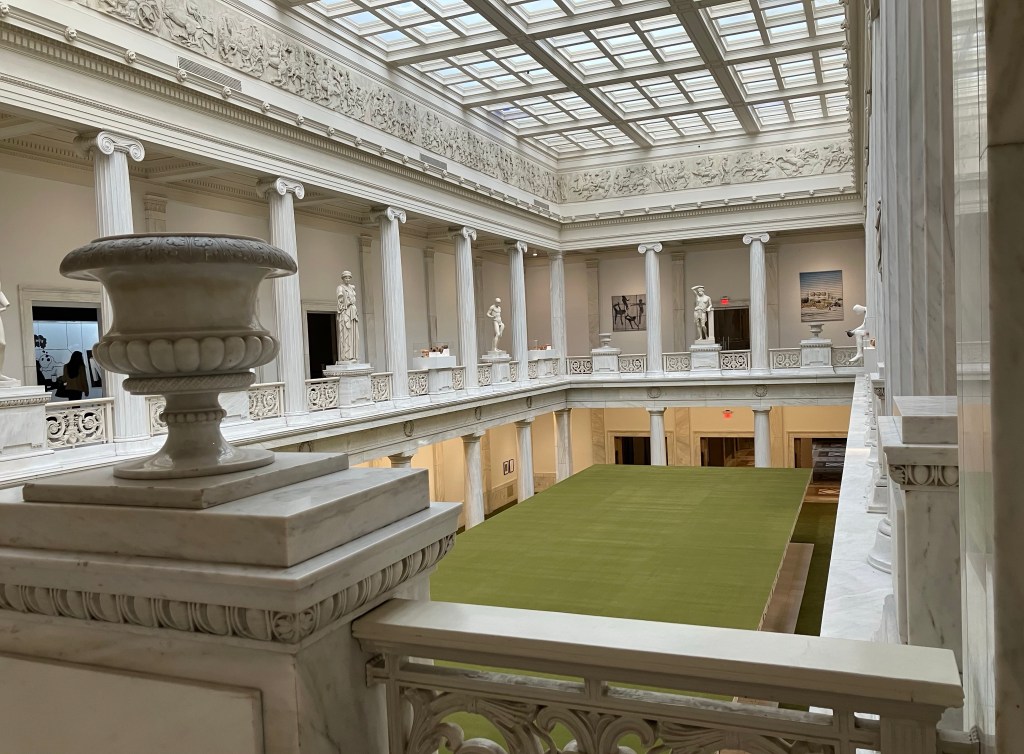
[Green Hall Annex from the balcony]
From the Hall of Sculpture’s balcony, the frissons and dissension are covered by the officious bureaucratic carpet, and even at eye level, the marbleesque columns lend the structure of democracy a grandeur in keeping with the facades of order in the western world, often exemplified by the “restrained” beauty of the classical art that lives in the hall. It’s only by looking deeper, investigating further, that we see the dissent and disunion beneath.
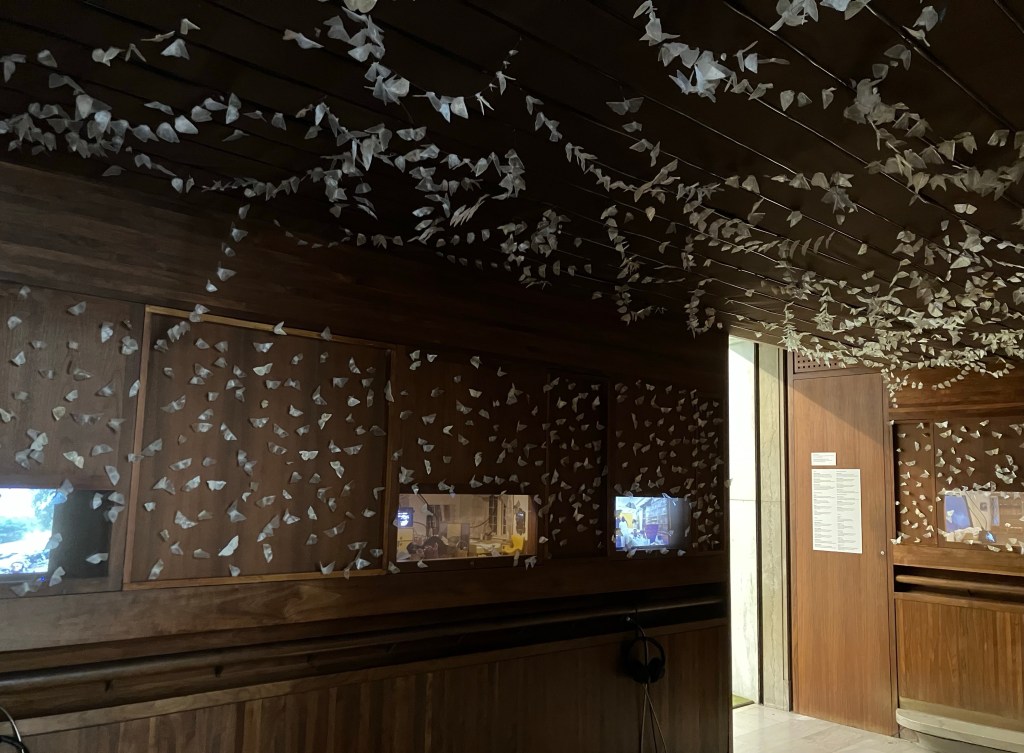
[DOCTORS HAVE THE RITE TO SUCK, Miller Robinson (2026)]
Okay, the first part of Robinson’s installation is where I started to lose my mind (affirming). Look at this whimsy! Taking the unavoidable tweeness of Sarah Scaife’s rich lady antique miniatures of her rich lady mansion and turning it into… this! What an inspired use of a usually flyover space! Not only taking a glorified closet and filling it with resin and bone butterflies (moths?), but changing the miniature room tableaus into almost microscopic worlds unto themselves. As genderfluid two-spirited Karuk/Yurok artist, Robinson uses traditional coastal native crafts like basket and bead work (we’ll see more up top when I go back to the Sculpture balcony) and transforms it into what they refer to not interdisciplinary art, but rather “antidiscplinary” art, something without static boundaries or labels.
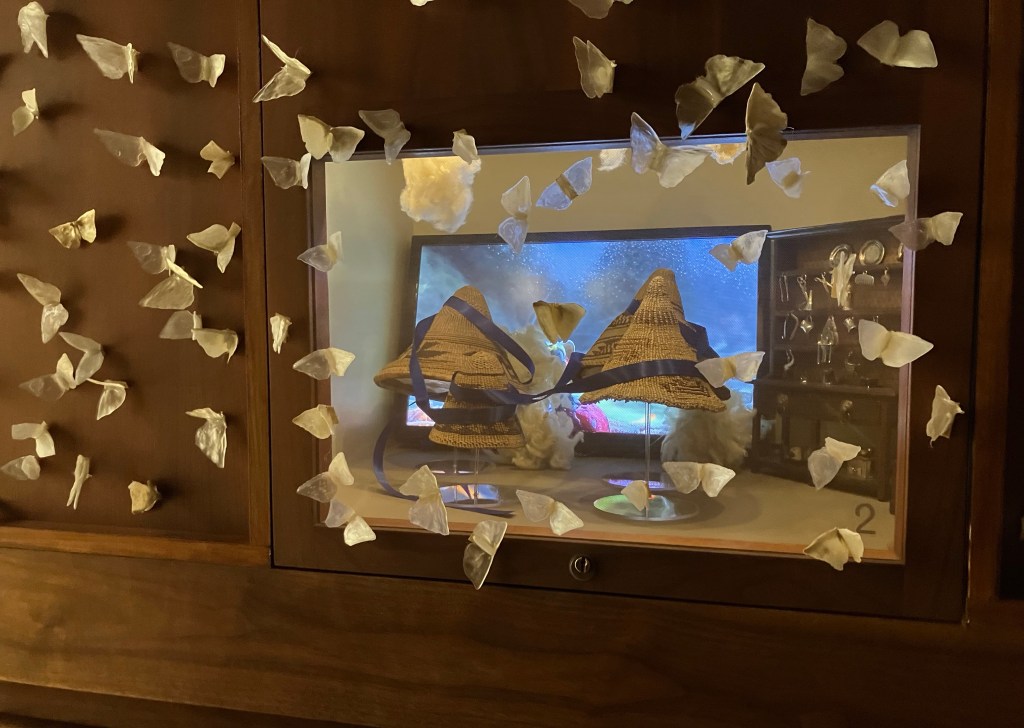
[Closeup on one of the made-over tableau]
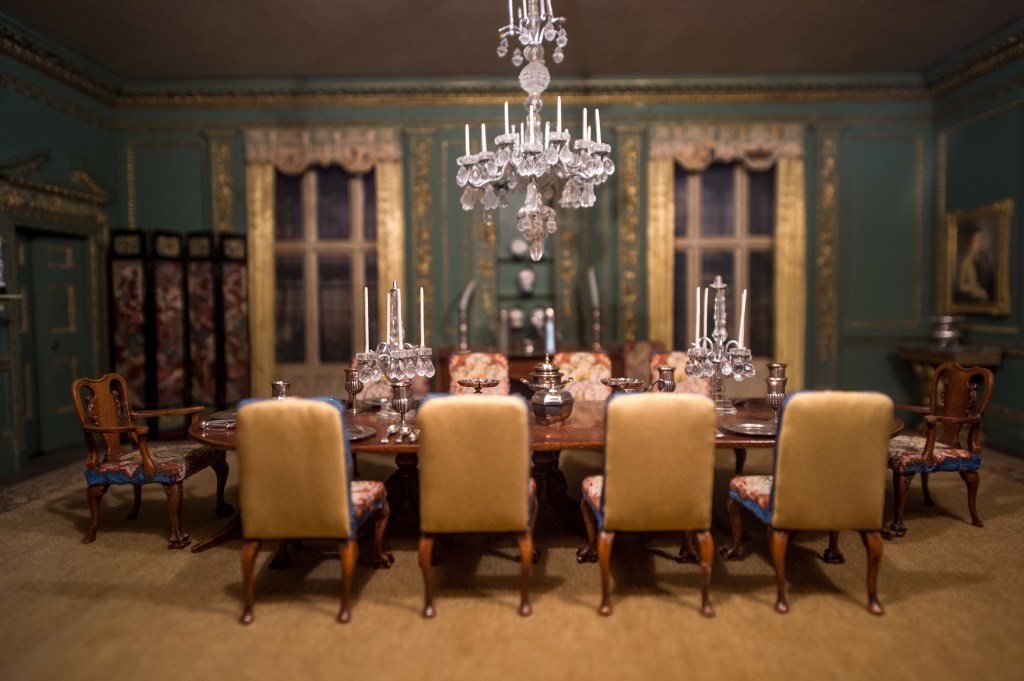
[Compare with the kind of thing we’re usually looking at in here]
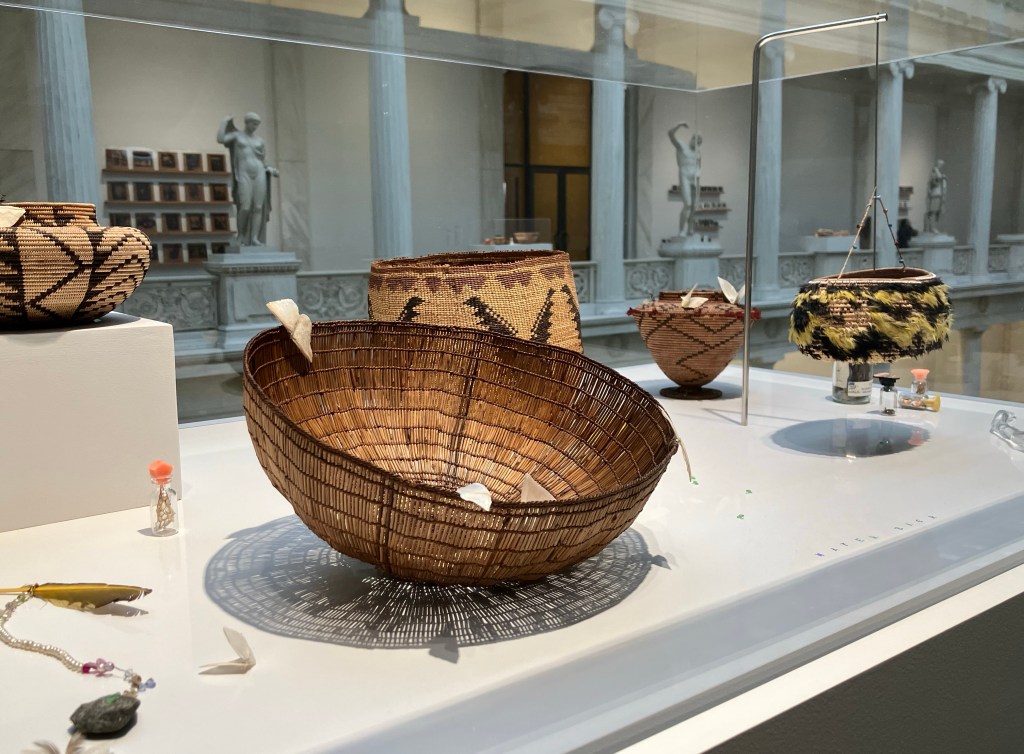
[Also part of DOCTORS HAVE THE RITE TO SUCK, one of Robinson’s six or eight enclosed basket arrangements on the Sculpture balcony. See how the bone moths are here too for continuity? See also how this indigenous art interplays with both the permanent Greco-Roman sculptures of the space, as well as the mixed media Black photography of Liz Johnson Artur (Black Balloon Archive, 2026)]
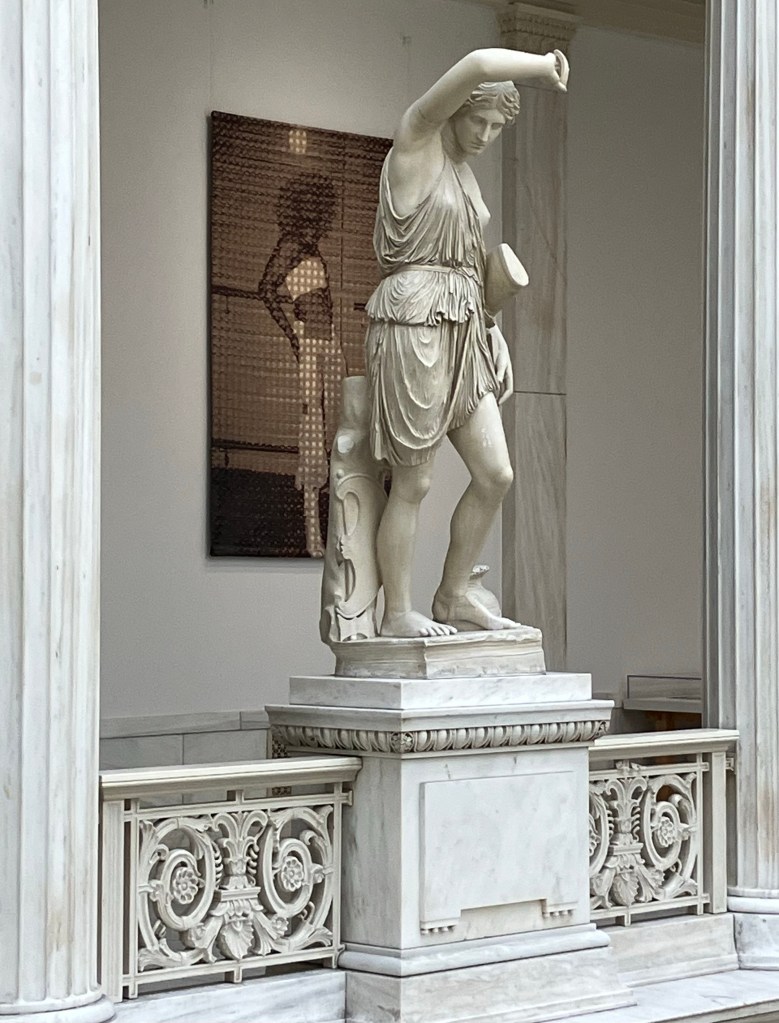
[Part of Black Balloon Archive and plaster cast of the “Wounded Amazon” type]
Back in the Miniature Gallery, I was just getting a grip on myself when we exited into the Hall of Architecture and found—lo and behold—that it was being used as more than storage space!
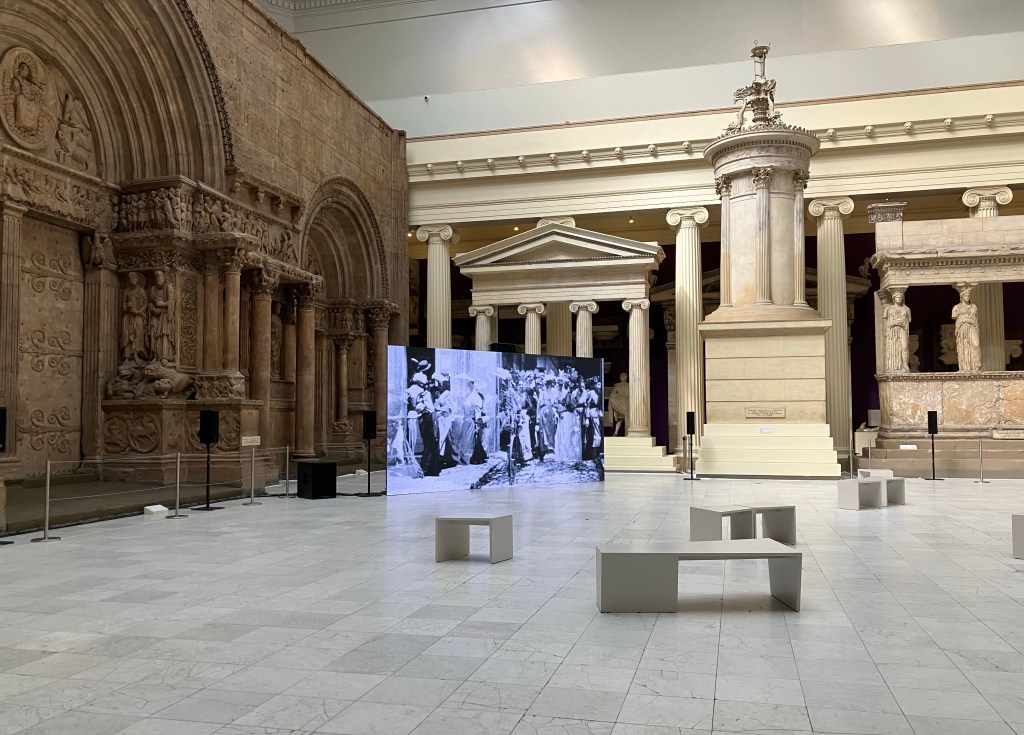
[Ahhhh!]
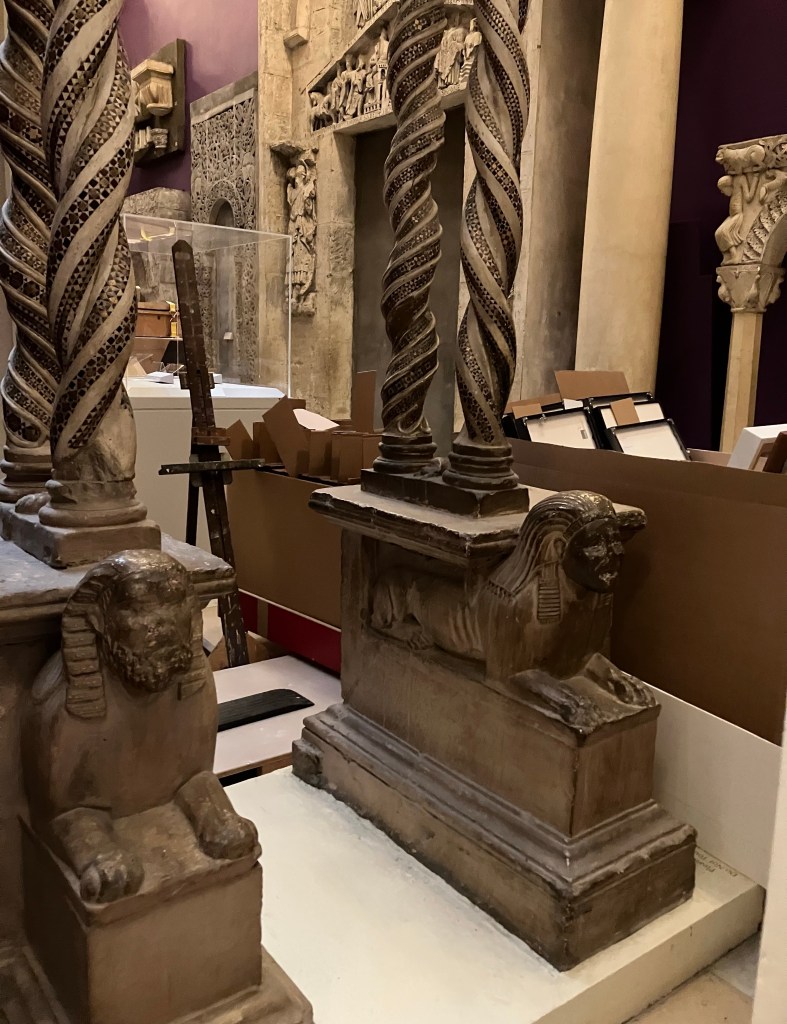
[Okay, still also being used for storage space, too…🙄]
Just like the Miniature Gallery, this year’s International finally thought to use the dramatic staging of the museum’s most underutilized (unless it’s the holidays…) space! Unfortunately, though I hunted around my favorite haunt looking for the artist (or heck, the title) of this film installation, I didn’t find it, and frankly I was so arrested by the visual contrasts that I gave up pretty soon to just let it wash over me. There was an extended visualization of the character of Carmen as a fictional construct, but it also tied in with bull fighting and industrialized labor. Loved the contrasts again with its Classico-medieval setting, and how the contrasts weren’t as seismic as you might imagine.
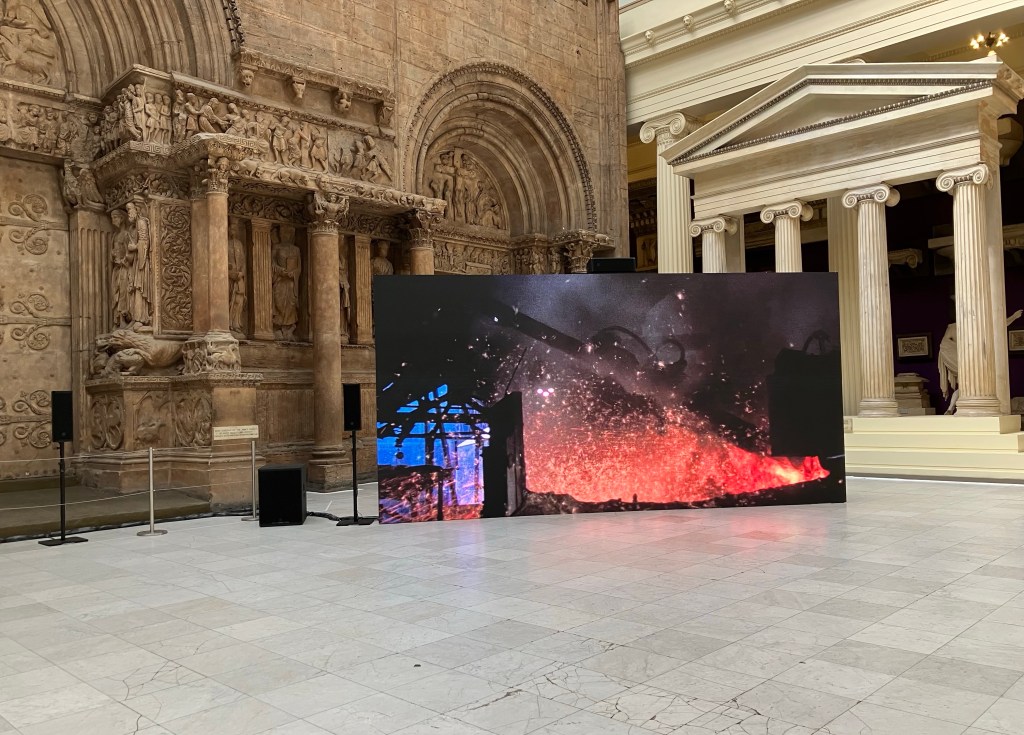
[CMOA, Andrew Carnegie’s baby, is always in tension with Pittsburgh’s industrial past.]
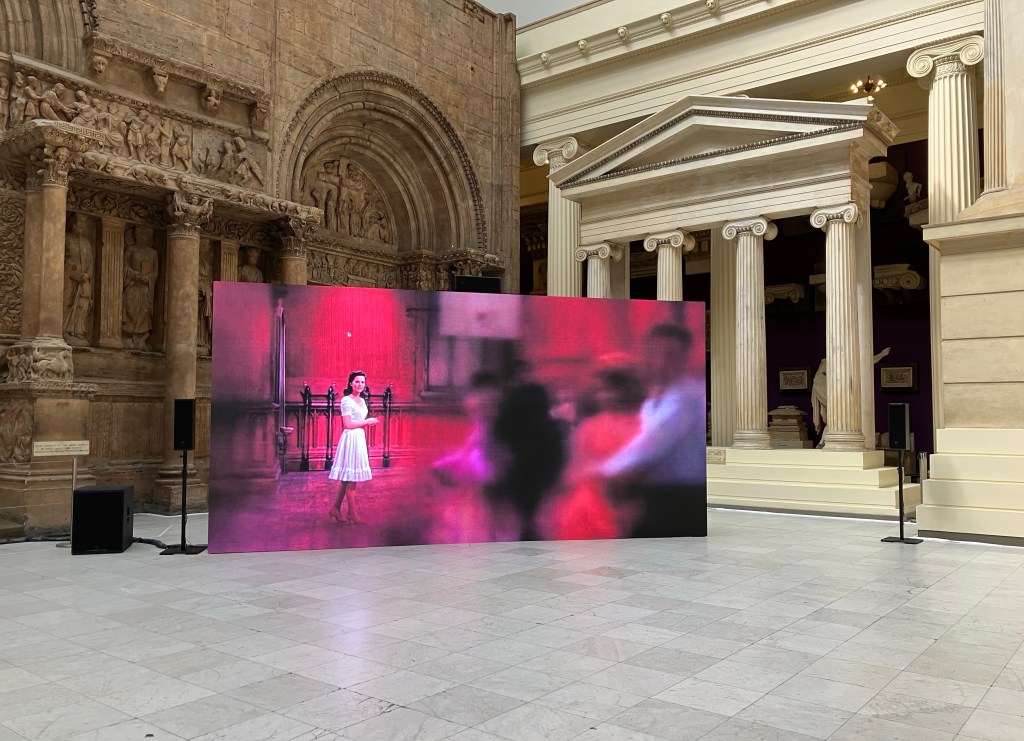
[The Hispanic Carmen-figure of Maria from West Side Story (1961) with classical plaster cast figures of beauty and desire (and ultimately limitation) like the Venus de Milo and the Erechtheion Caryatids just out of frame.]
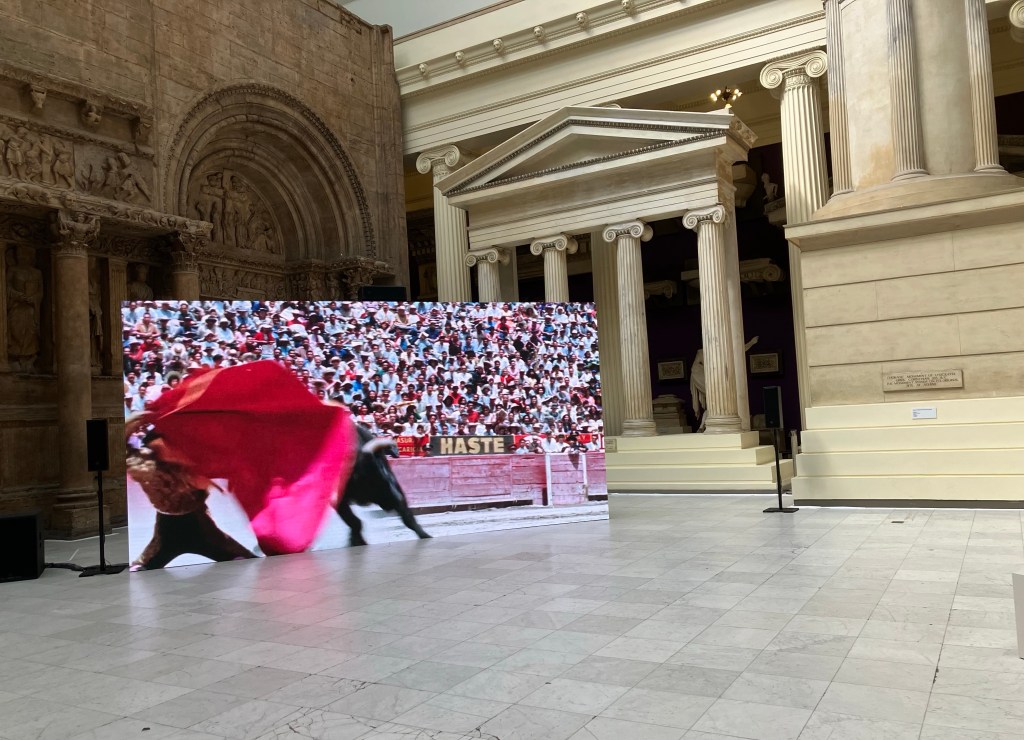
[Modern Spanish bull fighters alongside a Minoan/Cretan art space, blending of sacred bull mythos.]
God, we’ve barely made it off the ground floor yet… because we also got waylaid at the bottom of the Grand Staircase—a nontraditional installation space that was used last time around, mainly for feminist icon Kate Millet’s mannequins and Daniel Lie’s natural fiber tapestry work. This year, we have another stop-in-your-tracks piece of meaningful whimsy: Hyun Nahm’s Puppeteer (Archipelago).
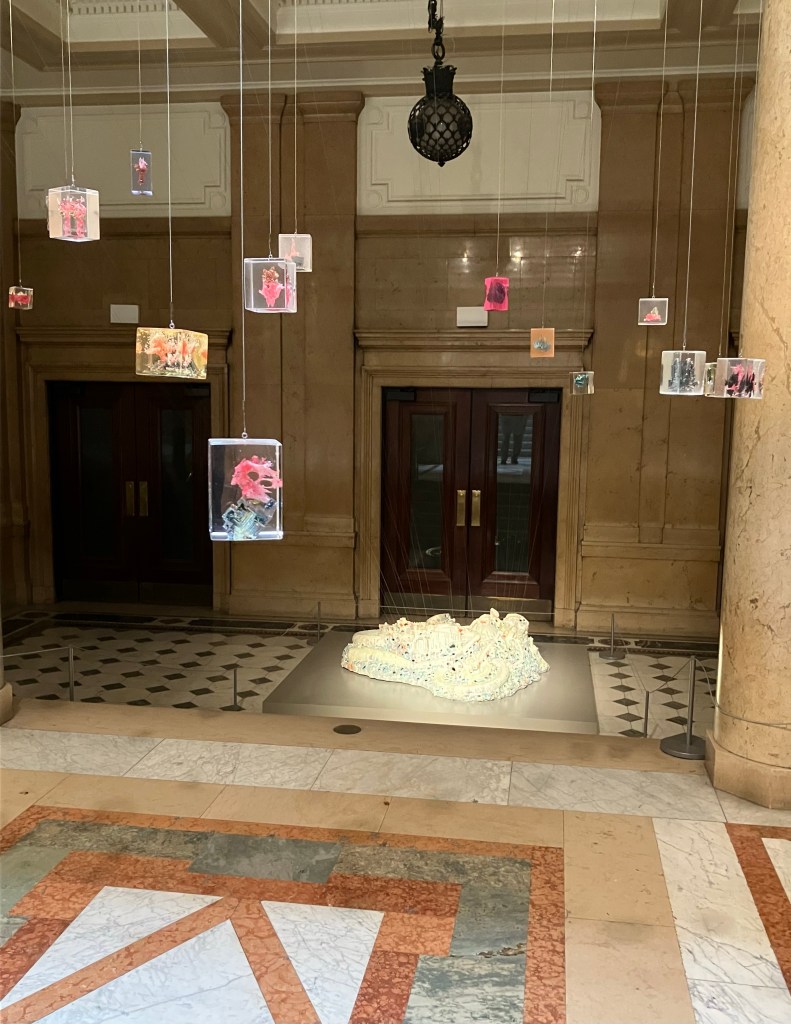
[Puppeteer (Archipelago), 2024/2026]
Made of polyurethane resin, sulfur, and insects, Puppeteer is another installation with so many tiny parts that you have to spend a long time taking it in. Nahm is Korean, but this piece was born during an artist’s residency in Indonesia and his fascination, much like Miller Robinson, with so-called “miniscapes” (縮景). Taking snapshots of urban decay and postcapitalist ruin, the focal point of Puppeteer (Archipelago) is melting sculpture of motorcycle parts rendered amorphous by Indonesian volcanic sulfur. But branching out from this in a scattered eruption are dozens of suspended resin cubes filled with small manmade objects, mineral samples, and preserved insects. Indonesia is equatorial, but the resin boxes are arranged to mimic the placement of the northern constellations as a juxtaposition of capital and divisions of labor that often characterize the line between the global north and south.
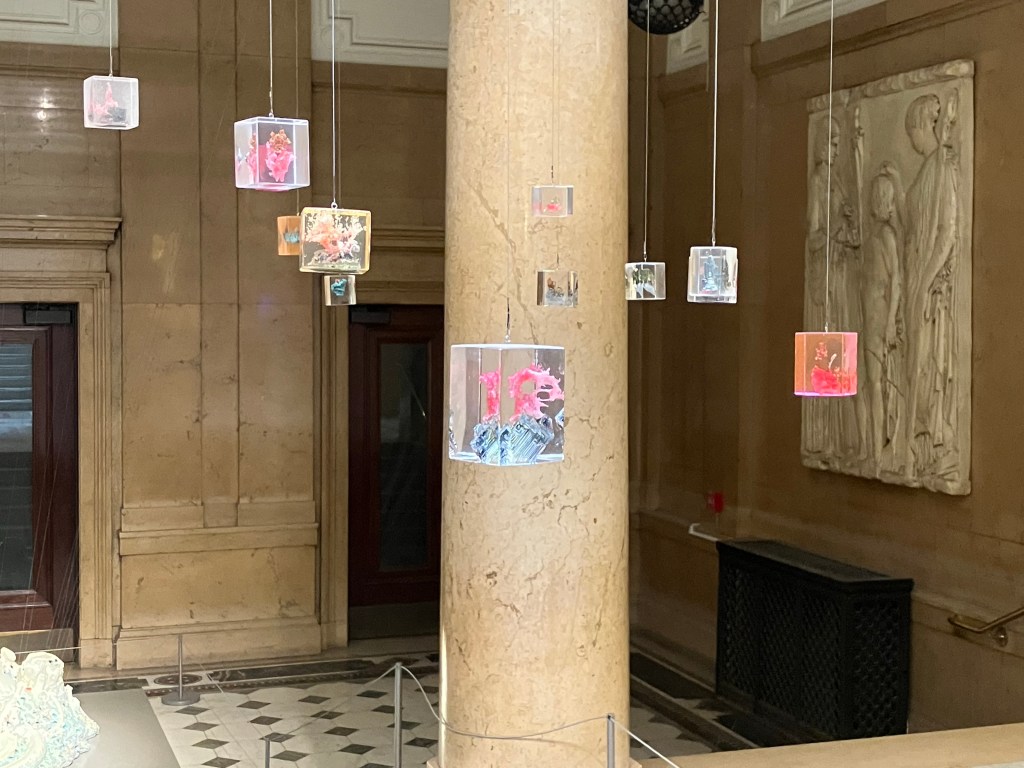
[Detail of Puppeteer (Archipelago). Difficult due to its breadth and the implication that we were meant to hold to the perimeter of the resin part of the installation, it’s hard to fully encompass, but the objects in the boxes are also specific references to some of the constellations’ forms.]
After Puppeteer, we can finally head up to the second floor, and I’m going to have to rapid-fire a little more to keep this any kind of reasonable length. But that’s not a terrible thing as upstairs in the galleries, most of the pieces are staged in much more traditional, though still interesting ways.
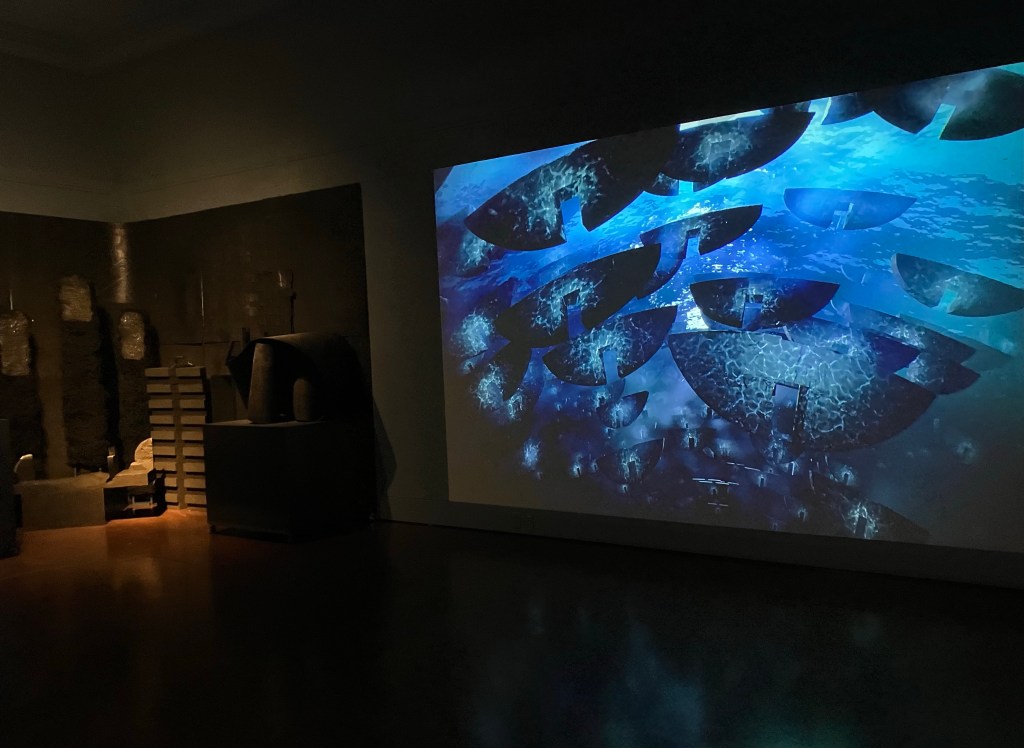
[Also, there are multiple audio and video installations that were harder to get still photography of that must really be experienced. (part of Flight, Shala Miller (2026), an examination of flight as an escape and as a power in Black folkloric traditions)]
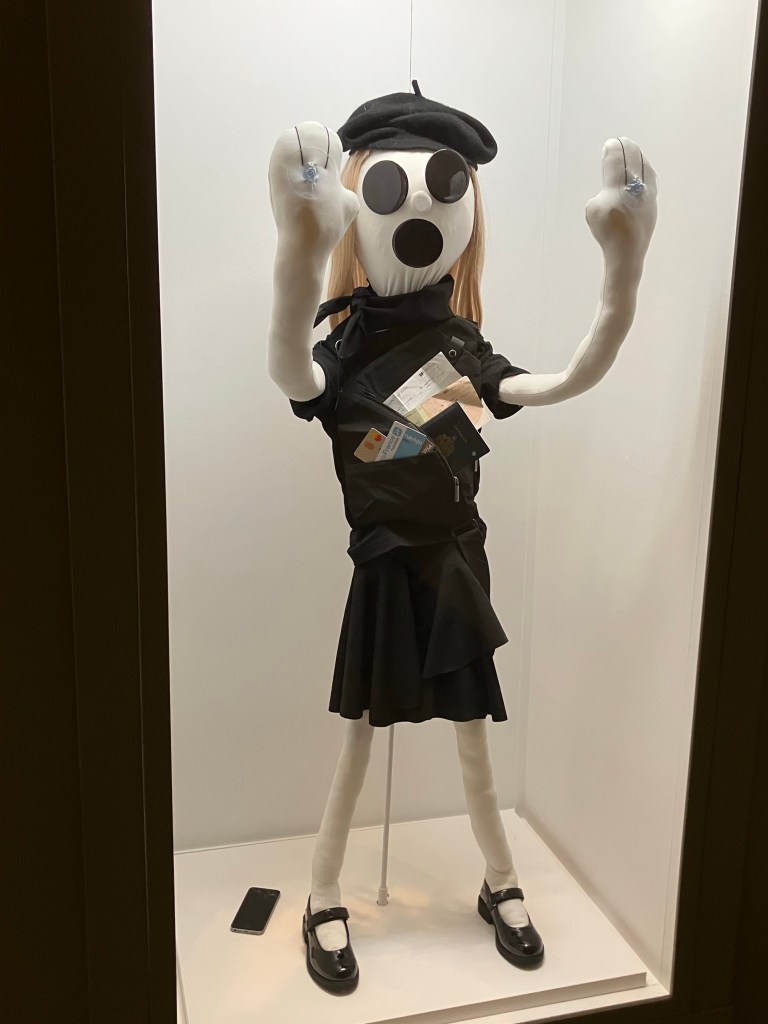
[Walter Scott’s Euro Trash Girl (2026), placed in a stairwell off the Sculpture balcony, who made me laugh out loud.]
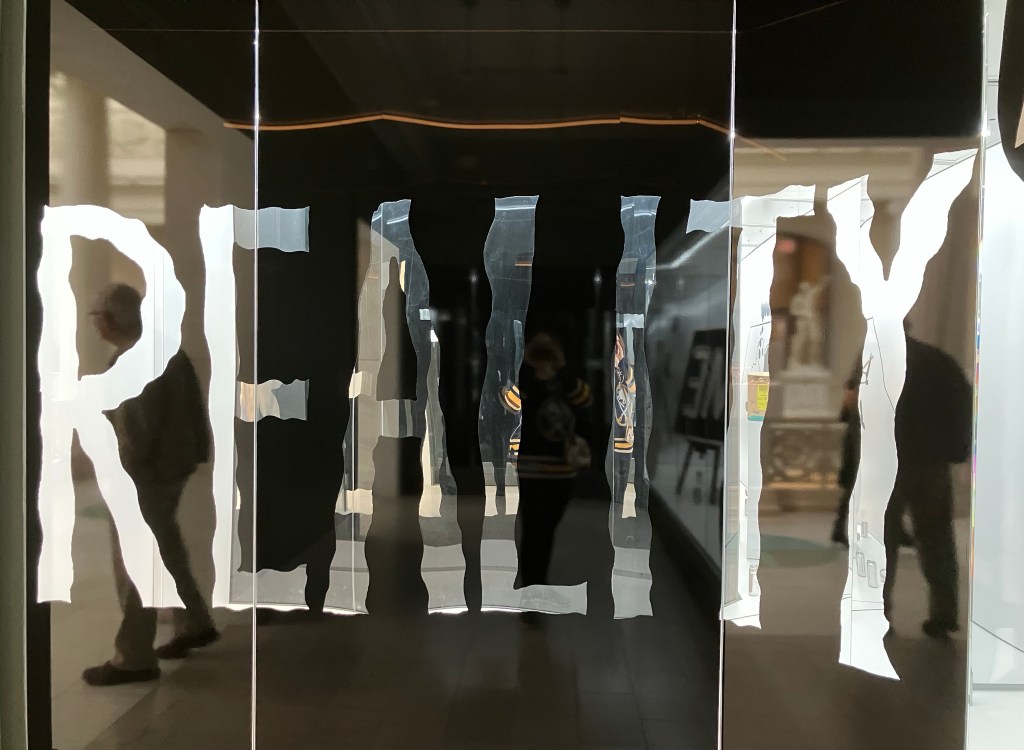
[Part of Scott’s other installation in the Charity Randall Gallery. That’s me in the reflection, high on my Buffalo Sabres ending their 14-year playoff drought. RIP 2026 Stanley Cup contender Sabres…🦬]
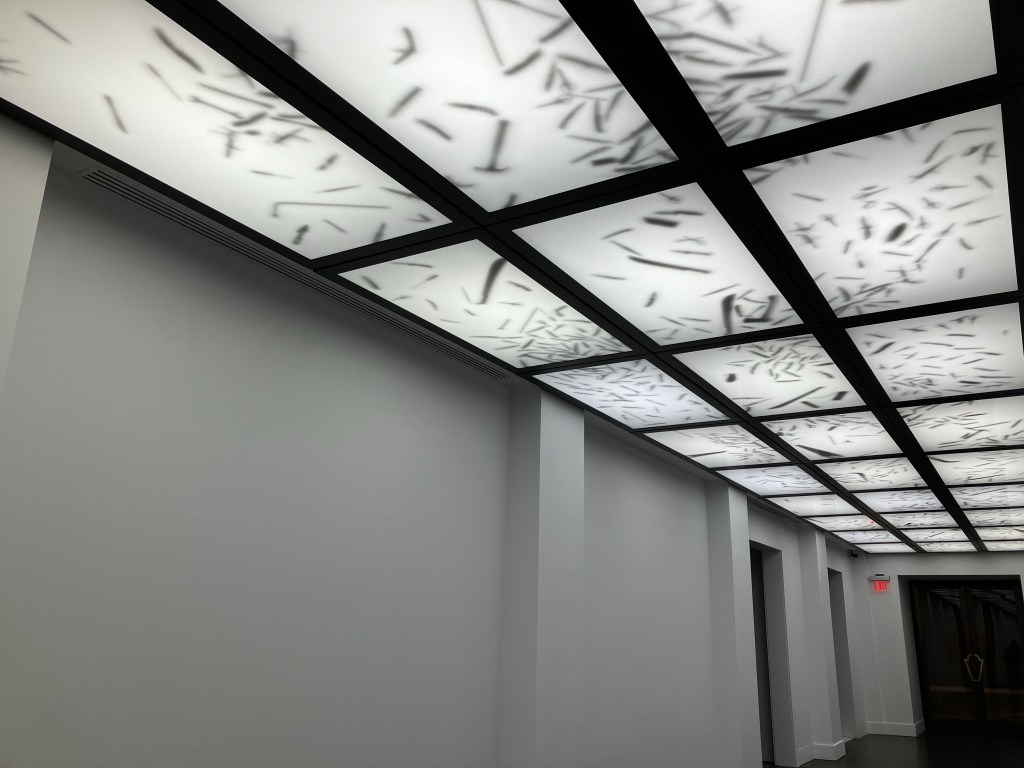
[Across the balcony in the Heinz Architectural Center, we have Ana Raylander Mártis dos Anjos’ Justiça (2026) as a ceiling light installation of weaponized objects which CMOA says are meant to ask the question: who gets to define justice, and who is permitted to enact violence?]
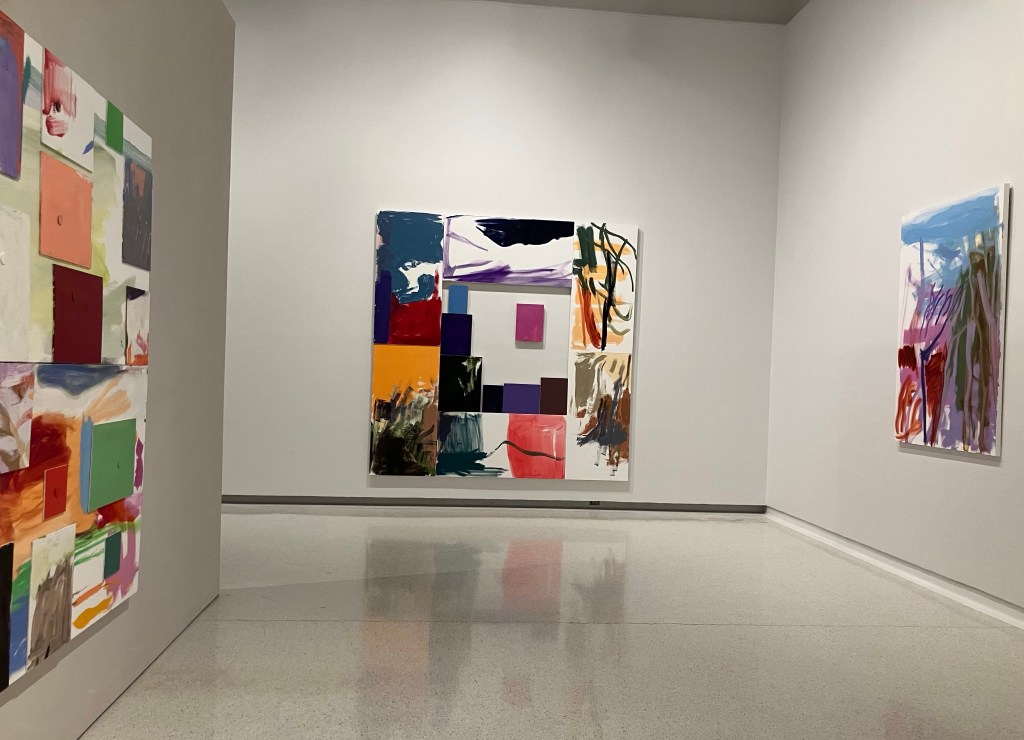
[Now in the Heinz Galleries, there is a huge spread. Too much to contain in a single entry, but I love the color and diptych-reminiscent structure of RJ Messineo’s commissioned paintings for the International.]
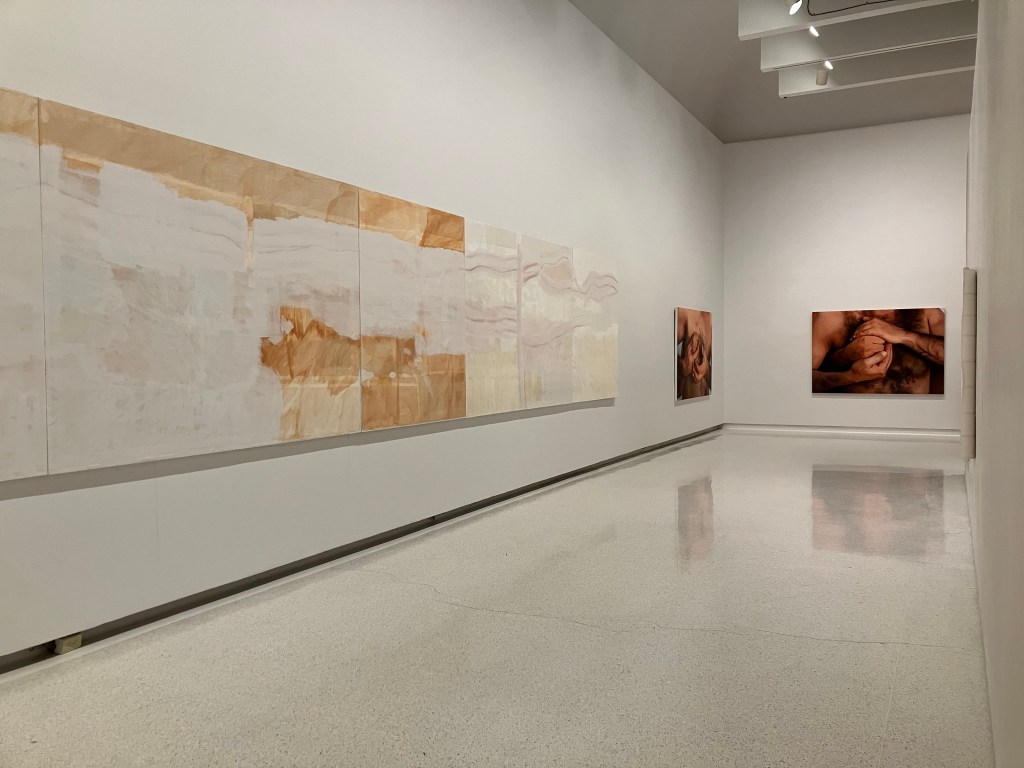
[Long view of d harding and Jordan Upkett’s 35ft Untitled (Private Painting J1) (2019/2026), made of indigenous Australian natural materials on canvas; and part of Palestinian artist Khalil Rabah’s series Making a Right Heart (2026) on the far walls.]
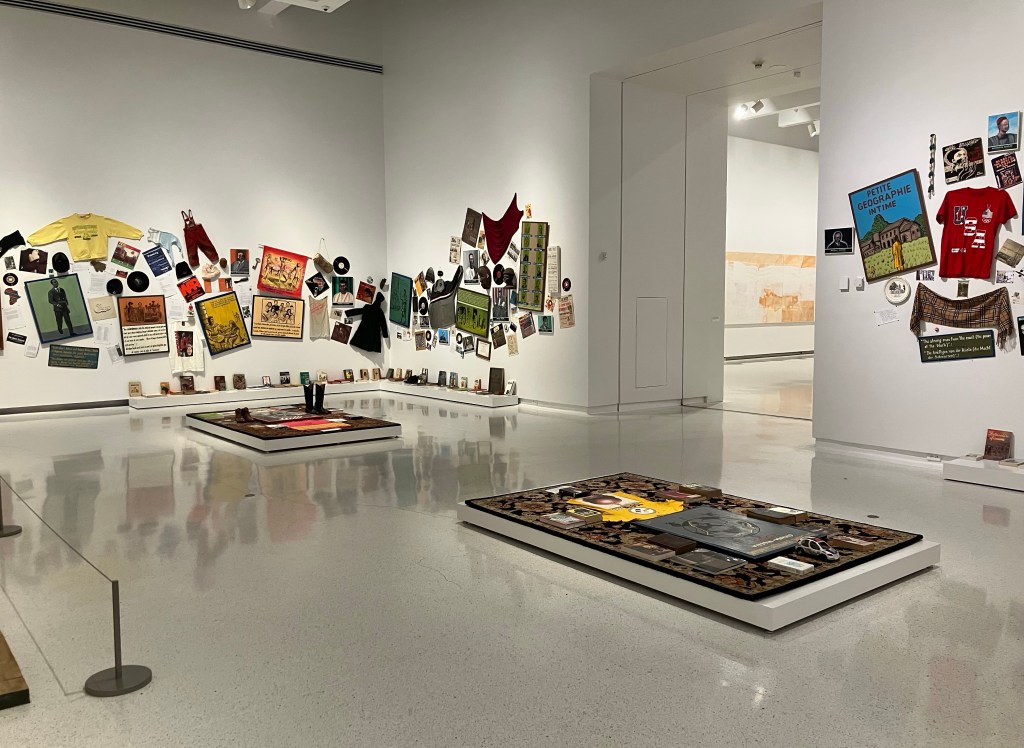
[A small part of Georges Adéagbo’s collage work, Le Socialisme Africain (2001-4/2026).]
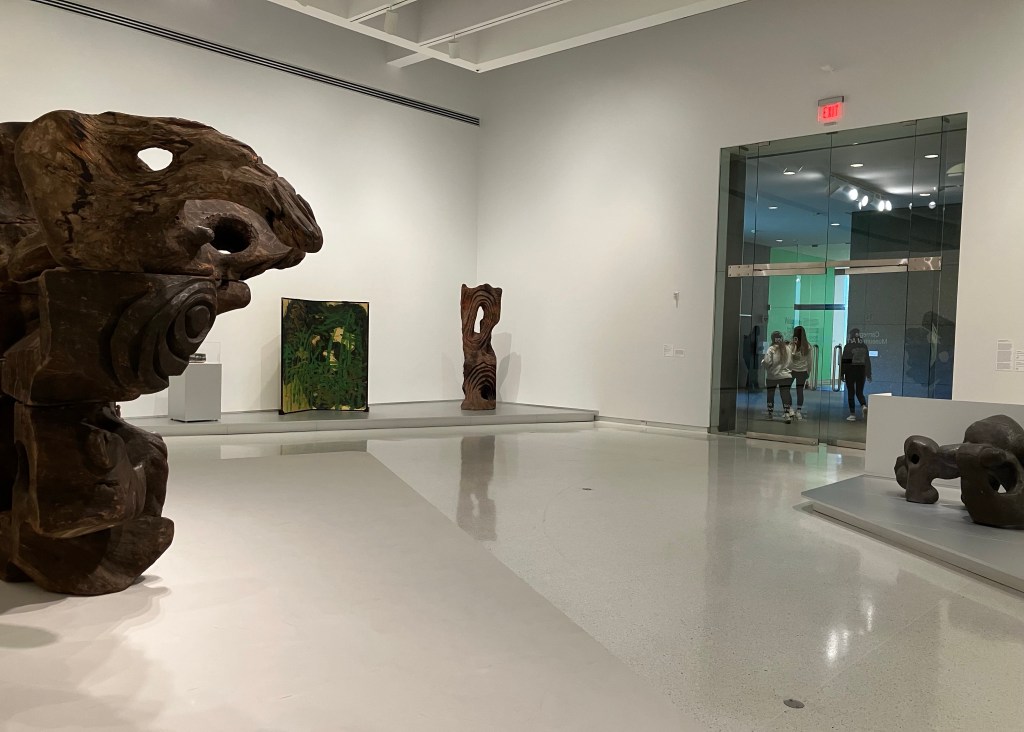
[Behind view of Sofu Teshigahara and his legacy Sogetsu Foundation’s large scale ikebana installations. Ikebana in its most simplified form is the art of Japanese flower arrangement, but Teshigahara took a long view of the art as an individual’s relationship to their environment and what they came into contact with. I loved every piece in this room, but after I took this picture, I saw signage that I couldn’t tell if it asked for no photography or simply no flash photography. So I erred on the sign of caution with potential apologies for this one. These wood and bronze sculptures, and the folding screen are just beautiful, though.]
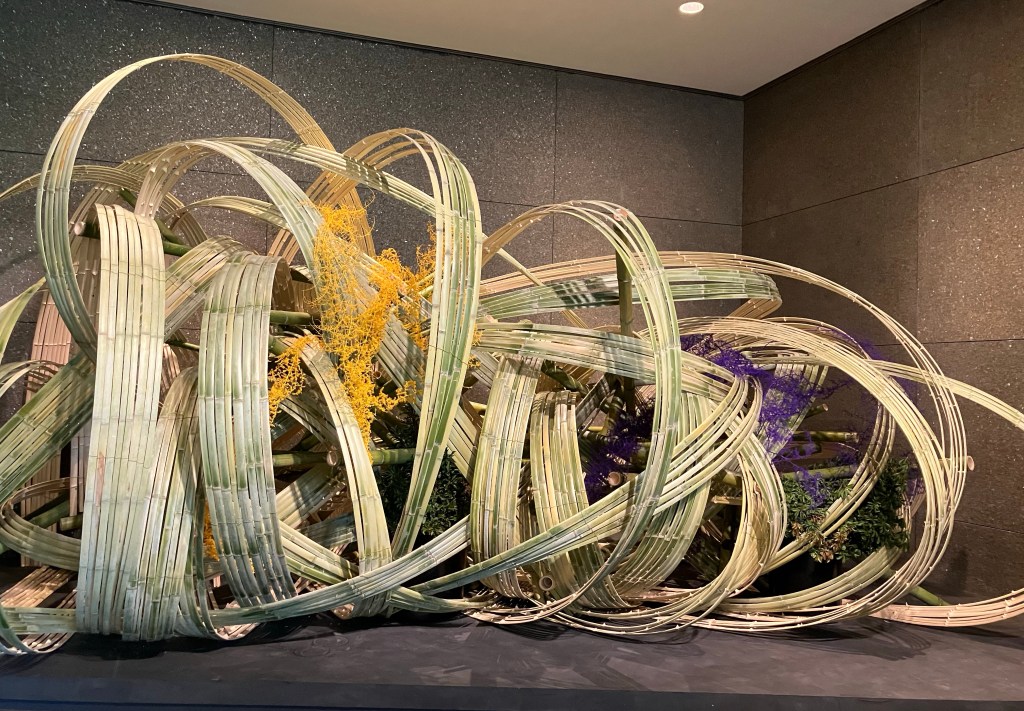
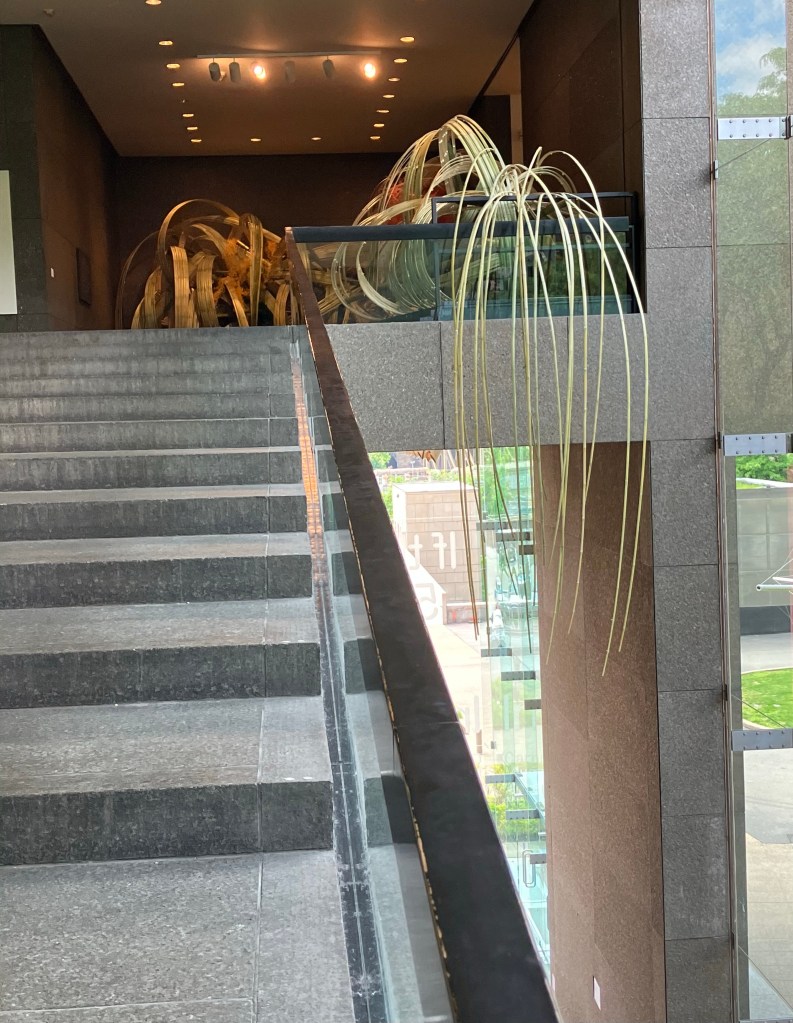
[Outside in the hall, we get some amazing mega-ikebana in the form of large living bamboo sculpture from Kenjiro Katayama. Though, it’s May in Pittsburgh, which means if I turn my back too long, this is what my side yard will look like🎋]
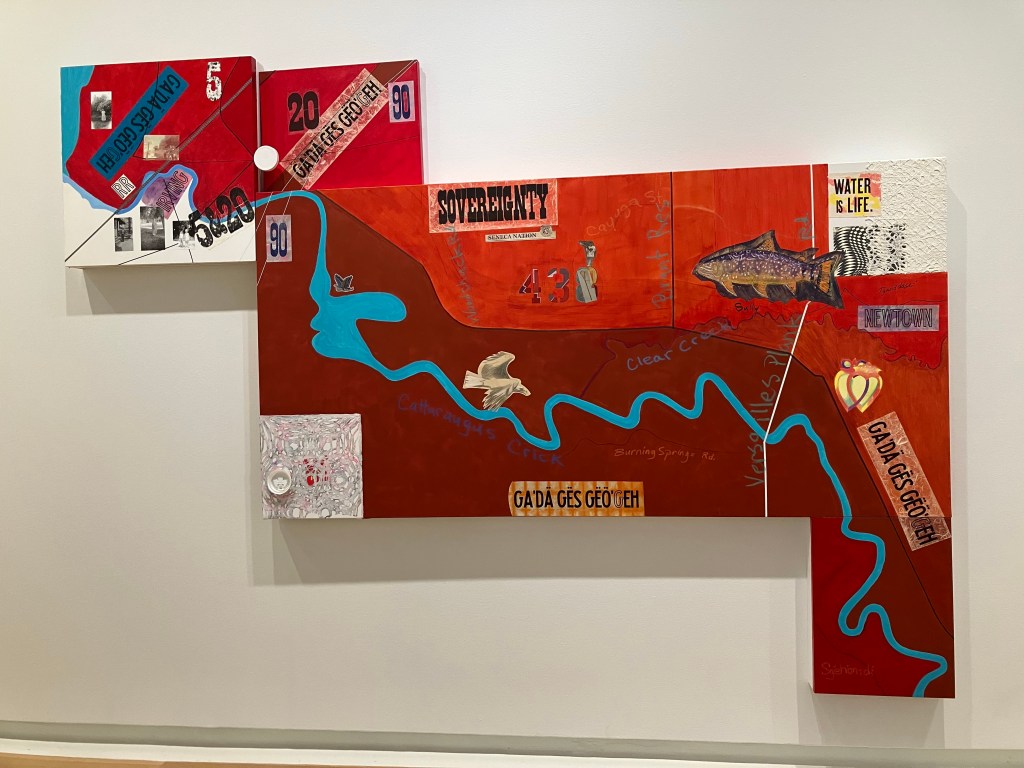
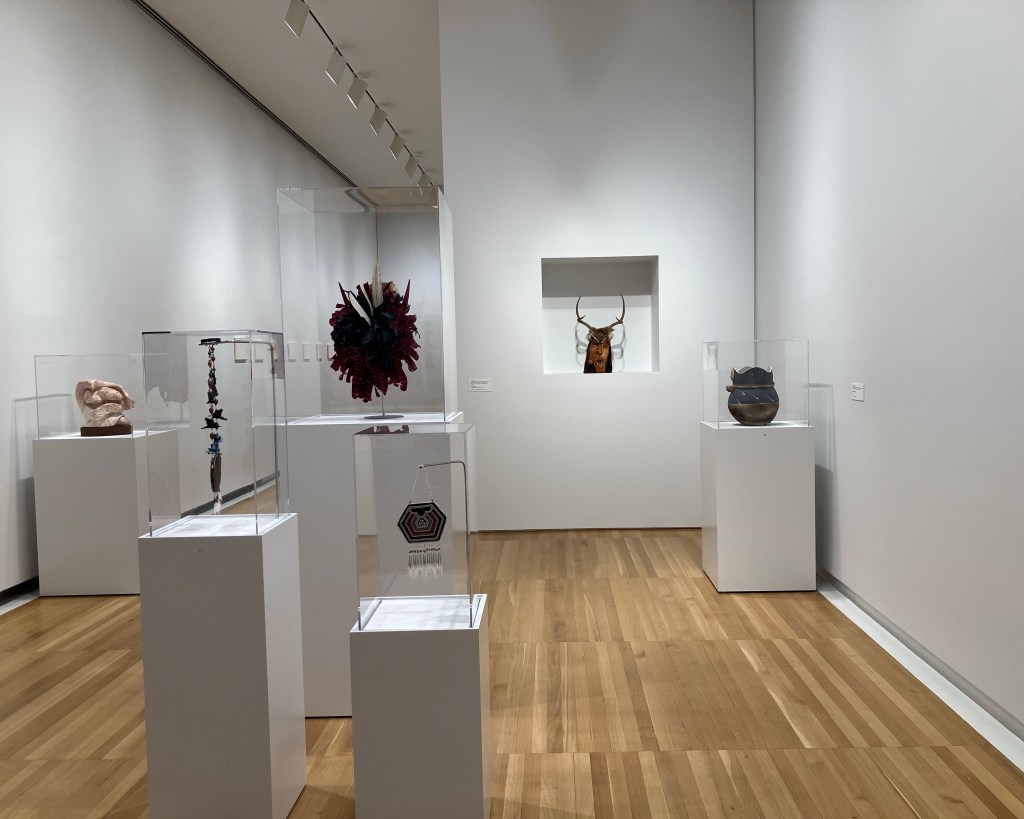
[Crossing over at last into the Scaife Galleries, we have more Indigenous art from regular collection artist G. Peter Jemison (Heron Clan Seneca/Haudenosaunee), as well as from several other Mohawk, Seneca, and Kiowa artists below⬇️ I especially love Katsitsionni Fox’s clay jar of Sky Woman in the rightmost case.]
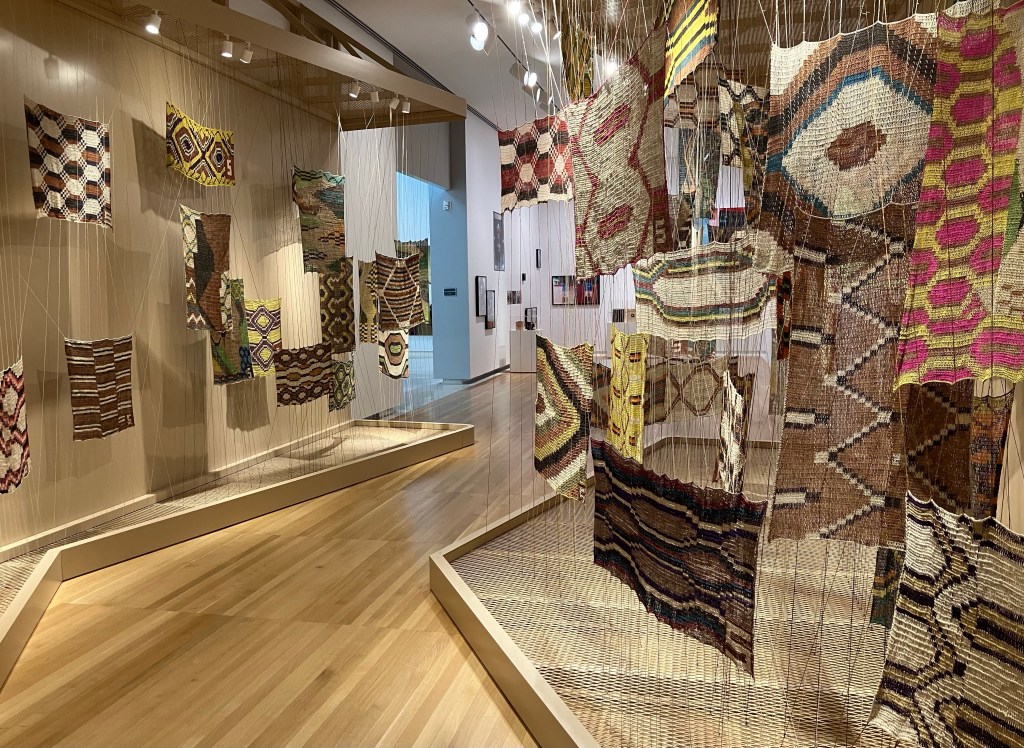
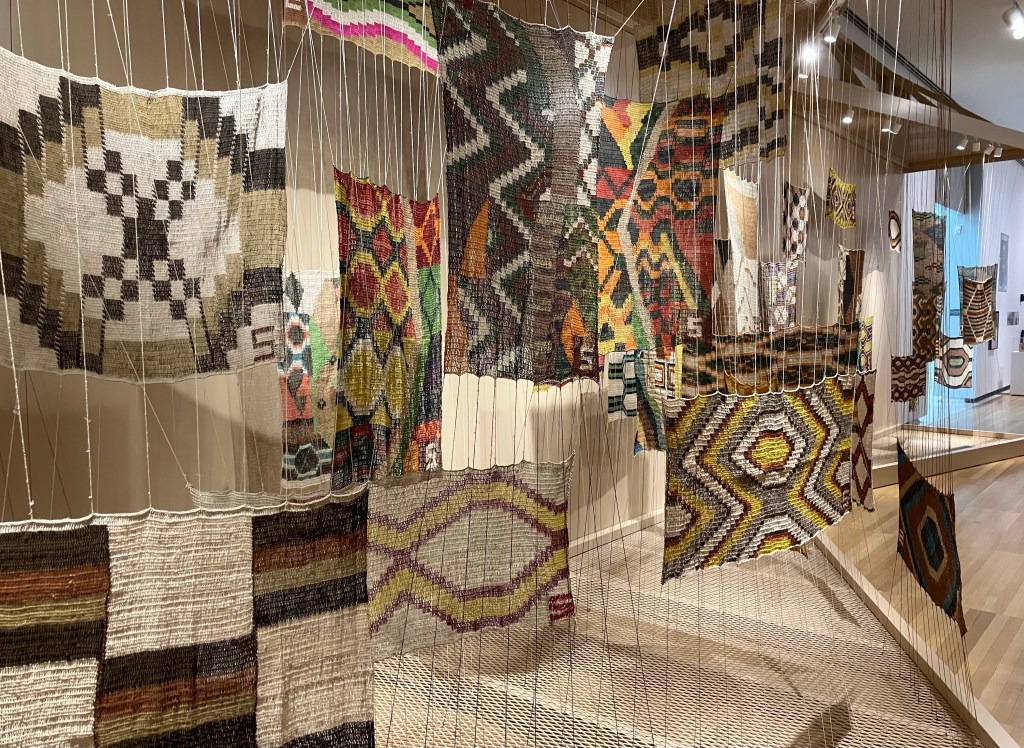
[But the real stunner in this part of the gallery is Tewok: the river we weave (2026),the extensive installation of 102 individual woven pieces made by Argentinian artist Claudia Alarcón and the indigenous Wichí women of the Silät collective. Drawing from the natural forms and materials of their ancestral lands spanning the Argentinian/Bolivian border, each piece has been woven by a member of the collective, and together they are meant not just as handicrafts of memory and continuity, but the various forces and tensions that interplay with the past and the present. I could’ve spent an hour just in this room.]
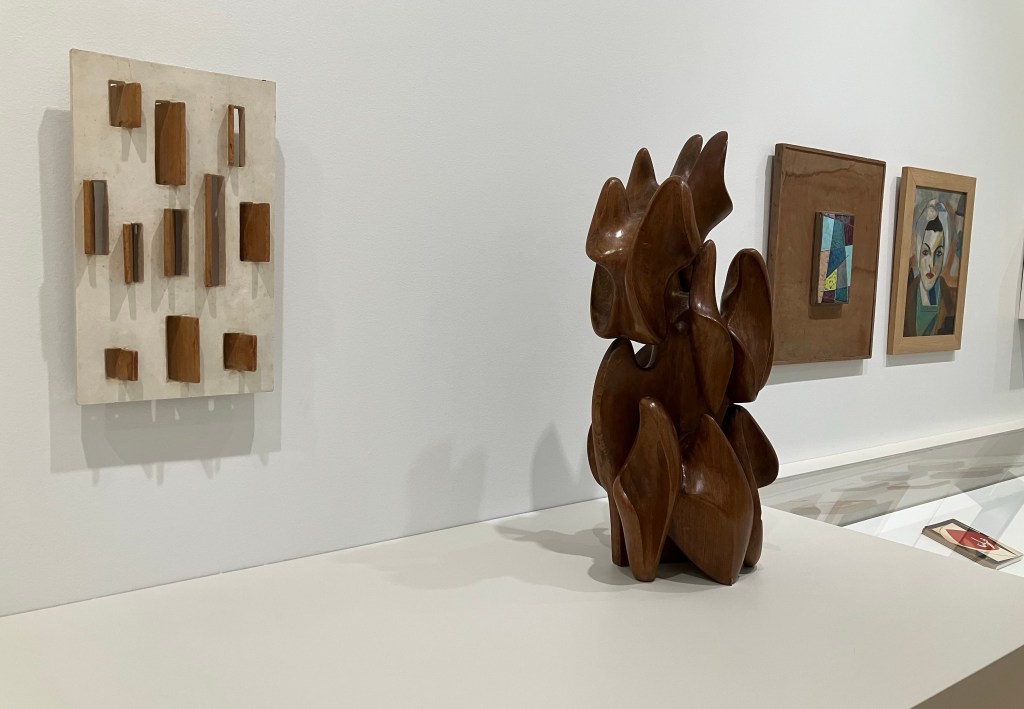
[In the next wing, we have a wide-ranging mixed media collection of art from Saloua Raouda Choucair, a groundbreaking Lebanese artist, primarily known as a sculptor, but also comfortable working in paints, textiles, and metalwork.]
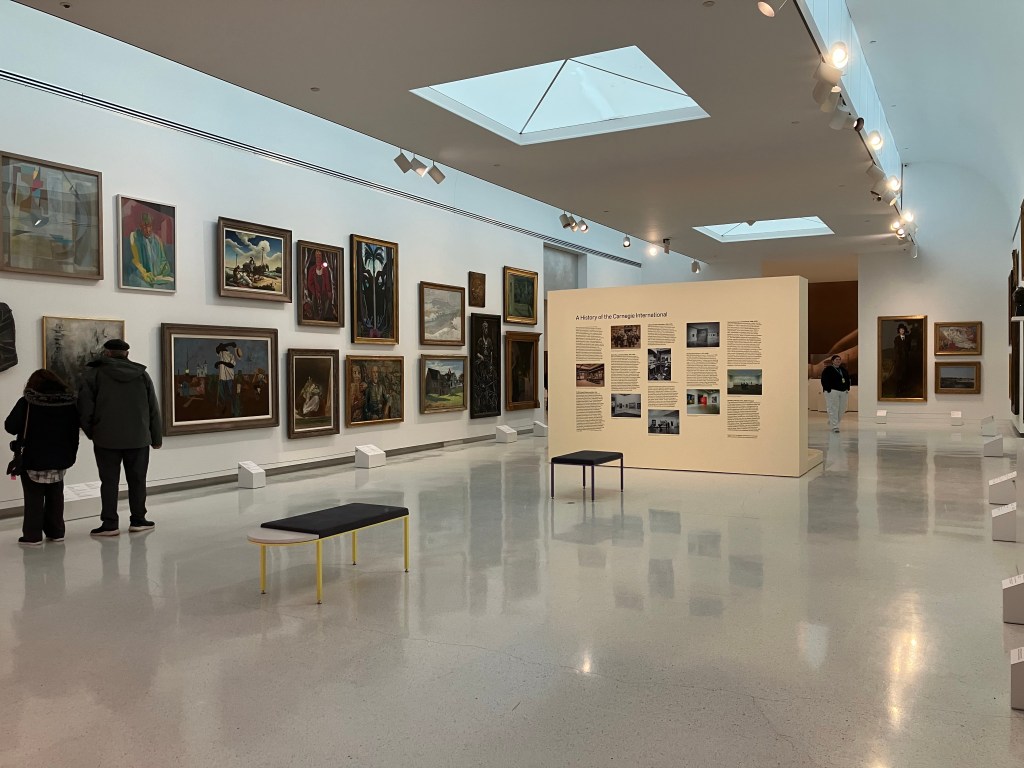
[In the middle of the Scaife Galleries, where most of the remaining regular collection is sitting right now, CMOA also put these “normal” pieces in an arrangement meant to be evocative of how the original Internationals would be staged—as walls of art—while teaching visitors about the history of this one-of-a-kind historic art show. This is also just barrels of fun to walk around…]
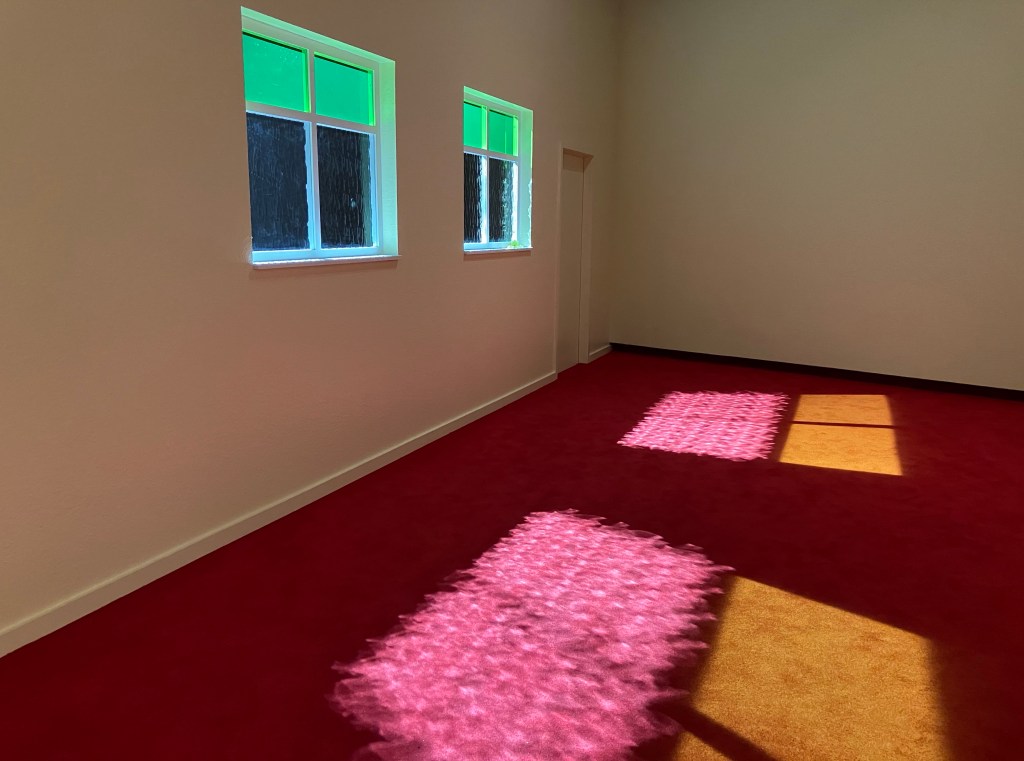
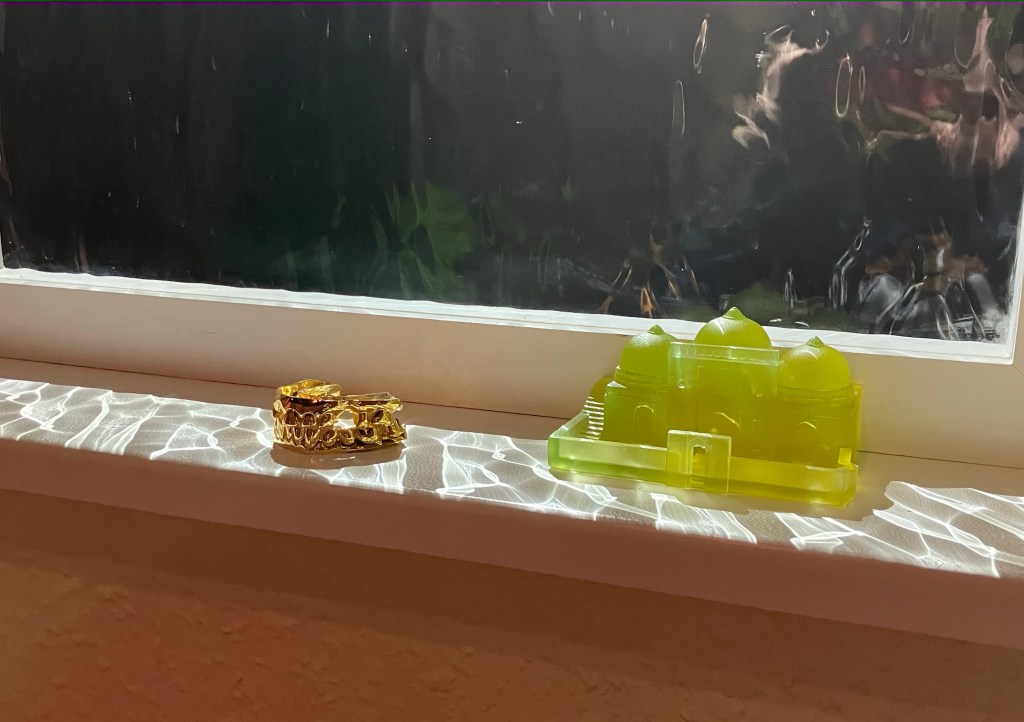
[And in one last nontraditional staging space, this year’s International carved out room in its usually untouched Contemporary wing for some pieces. Including this atmospheric roomscape Supra (2026) by Scottish artist Jasleen Kaur, which seems simple enough on its surface, but is actually interrogating the quiet intersection of the domestic and the global, in part represented by the small uranium glass model of the Babri Masjid, the mosque in Ayodhya, India that was demolished by Hindu nationalists in 1992, set on the eerie faux-stained glass windowsill next to a gold-plated cast of Kaur’s teeth literally set on the edge (of the sill and the situation).]
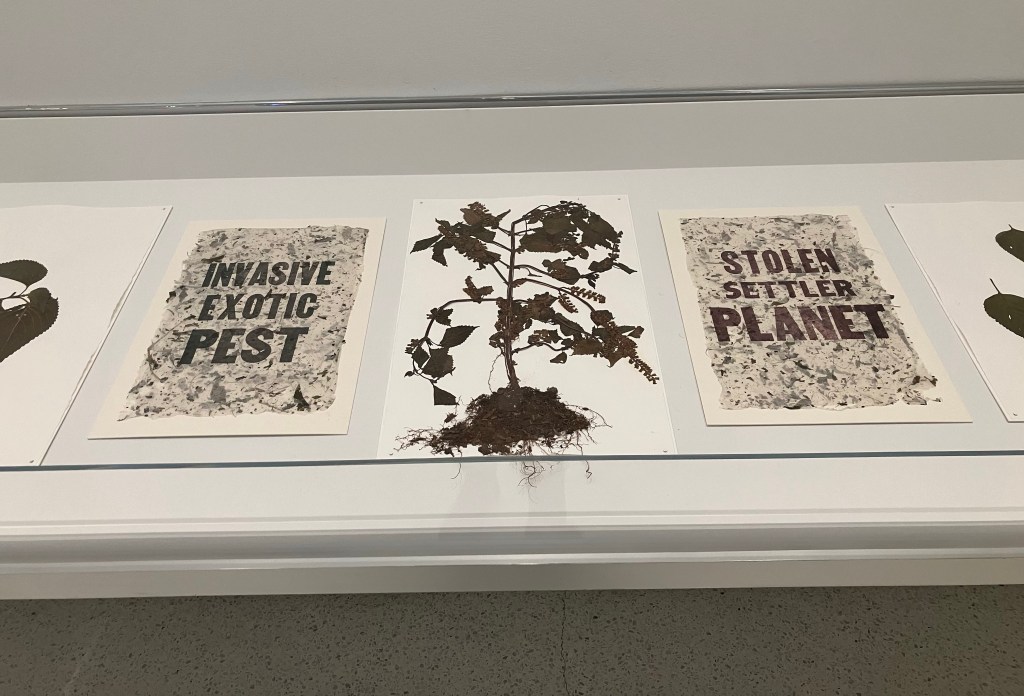
[And very lastly, we have Ginger Brooks Takahashi’s multimedia exploration of lens of immigration through the Carnegie Museum of Natural History’s botanical collection and the study of invasive plant species—
Works from the series Exsiccata Diaspora: Perilla,
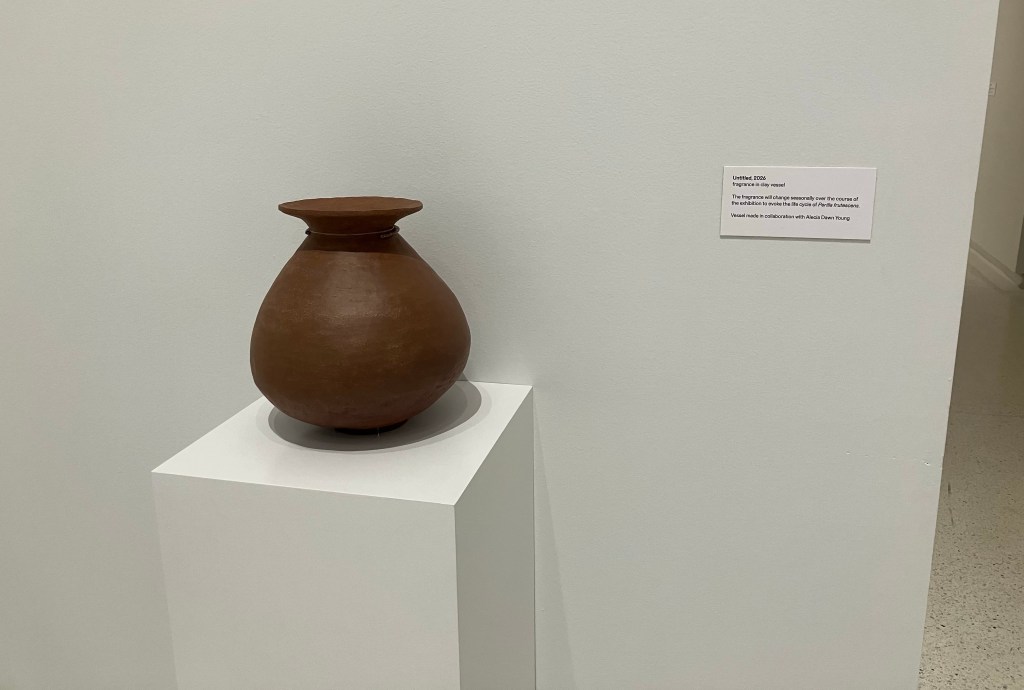
2025-2026. In addition to these plant pressings, their is an ongoing audio interview with Brooks Takahashi on the nature of immigration discourse, and a clay pot made by fellow artist Alecia Dawn Young designed to emit a changing fragrance over the course of the exhibition to mimic the life cycle of Perilla frutescens.]
As I said though, this feels like only a slice of everything I saw, and if you’re anywhere near the greater Pittsburgh metro area, I really can’t recommend enough that you come down and check it out for yourself. I love the International because its perspectives are always challenging in the best way, and it’s a wonderful way to connect with the wider global art scene without leaving Western Pennsylvania. Heck, even if you’re not a local, the International is on until January 3rd next year, and it might be worth the trip (come during the holidays and find out with me what they plan to do about that huge projector screen in the middle of their Christmas tree space in the Hall of Architecture!)
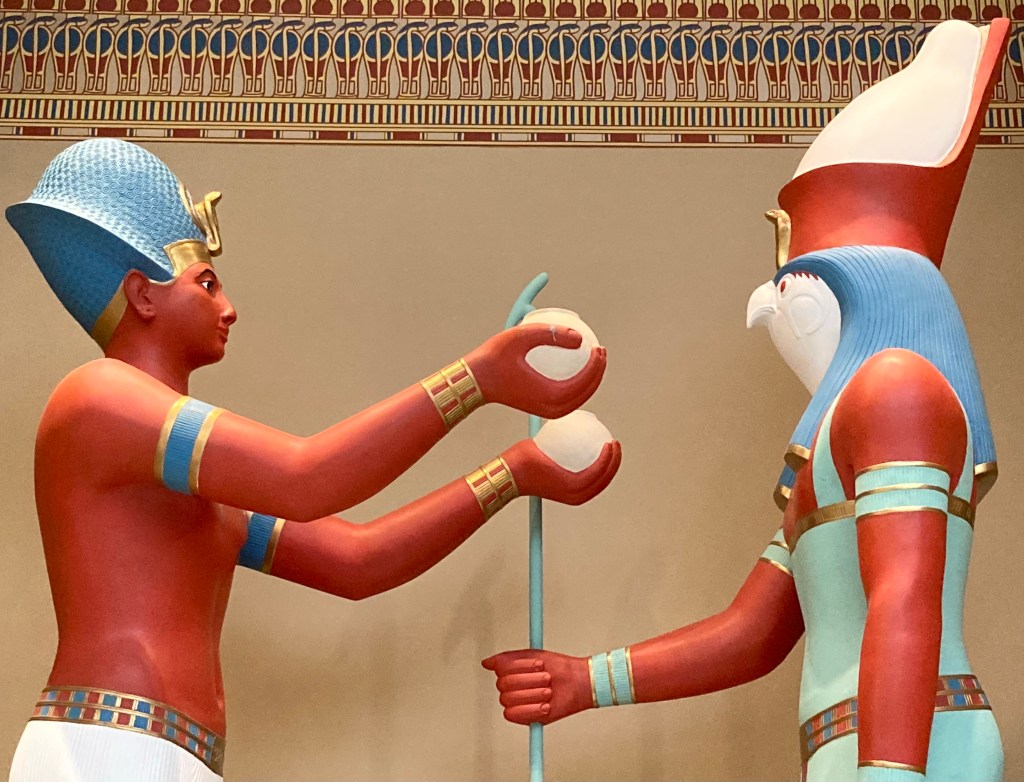
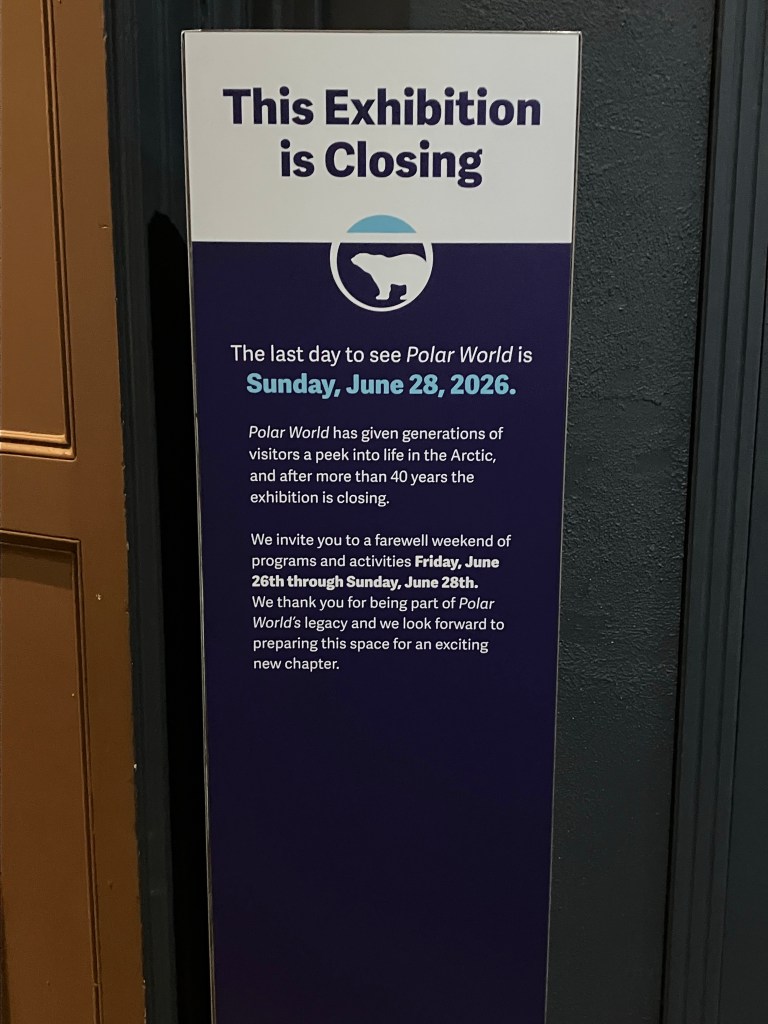
That probably won’t be the only thing afoot, either… because over in CMNH, they took down the giant fiberglass statues of Seti I and Horus outside Walton Hall, so you know the Egypt renovations are picking up their pace. Not to mention that its equally-problematic neighbor, the Wyckoff Hall of Arctic Life, beat my lowball estimate by two years and is closing down for long term major retooling at the end of June. So much change and excitement to look forward to!


Leave a Reply