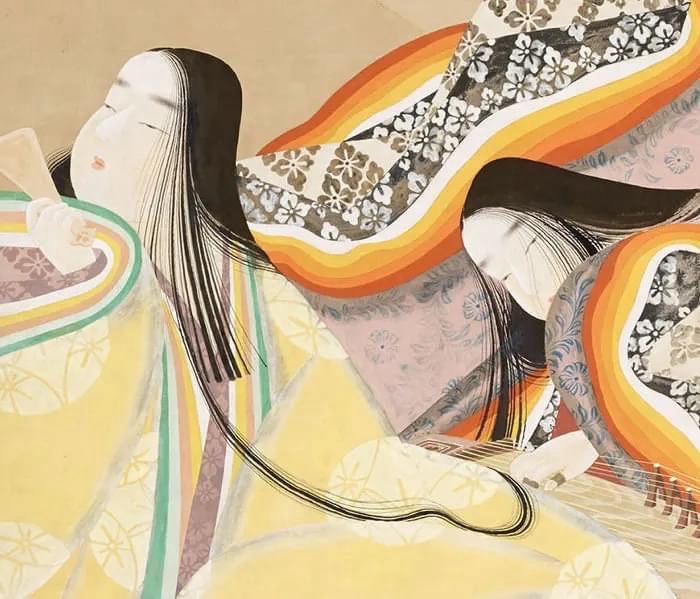
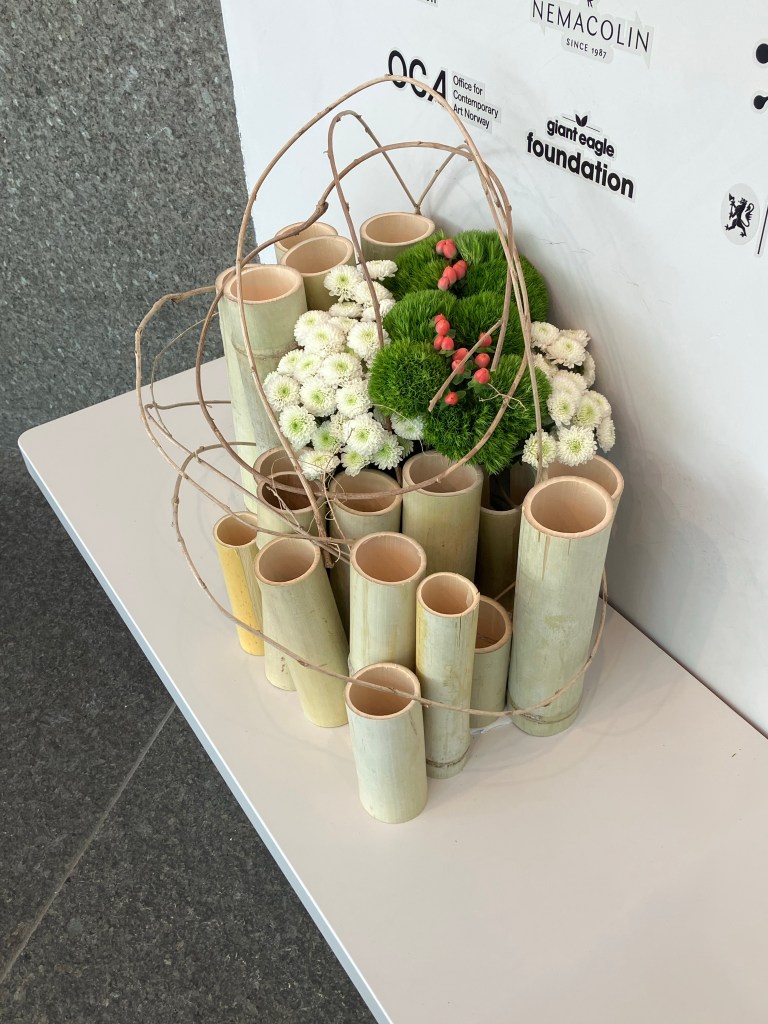
I know that I’m behind my usual schedule this week, but I took a self-care day yesterday to get a second look at the Carnegie International. And I’m glad I did, because I was able to get some clarifications on musings I had in my May entry, mainly: 1) yes, asinnajaq’s cross-environment installation in the main hall is left in situ for the duration of the exhibition, so the pieces sitting outdoors have been weathering naturally; and 2) we do have permission to take non-flash photography of the Sogetsu Foundation’s mixed media ikebana-adjacent pieces in the Heinz Galleries.
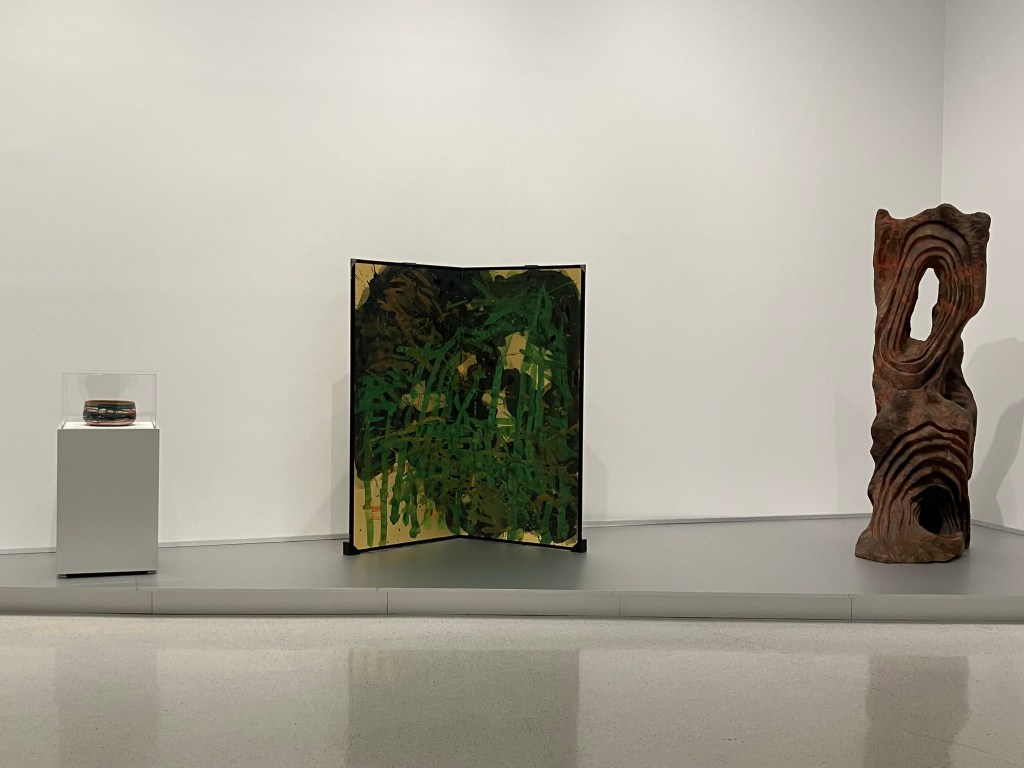
[Banzai on that second bit in particular, because these pieces were really arresting in person. Sofu Teshigahara (1900-1979), right to left: Uzu (Whirlpool or Vortex), Suichiku (Ishi) (Verdant Bamboo (Stone)), Bowl (title unknown). The folding screen is my favorite, because it takes a very traditional subject—bamboo painted on a screen—and imbues it with the energy of modern abstract art, which ironically returns the subject to its literal, natural roots; because few things in nature are more chaotic than an uncultivated bamboo grove. I think this untamed view of bamboo as a subject speaks to Sofu Teshigahara’s philosophy of ikebana as quoted from the International’s literature: “Flowers have a front and back. The side meant for viewing is the front, and the side not seen is the back. The clearer the distinction of the front and back of an ikebana arrangement, the more beautiful is the work. In addition to the front and back of flowers and branches, there is another important distinction to be made. That is the front and back of the artistic intent. The front is created by the eyes, and the back is created by the heart. One can view the front with the eyes. One views the back only with the heart.” This folding screen is more of a “back view” of bamboo, a less traditional view, but no less important in intent.]
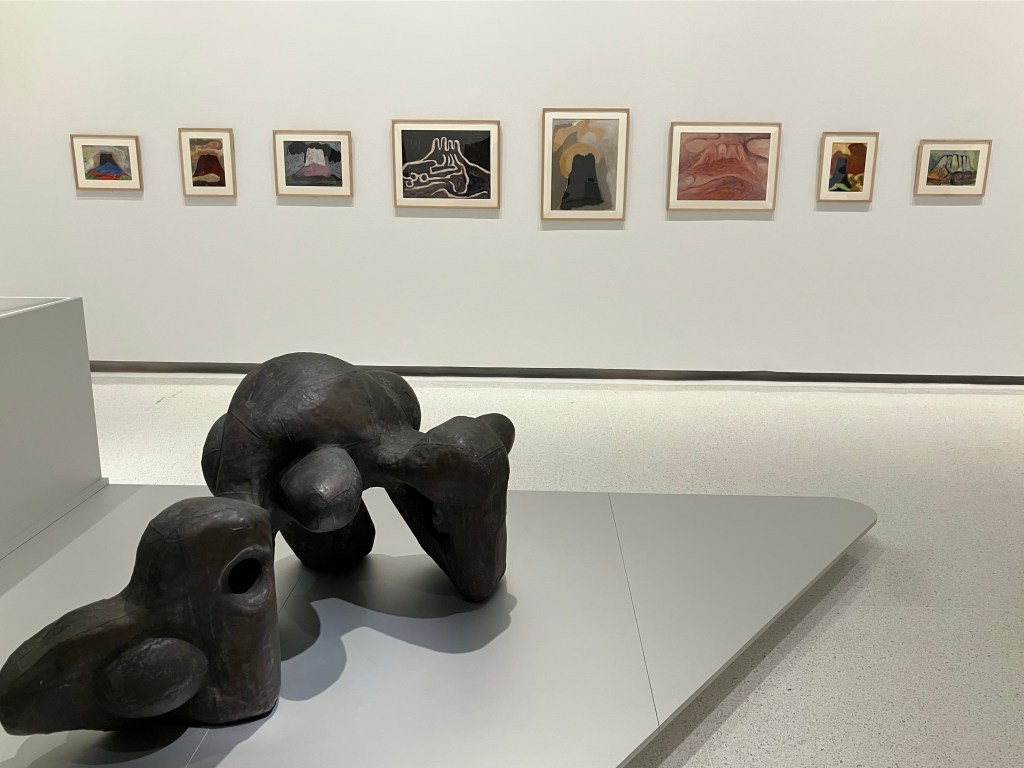
[They also have nine (one is out of frame) of Sofu Teshigahara’s oil paintings of Mt. Fuji—again, an extremely traditional subject matter painted in a postmodern, “back view” way.]
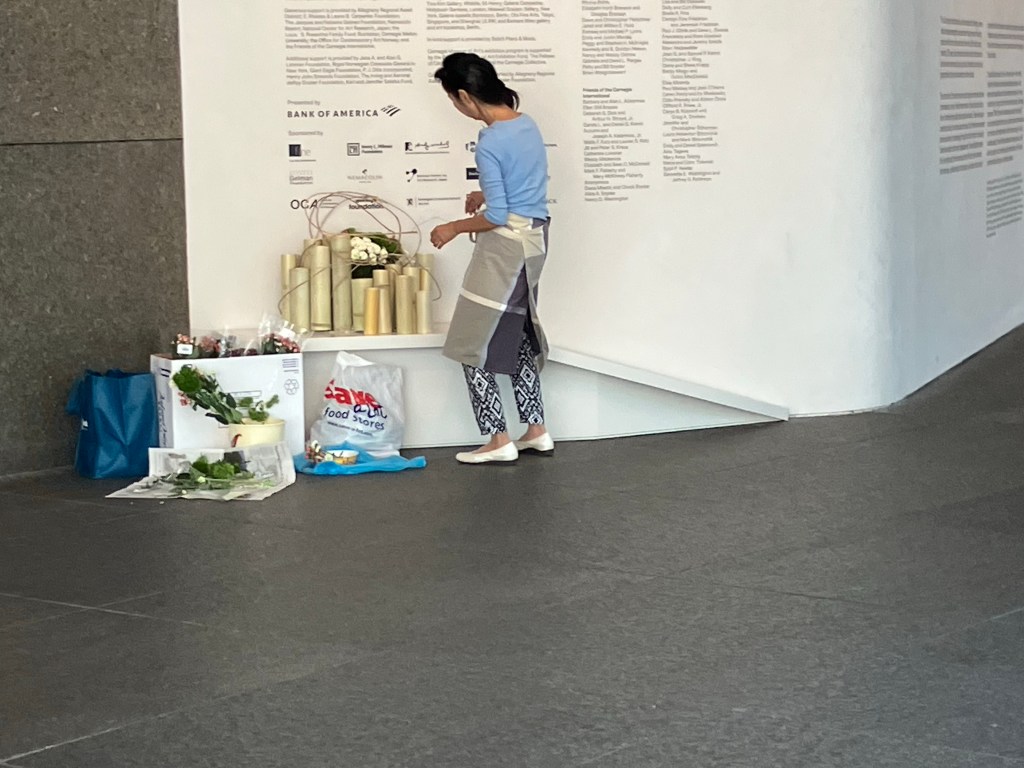
[I also got to see a member of the Sogetsu Foundation refreshing the ikebana arrangement in the main hall while I was there; something they will do throughout the International.]
[Beautiful]
Anyway, getting some deep exposure to contemporary Japanese art isn’t an inappropriate segue way into some more Lady Safflower content, and I thought this week we’d do a bit of a crash course on one of the focal prongs of my story and world building: the writers of the Heian period. Specifically, the women diarists who make up the bulk of its literary output. “Diarists” is a bit of a catch-all term here for the works of these women. Like the equally literary men of their milieu, Heian women were not writing in strict genres, and any one piece of literature could encompass a wide range of subjects such as diary, poetry, and prose fiction. Most of the works we are going to discuss today fall under the broadest genre: nikki (日記).
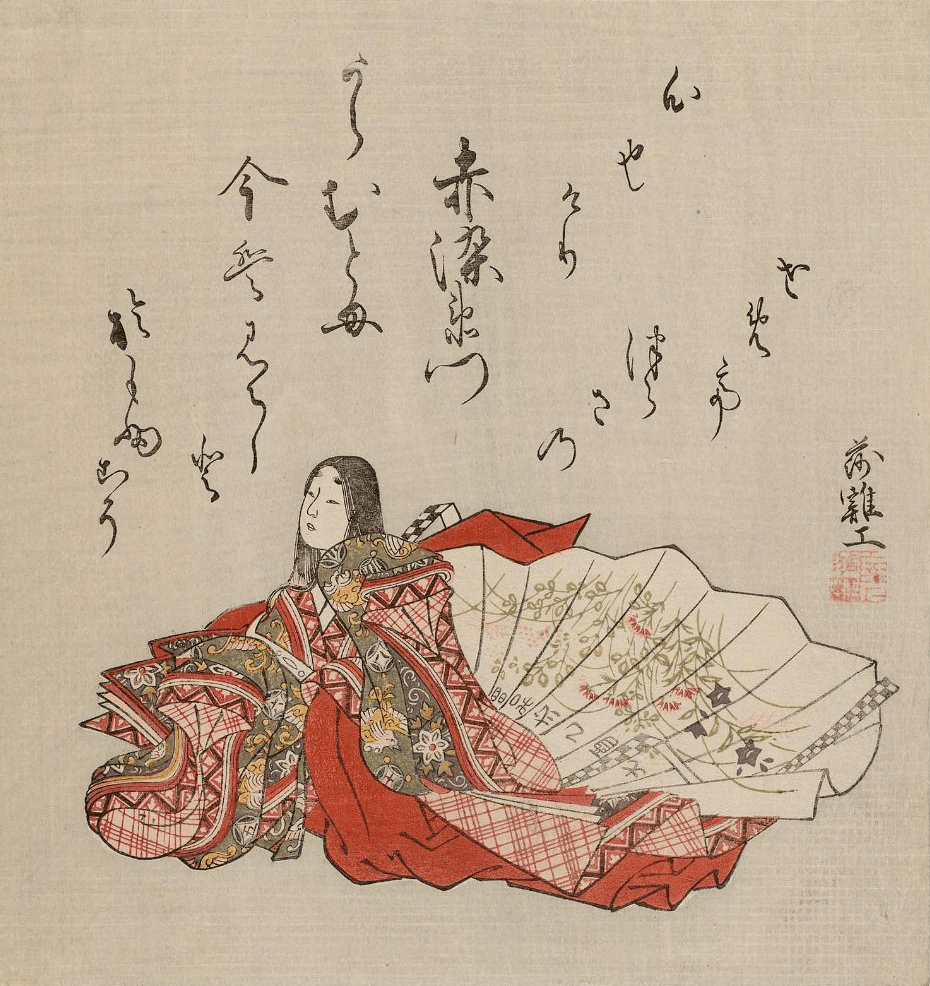
[Arguably outside of waka (和歌)—poetry—the other big Heian literary genre was monogatari (物語), usually translated as “prose narrative.” These could be fictional works like The Tale of Genji, or intended nonfiction works like the Eiga Monogatari, which was ostensibly about the rise of the northern Fujiwaras and the great imperial regent Michinaga in particular. Incidentally, while the Eiga as we know it was almost certainly compiled by several authors over several centuries, one of the prime candidates for its original authorship, like Genji, is also a woman: the poet Akazome Emon (c. 950/60-1041 CE or later), pictured above in an 18th century woodblock.]
Nikki were once something very un-literary. Mainly, it originally denoted the bog-standard private memoranda of male court officials in which they recorded the proceedings of their official duties or domestic affairs. What separated these documents the most from men’s conscious literary output was their language. In the early Heian period, like the Nara era that had preceded it, “official” or public business was conducted largely in Chinese, still the marker of education and cultural sophistication above native Japanese. If high ranking men had to conduct business in Japanese, it was using the earliest form of the kanji (漢字) script, which was the sound of Middle Chinese words adapted to a Japanese script. Below this was a script meant to phonetically translate Japanese into a coherent writing system, which has several names, but is modernly kana (仮名) and is historically called hiragana (平仮名) or onnagana (女仮名). The third of those names is literally “women’s writing” because kana, based as it was in vernacular Japanese instead of Chinese, was the work-a-day, non-literary script for men, but (usually) the only one even highborn women were ever taught. Men wishing to produce literature of any kind would have been mortified to put something forth in kana, but if a woman wished to express herself, she often had no choice. And this quirk of linguistic necessity, much like Dante’s use of vernacular Tuscan over scholastic Latin in Renaissance Italy, would end up fundamentally changing Japanese literature forever.
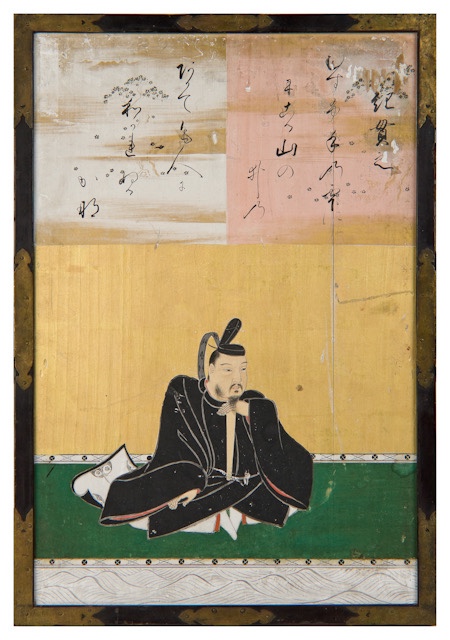
But arguably the first Heian nikki, the Tosa Diary (Tosa nikki 土佐日記) is also its biggest outlier—because its author is not a woman. Ki no Tsurayuki (872-945 CE) was a nobleman and court official who was, like many men of his class, primarily a poet. And like all male Heian poets and writers, Tsurayuki wrote in Chinese/kanji… except for the Tosa Diary, which he composed in kana. To explain this choice, Tsurayuki takes on the alter ego of an unnamed aristocratic woman, whose supposedly wrote this nikki as she was traveling with Tsurayuki as he returned to the capital Heian-kyō after serving as governor of Tosa province. The diarist is this woman, while Tsurayuki himself is only a third person character (often referred to as “a certain person,” or simply “the governor”). But why would an established writer like Tsurayuki choose this circuitous style, or write in the maligned kana script in the first place? Obviously, we don’t know for certain, but I have what I think is a very plausible theory. Most of the short (most of the nikki are relatively short) Tosa Diary is a methodical travel journal (with its adjacent genre of travel poems, kiryoka), where the diarist records what the travelers saw, where they got stopped by acquaintances or storms, and various remarks and poems they made along the way. But a biographical note that crops up again and again in the narrative is Tsurayuki and his wife’s grief over the loss of their young daughter, who died while the family was serving in Tosa and whose burial was presumably left behind them in the province. While Tsurayuki’s wife’s sorrow takes more visceral center stage, his is alluded to with equal, if more understated, frequency. Like all Heain nobles, the couple are ecstatic to return to “civilization” in the capital, but this typical elation is tempered by the devastating loss of their child who is no longer with them. And while male Heian writers were more emotionally open in their writing than men in some other cultures, death and mourning, specifically of a child, has always been a feminine-coded literary subject, and I think Tsurayuki used the feminine-coded kana script and a female alias as a psychological buffer to express this private tragedy.
While Tsurayuki failed to kick off a kana literary revolution among his male peers, the cultural flowering of the imperial court under the Fujiwara regents in the 10th and 11th centuries drew a number of intellectually gifted women into the households of the Fujiwara empresses, and really got the ball rolling. As we discussed last time, the two literary titans of the High Heian scene were Murasaki Shikibu (c. 973-1014/1025 CE) and Sei Shōnagon (c. 966-1017/1025), who served the rival empresses, Shōshi and Teishi respectively, of Emperor Ichijō (r. 986-1011 CE). Although Murasaki would be more famous for her monogatari, the Tale of Genji, she, too, was a nikki writer, so we’ll talk about her in that context. But first, her literary and political rival, the nikki writer nonpareil…
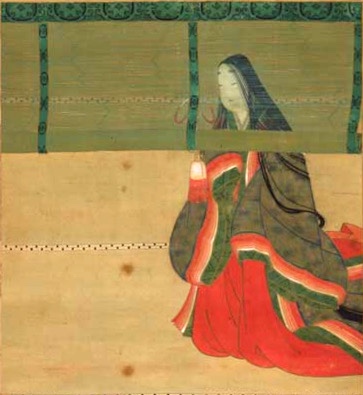
We don’t know Sei Shōnagon’s real name, but her father was the renowned poet and provincial official Kiyohara no Motosuke. This is where her not-name comes from: “Sei” is the Chinese-based kanji rendition of the Japanese kiyo, the first character of her clan name, and shōnagon is her father’s court title (essentially “lesser official of state”). This family background will be a trend among the known Heian nikki writers: they will uniformly come from the lower, government-class levels of the aristocracy, as opposed to being princesses or empresses. Most of them come from literary families, where their immediate male relatives were well-respected as poets and scholars, which would have given them more exposure to a wide range of both Japanese and Chinese works, and willing tutors in intellectual pursuits. Indeed, using a kanji nickname is very in keeping with Sei’s personality, as she was one of the few women of this period whom we know was able to read and compose in the male, Chinese kanji script—partly because, according to less-enchanted people around her like Murasaki, she never shut up about her Chinese skills. Sei’s nikki, the Pillow Book (Makura no Sōshi 枕草子), is ironically one of the few to not actually be called a nikki, but it set the tone for the Heian iteration of the genre. Some of the Pillow Book functions like a straightforward diary, where she records incidents and anecdotes about court life in Teishi’s household, as well as poetry, but Sei is probably more famous for her witty, bitchy lists where she rattles off things that delight her (children playing with toys), annoy her (people talking while they try to apply their cosmetic tooth-black), and hundreds of other little personal preferences that add color to what often comes off to a modern reader as a tedious, low-stakes world at court.
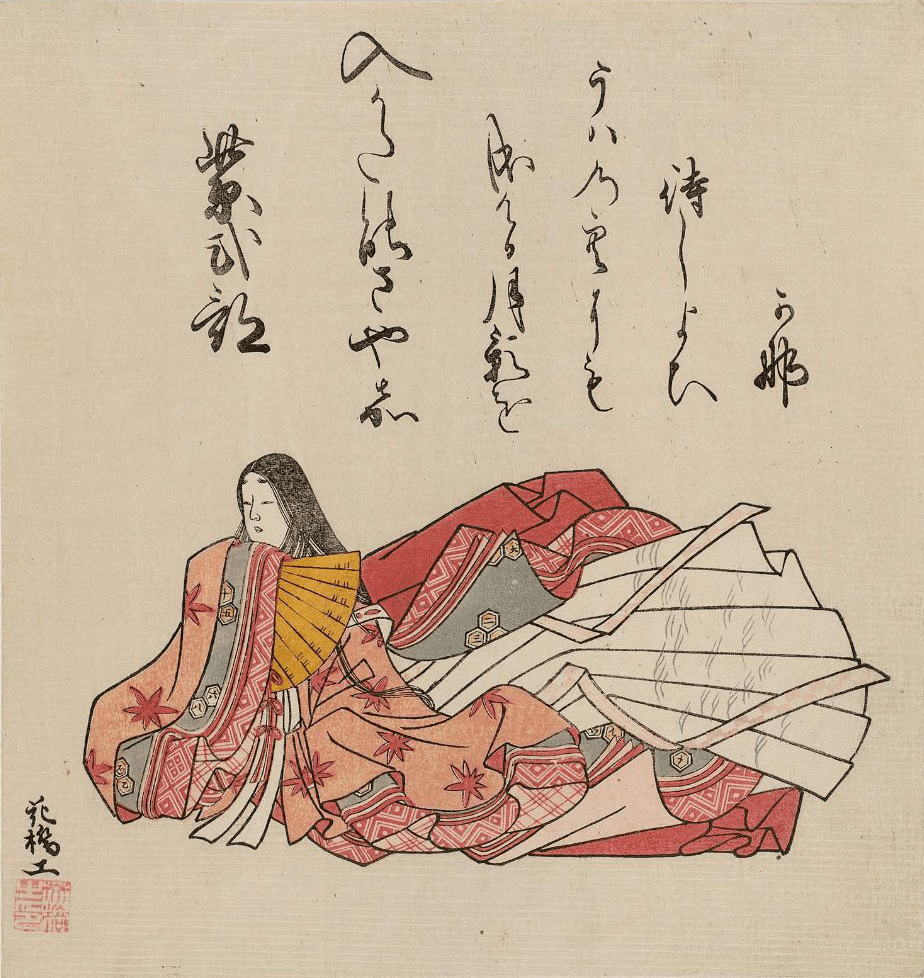
Sei’s place at court was ultimately doomed because her mistress, Empress Teishi, died early in 1001; but even if she had lived longer, she was never in favor with her powerful uncle Michinaga, who understandably was more interested in promoting the position of his own daughter, Empress Shōshi. Even before she became Japan’s first celebrated novelist, Murasaki Shikibu was specifically recruited by Michinaga to boost the cultural reputation of his daughter’s household. Like Sei, she was the daughter of a lower-level official and scholar (Fujiwara no Tometaki)—shikibu roughly translating to a position within the Ministry of Ceremonials—though Murasaki’s family descended from another branch of the northern Fujiwaras who had actually held regency power before the rise of Michinaga (another reason for the regent to favor her, Murasaki was kin). Murasaki was also a not-name nickname: either as a reference to the most famous female protagonist in the Tale of Genji, or as with Sei, a play on the first syllable of her clan name (murasaki and fuji both meaning “purple”). Also like Sei, Murasaki possessed the rare feminine ability to read and compose in Chinese; though she was, to her mind, less boastful about this. Despite her obvious erudition and the success of the Tale of Genji, the Murasaki revealed by her slim, less famous nikki (usually simply referred to as the Murasaki Shikibu nikki 紫式部日記) is a quiet woman defined by her propriety more than her intellectual verve. Whatever ambitions her writing of Genji points to, she keeps them carefully under wraps in her nikki, aside from mentioning her father’s regretful pride in her abilities (because she wasn’t born a boy). Like the Pillow Book, Murasaki’s nikki is mostly a chronicle of major events in the life of her mistress, Shōshi—like the birth of her children—as well as festivals and shrine visits. But Murasaki tends to reserve her opinions for the actions of her fellow ladies-in-waiting, like her aforementioned disapproval of Sei’s acid-tongued arrogance: “Sei Shōnagon, for instance, was dreadfully conceited. She thought herself so clever and littered her writing with Chinese characters; but if you examined them closely, they left a great deal to be desired. Those who think of themselves of being superior to everyone else in this way will inevitably suffer and come to a bad end.”
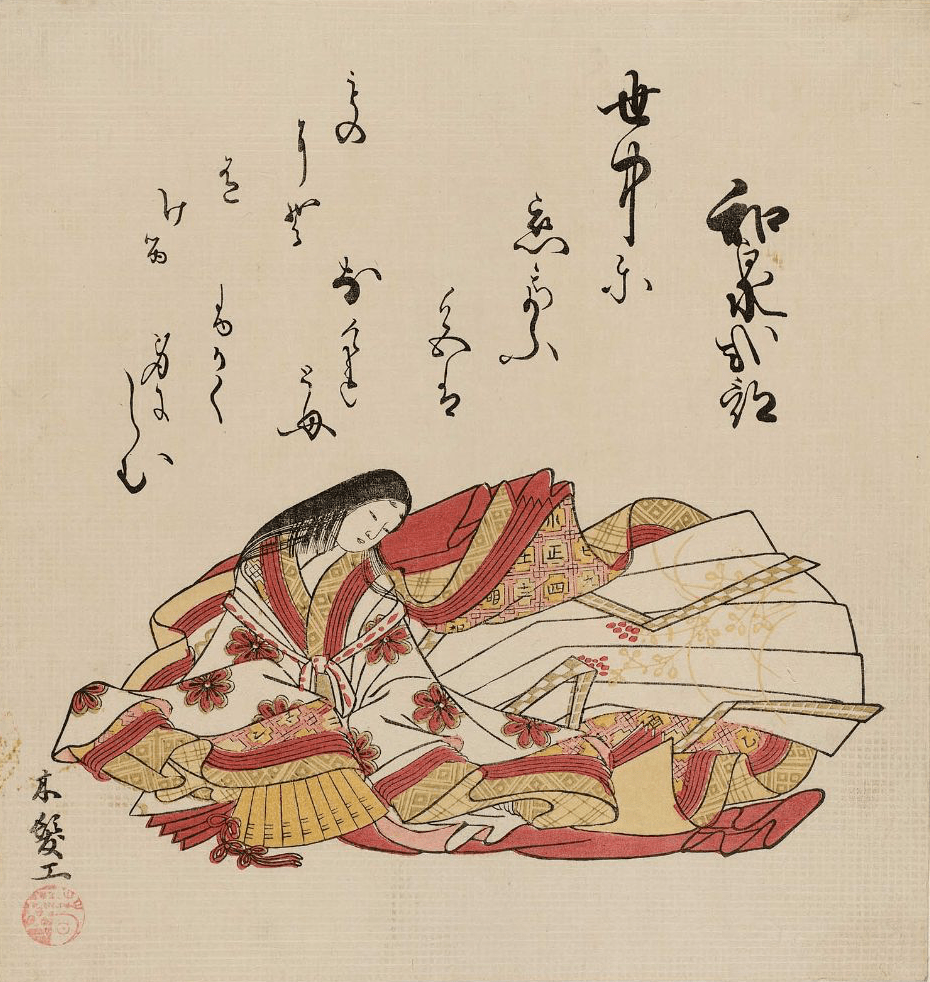
Murasaki also wasn’t shy about a fellow nikki writer in Shōshi’s train, Izumi Shikibu (c. 976-after 1027 CE). Murasaki and Izumi weren’t related—both of their fathers served in the Ministry of Ceremonials—and Izumi came from the most prestigious province her husband served in as governor. But also like Murasaki, Izumi’s nikki is considered somewhat of a footnote in her oeuvre, as today she (along with perhaps Ono no Komachi) is widely considered the greatest of the Heian women poets. Though based on her own nikki, Murasaki would have probably disagreed with this assessment: “[Izumi] has a talent for tossing off letters with ease and seems to make the most banal statement sound special… she can produce poems at will and always manages to include some clever phrase that catches the attention. Yet, she… never really comes up to scratch… I cannot think of her as a poet of the highest rank.” Some of this is also likely because Murasaki thought that Izumi had an “unsavory” character, as she was definitely a courtier more on Sei Shōnagon’s level rather than the demure Murasaki’s. Izumi used her life at court and the uxorilocal nature of Heian marriage to carry on not one, but two notorious love affairs with imperial princes (men who would have been deemed out of her social league, not to mention the scandal of successive affairs with brothers). Indeed, the Izumi Shikibu nikki (和泉式部日記) is mainly a singular narrative (similar to the Tosa nikki) about her affair with the second prince, Atsumichi, after the death of his brother, Izumi’s former lover. Like the Tosa nikki, Izumi chooses to tell her and Atsumichi’s story in a third person narration interspersed with poetry exchanged between the lovers. Despite her chaotic love life, Izumi would eventually take Buddhist vows and die a nun.
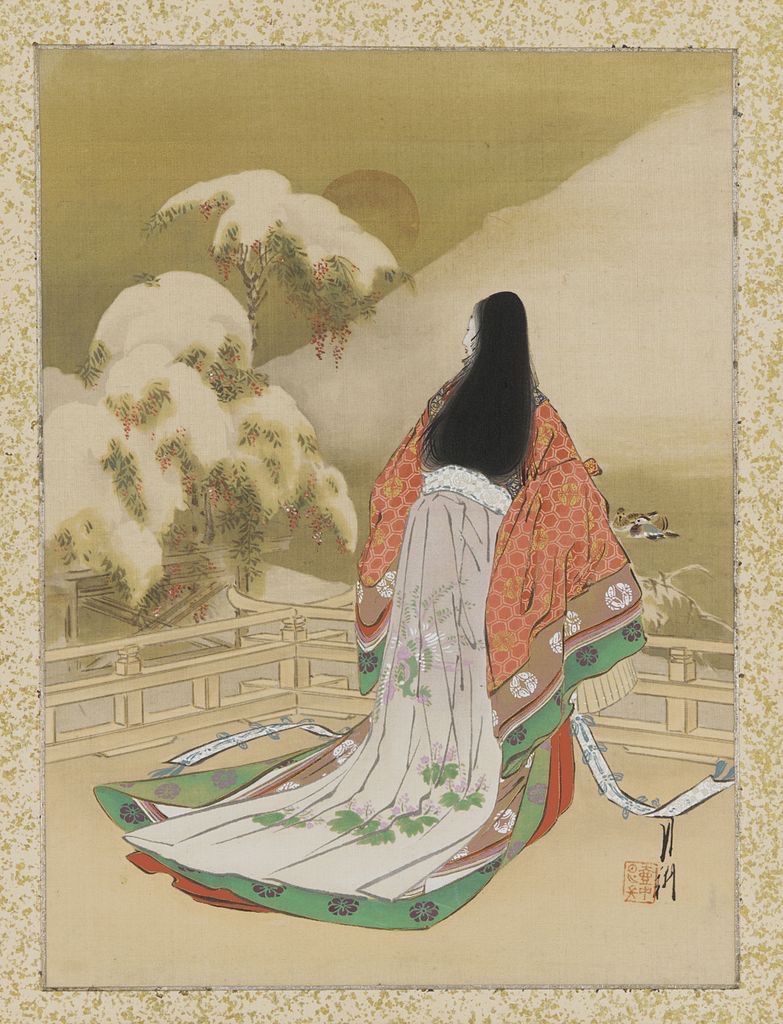
Unlike the coincidentally-named Shikibus, the most interesting thing about the next three chronological Heian era nikki writers is that they are all related. We don’t know the name of the oldest of these women, who was of the generation before Sei, Murasaki, and Izumi, but she is generally referred to as the Mother of Michitsuna (Michitsuna no Haha)(c. 935-after 976 CE). Like them, she was the daughter of a provincial governor, Fujiwara no Tomoyasu, and while she never served at court, she did have a claim to fame that none of the others could have touched: she was Regent Michinaga’s stepmother (sort of). The Mother of Michitsuna was married to Michinaga’s father, Fujiwara no Kaneie, before he rose through the ranks of the imperial government and set the stage for Michinaga’s eventual political dominance. As a secondary wife from a less exalted family, the Mother of Michitsuna’s position deteriorated as Kaneie’s fortunes rose, and her diary, the Kagerō nikki (蜻蛉日記)—kagerō meaning “mayfly,” signaling ephemera and impermanence—is a detailed depiction of non-court aristocratic life, mainly surrounding the slow dissolution of her relationship with Kaneie. As a result, her nikki is distinctly bitter, her jealousy and rage demonstrating that those emotions weren’t absent in the Heian marriage system, and that the fading of her marriage was no less painful to her even if its dissolution didn’t leave her or her children completely destitute as a result. She tries to find solace in religion, but without assured support from Kaneie, she knows she can’t take monastic vows and leave Michitsuna with no familial connections on which to make his way in the world. Because of the struggles of its author, the Kagerō nikki is less popular than the Pillow Book, but it is a fascinatingly honest account of what this era was like to live through as a woman, one unhindered by the fairytale embroidery that Murasaki employs in the Tale of Genji.
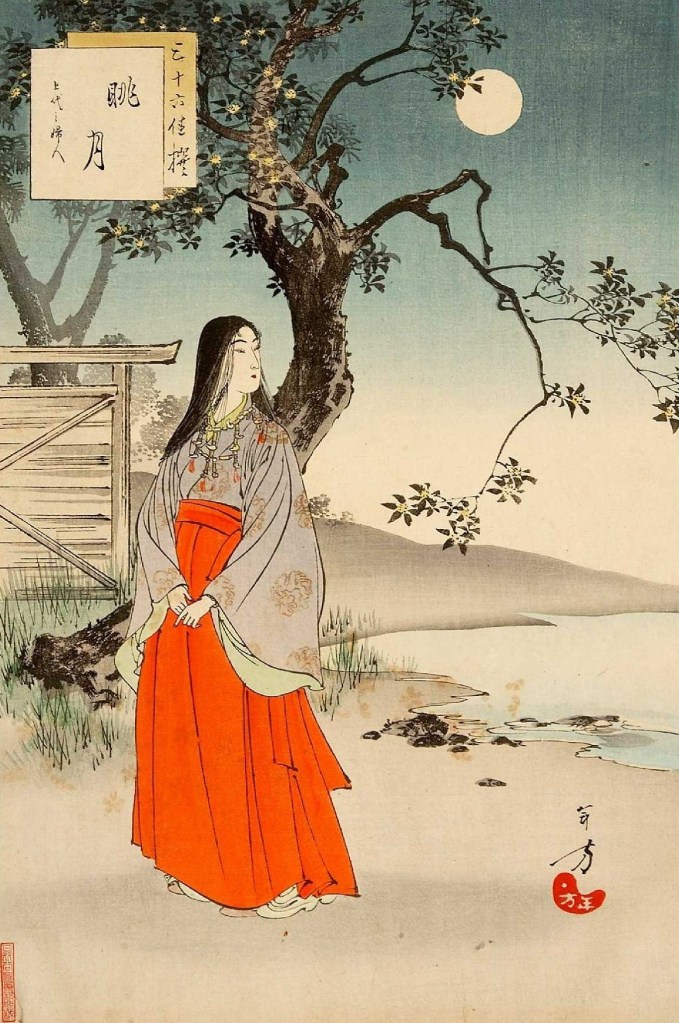
The illusions of fiction and reality is a major theme of the next chronological nikki, that of the Kagerō diarist’s niece, usually officially known as Takasue’s Daughter, but more colloquially called the Sarashina diarist (c. 1008-after 1059 CE). She was the daughter of the Kagerō diarist’s younger sister, and she spent most of her childhood in Kazusa province, where her father served as governor. Like her aunt, the Sarashina diarist was a lower-ranked lady whose personal position and comfort rose and fell with her father’s ability to keep government posts, and she would only be married in her thirties as a result. Her diary, the Sarashina nikki (更級日記), is above all, a memoir she wrote in her fifties structured to highlight the impermanence of the world from a Buddhist mindset. We’re not exactly sure why this name was given to the nikki, but the prevailing theory is that Sarashina is in Nagano, where the diarist’s husband was posted, and the descriptor attached from there. The diarist frames her life story through her girlhood obsession with the romance of the Tale of Genji (she representing the first generation of young people to grow up with Murasaki’s story), and how the realities of the real world slowly chipped away at that rosy fantasy. Her family’s return to Heian-kyō echoes the travel narrative of the Tosa nikki, right down to the melancholy air that even the delights of the capital can’t solve all of one’s problems. Unlike her housebound aunt, the Sarashina diarist serves occasionally at court throughout her life, but she finds it alienating and only briefly experiences the sort of glamour depicted in Genji and in the older court-lady nikkis. But while the Kagerō diarist rages against fortune, her niece’s nikki is a long dialogue about accepting one’s fate and defeating one’s desires and illusions. This narrative cohesion, along with the Sarashina diarist’s understated lyricism (born as she and her aunt were from another line of respected minor poet-officials), is probably why the Sarashina nikki is only second to the Pillow Book in popularity, despite the humbleness of its author.
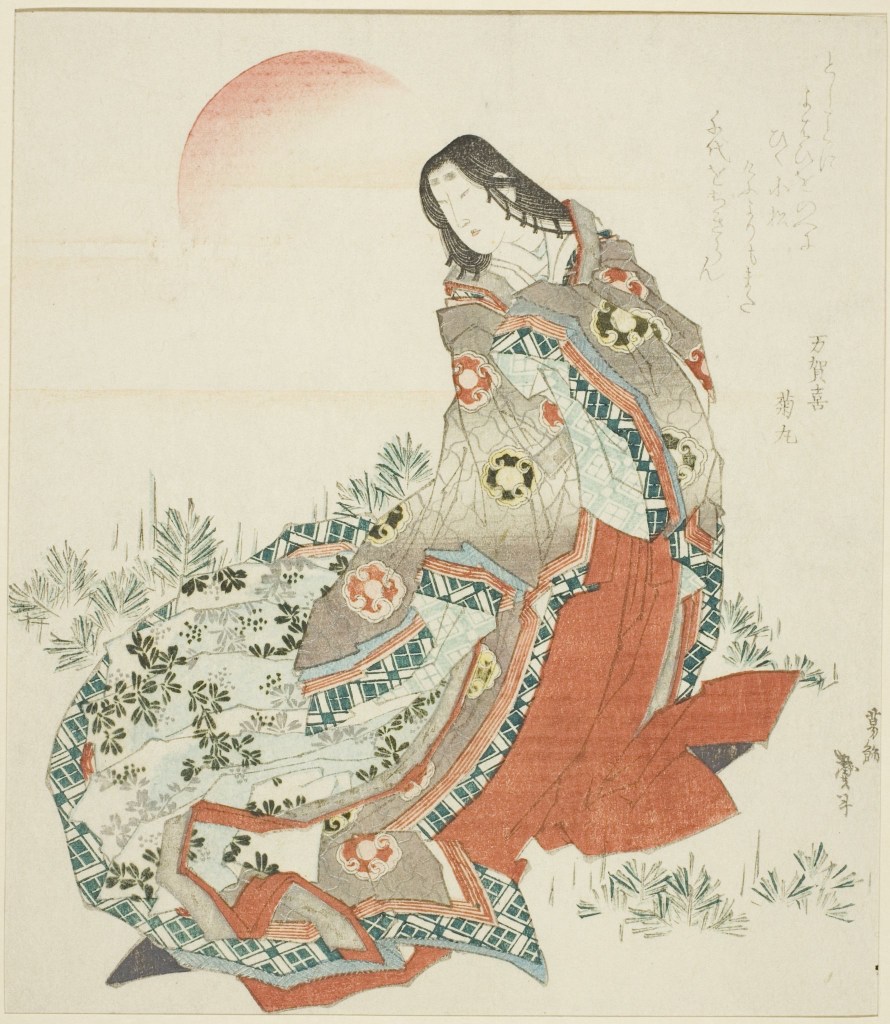
The last of this triad of talented nikki relatives is my girl Fujiwara no Nagako (1079-after 1119 CE), known at court as Sanuki no Suke (Sanuki being her father’s most prestigious governorship and suke being her imperial household position, basically “assistant attendant”). Nagako’s father, Fujiwara no Akitsuna, was the grandson of the Kagerō diarist’s beloved son, Michitsuna, so the Kagerō diarist was Nagako’s great-great-grandmother. This tenuous direct connection to the ruling branch of the regent Fujiwaras descendent from Fujiwara no Kaneie kept Nagako’s family in better overall straits than the more distant Sarashina family. Akitsuna held several governorships during his career, and he was given the honor of adopting one of Emperor Go-Sanjō’s Minamoto-made sons, former prince Arisuke. Nagako’s older sister, Kaneko, was one of Emperor Horikawa’s official wet nurses, a superlative honor for both her and her family. Nagako herself would serve as a lady-in-waiting to both Horikawa and his son, Emperor Toba, for a combined nearly twenty years. Usually an emperor’s household left imperial service upon his death, so Nagako’s selection to remain on was extremely rare, and gave her a unique breadth of insight into imperial life at point long after the glitter of Murasaki and Sei’s High Heian court had begun to fade. Suffering from almost continual ill-health and overshadowed by his overbearing father, the retired emperor Shirakawa, much of what we know about Horikawa’s life and reign come from the Sanuki no suke nikki, most of which is a record of the year following Horikawa’s death, where Nagako struggles to come to terms with her grief while adjusting to another stint at the palace in the household of the very young Toba. This makes it an odd blend of all the nikkis that came before it: like the OG court-lady diaries, it records anecdotes about the insular world of the palace, but its raw emotionality is right in line with her kinswomen’s nikkis. And it could be argued that just as her great-great-grandmother’s inability to move on from Kaneie blighted the rest of her life, Nagako’s inability to release Horikawa’s memory will eventually lead to her ignoble dismissal from court with the label of insanity. The exact parameters of her relationship with Horikawa are left vague by her, but whatever the nature of the love they shared, Nagako’s was burned by it just as deeply as the passionate Izumi Shikibu was by her forbidden princes, or the Kagerō diarist was by her ill-starred marriage to Kaneie.
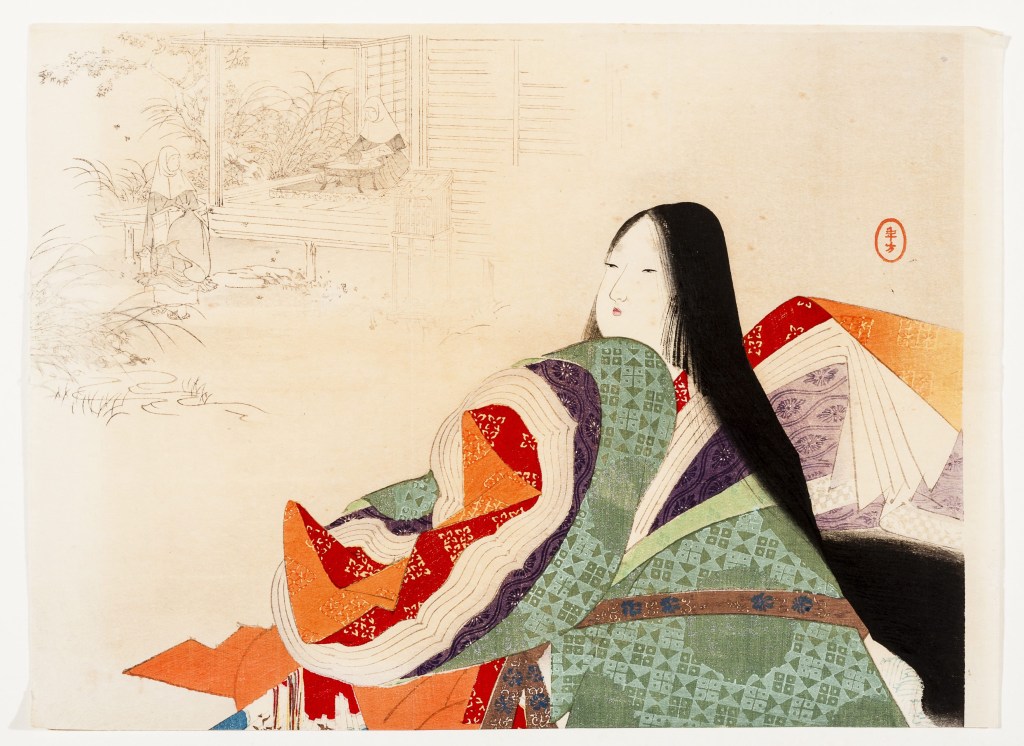
And finally, the last of the true Heian nikkis is probably the most emblematic of both the diarist art of the period and the fall from grace of the era into the shōgunates. The Daibu nikki, is written by one last court lady, the so-called Lady Daibu (c. 1150s CE-?), the daughter of a respected court musician and family of calligraphers. This is another step down the social ladder from our other nikki authors, and this is in part because the whole court social structure had sort of taken a down step. Daibu served Emperor Takakura’s empress, Tokuko, daughter of the great Taira warlord Kiyomori, who’d crumbled the power of his overlords, the northern Fujiwaras in the Hōgen rebellion (1156) and taken control of the imperial line. This shifted power away from the traditional highest Heian nobility into that of their militarized vassals and retainers, which will eventually lead to all-out civil war between the Taira and the Minamoto in the 1180s (the conflict depicted in the Tale of Heike), which the Taira and their retainers like Daibu will lose. This calamity will directly intersect with Daibu’s court service, but you’d never know it from her much of her nikki, which makes reading it a surreal experience. Hers is largely the classic High Heian account of elegant court parties and poetry contests, all the while a terrifying civil war is right outside. If Nagako’s nikki is like reading about a world where the smell of smoke is in the air, Daibu’s is like reading about a party in an actively burning house. The last of the Heian’s supposed glory is completely depleted, but this small, insular group of men and women are still going through the motions of pantomiming a time that is bleeding out right in front of them. Eventually, even Daibu can’t ignore the march of events upon her and her circle, and the end of her nikki is her attending in a diminished court with an even more puppet emperor held in the power of those whom she counted as her enemies. If Nagako’s diary morns for a lost life, Daibu’s mourns for an entire era. A few nikkis will come out of the following Kamakura period, but the great age of the women diarists of Japan will come to this abrupt and violent end as suddenly as it seemingly began some two hundred years before.
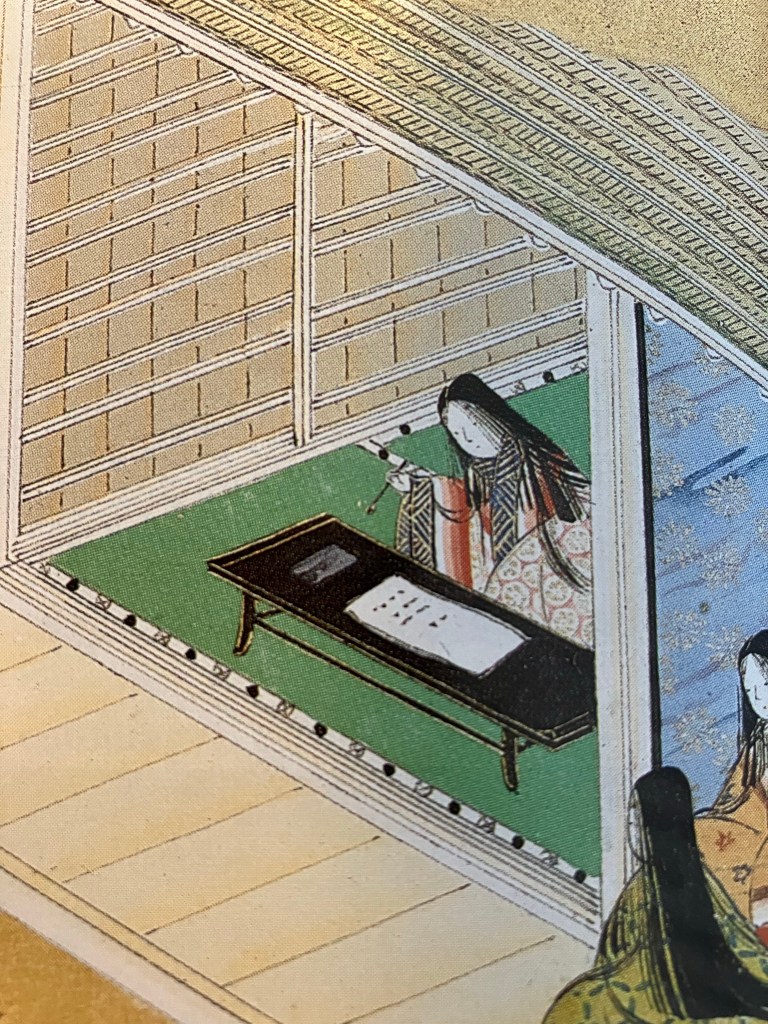
As a coda, I wanted to provide some information about the Heian nikkis’ English translations for those who might want to read more about these unusual, extraordinary women—some of which are easier to find than others:
Sei Shōnagon’s Pillow Book has three major translations: Arthur Waley’s translation from the 1950s, Ivan Morris’ 1991 Columbia University Press edition, and Meredith McKinney’s 2006 Penguin edition. I haven’t read Waley’s, but I think both Morris and McKinney’s translations are excellent. Some people prefer McKinney, as a woman translating a woman’s writing, but I don’t have an especial preference myself.
Murasaki Shikibu’s nikki is published in English as The Diary of Lady Murasaki by Penguin (trans. Richard Bowring, 1996)
Izumi Shikibu’s nikki has no mass market translation that I know of, but Edwin Cranston’s 1969 translation, The Izumi Shikibu Diary: A Romance of the Heian Court, is available through Harvard University Press.
Michitsuna no Haha’s Kagerō nikki has two major English translations: Sonja Arntzen’s The Kagerō Diary (U of M Center for Japanese Studies, 1997), and Edward Seidensticker’s classic 1964 Tuttle translation The Gossamer Years. I have only read the latter, but Arntzen’s translation is equally respected.
The Sarashina nikki’s major English translation is Ivan Morris’s 1971 Penguin edition, As I Crossed a Bridge of Dreams.
The only English translation of Fujiwara no Nagako’s Sanuki no suke nikki that I know of is Jennifer Brewster’s 1977 University Press of Hawaii translation, The Emperor Horikawa Diary.
Lady Daibu’s nikki is available as The Poetic Memoirs of Lady Daibu, translated by Phillip Tudor Harris (Stanford University Press, 1980).
And lastly, if you’re a nikki completionist, Ki no Tsurayuki’s Tosa nikki is most readily available in a 1981 Tuttle reprint of William Porter’s midcentury translation, The Tosa Diary. There are also two later Kamakura era diaries that I’m currently aware of: the Ben no naishi nikki, translated as Sacred Rites in Moonlight (S. Yumiko Hulvey, Cornell University Press 2005); and Towazugatari, translated as The Confessions of Lady Nijō (Karen Brazell, Stanford University Press, 1973).


Leave a comment