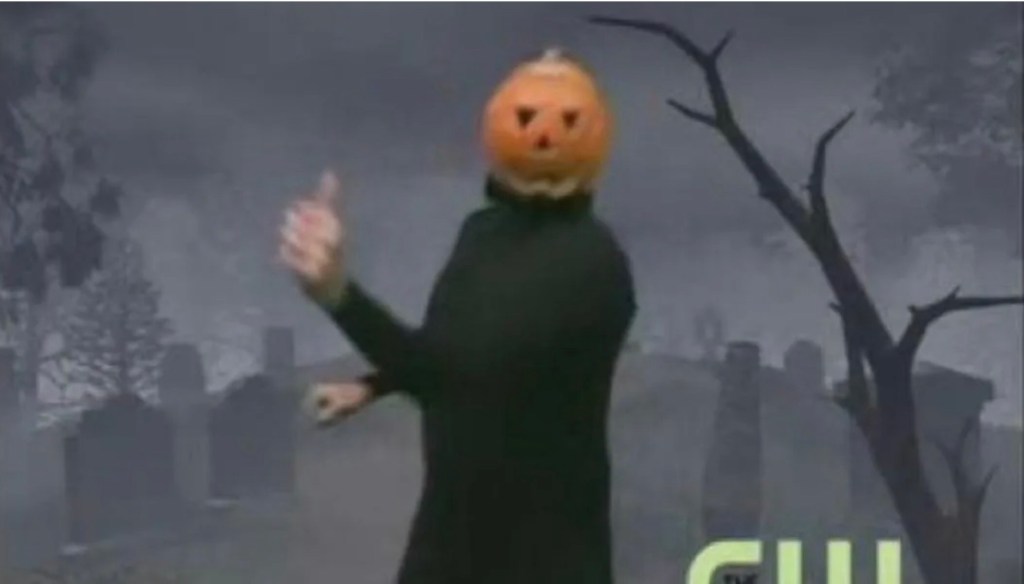
Okay, y’all have been very patient as we’ve discussed medieval Japanese history and literature the past couple of weeks. And while I have at least one more historical entry lined up discussing the Lady Safflower emperors, I figured you earned a little break. So this week, we’re going to have a bit of a “beach episode” and talk about something everyone will probably like: weird little guys!
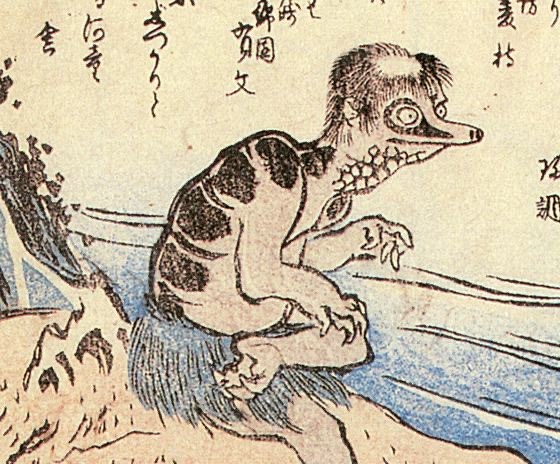
[Boo!]
Well, “little” is not always entirely the case, nor is “guys,” but using it in its least pejorative sense, “weird” is probably appropriate. Because they are integral to the plot of Lady Safflower, I wanted to to take a (unfortunately by necessity) brief look at the incredibly rich world of Japanese folklore, and in particular, arguably the most diverse group of beings within it: yōkai.
As I mentioned in an aside on my OG Egyptian gods listicle (gods defend us, still the #1 Google result for that topic—probably a true measure of how far the search engine has fallen…), yōkai (妖 怪), like so many Japanese words, is difficult to definitively translate into English. The first character, 妖, can mean attractive/calamity/bewitching/enchanting/goblin/witch/devil/monster/phantom; and the second, 怪, can mean strange/apparition/mystery/suspicious/doubtful/odd/to blame—among other translations. The specific meaning may be untranslatable, but what yōkai represent psychologically is pretty much universal across human culture: a common-source attempt to explain the unknown and the uncanny in the world around us. In keeping with their multitudinous name, the various natures of yōkai are extremely diverse. They can assume almost any manner of form, both animate creatures and possessed inanimate objects; they can be dangerous or benign—even helpful—beautiful or grotesque. But as I intimated before, possibly the most unifying characteristic of yōkai as beings is an innate mischievousness. Even the more malevolent yōkai have a certain comic quality to them, and one gets the sense that even the deadliest ones kill more as a lark than out of hunger or animalistic predation. Yōkai just love messing with people.

[Also, I am an elder millennial, so I will try really hard not to call any of these creatures “spoopy” or “creppy,” but no guarantees…🎃]

Like most so-identified folkloric entities, yōkai occupy the murky liminal space between an established, otherworldly divine (be it a light/“heavenly” one, and/or, a dark/chthonic “underworld”), and the present world we inhabit. These sorts of entities also tend to mark liminal spatial boundaries within our world, i.e., demarcations between the urban and the rural, between the interior and the exterior of manmade structures, or any other landscape boundaries. For example, my Boo! weird little guy above is a kappa, which are pond and river spirits, so you’re more likely to meet them in the country rather than the city, and if you met them there, you’d be more likely to see them in a lake or rice paddy as opposed to a wheat field or a house.
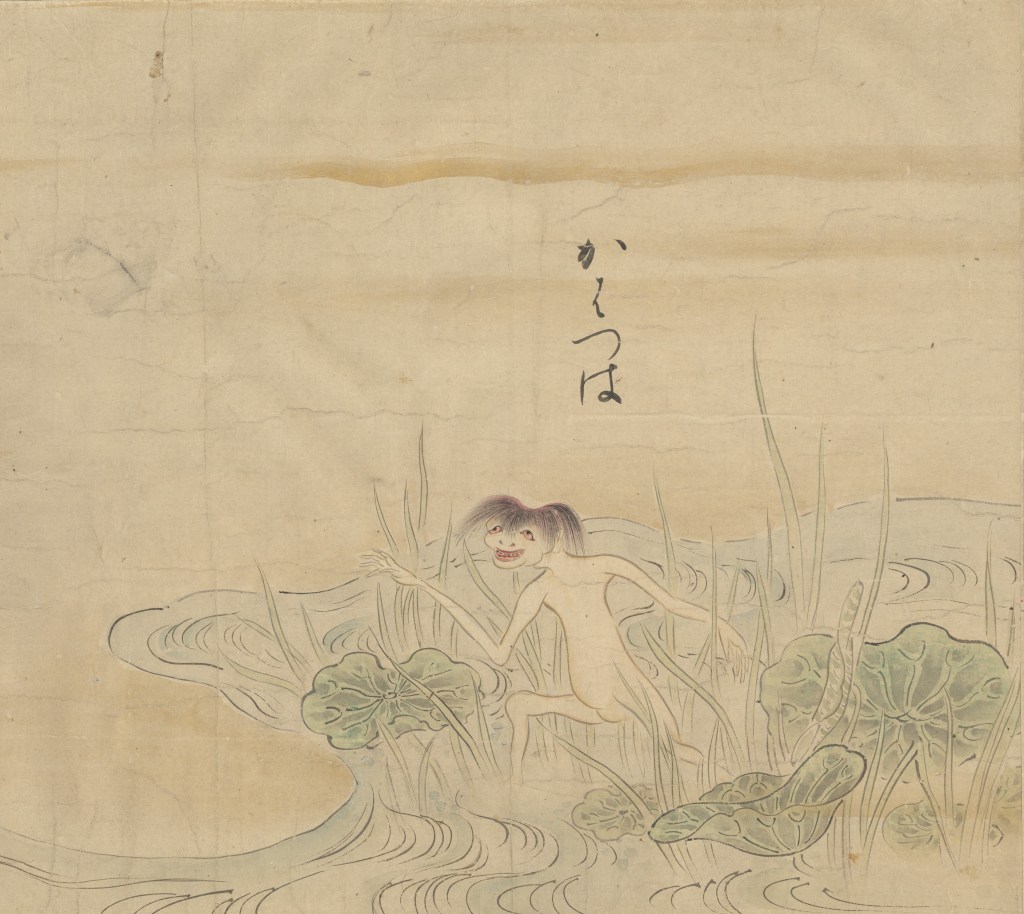
[Not that you should try to—kappas are one of the more dangerous yōkai and like to lure people (and horses) into the water so they can eat them.]
It’s this liminality that adds to the fluidity of what yōkai are and what they can do. There are literally hundreds of named yōkai (again, the running Wikipedia list is a delight), and there are new ones that pop up all the time as life in Japan continues to evolve with the modern world. Some scholars have even suggested that yōkai themselves came out of the Heian obsession with mono no aware (物の哀れ), where acknowledging and accepting the unsettling and unseen parts of life was essential to cultivating a detachment to the karmaic bonds of the world (The Book of Yōkai, 15). Basically, yōkai represented things we can’t control—that may or may not be harmful to us—but coming to grips with that is a part of living, or at least meaningful living.
Japan has many types of supernatural beings, and some like akuma (“demons”) or yūrei (“ghosts”) can be also lumped in more broadly with yōkai, but there are some rough divisions that tend to hold. Kami, which we mentioned a few weeks ago, are consistently differentiated from yōkai by magnitude. Kami are essentially the gods of native Japanese Shinto belief, but like with ancient Greek cosmology, “kami” can encompass great gods like the sun goddess Amaterasu, but also some lower emanations of divine beings that usually get translated in the west as “nymphs” or even “fairies.” All of these beings are generally considered more powerful and higher up in the social hierarchies of the spirit world than any yōkai would be. As we’ve said, the lines are blurry, but we can at least safely say that while yōkai can potentially evolve into kami, one would never call Amaterasu a yōkai.

On a similar but less stark scale, the other major group of Japanese creatures that you might be familiar with, kaijū (怪獣)—like Godzilla and Mothra—are not typically considered yōkai. Some suggest that it is in part kaijūs’ enormous size that disqualifies them as yōkai, but as some yōkai are in fact very big (or at least capable of changing themselves into many sizes), there is more to it than that. Nor is it the kaijū’s relatively recent appearance in Japanese history that is disqualifying, as new, particularly urban, yōkai are almost constantly being named by the Japanese public. Professor Michael Foster in his study, the already-cited The Book of Yōkai, posits that it is more kaijūs’ absence in folkloric narratives that categorizes them apart from yōkai (22-3); that film is simply a separate medium with a separate folkloric tradition. But the bottom line is that, as with most folklore, nothing can ever be stated definitively. Traditionally, yōkai and kaijū (despite their shared use of the character 怪, are classed differently, but theoretically you wouldn’t be 100% wrong if you considered Rodan a yōkai.
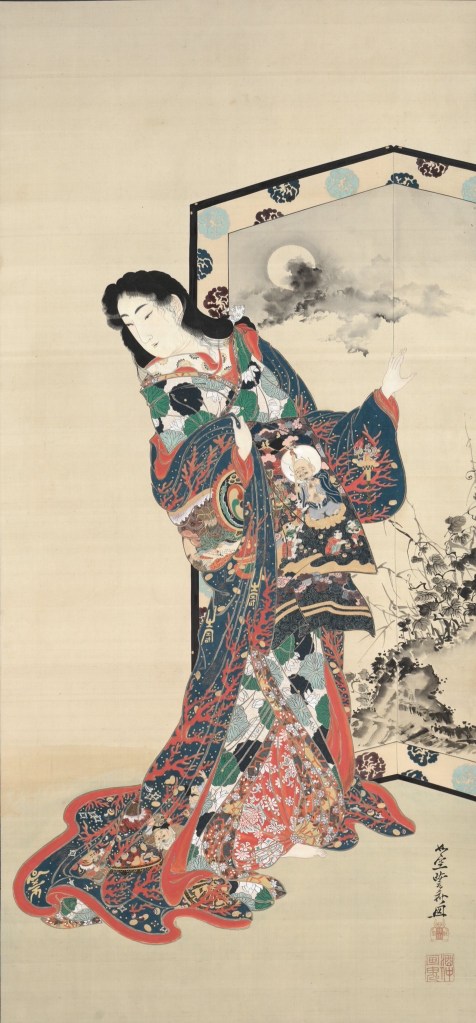
A good example of this categorical fluidity when it comes to classifying who’s a yōkai and who isn’t is actually one of my supernatural characters in Lady Safflower, Jigoku Daiyū, the Hell Courtesan (地獄太夫). Alternately spelled Jigoku Daiyū/Dayū/Ta(i)yū, depending on your transliteration, most of Jigoku’s folklore doesn’t initially point to her as a supernatural being. As her Edo period (17th-19th century CE) legends recount, she was the beautiful daughter of a Muromachi era (14th-16th century CE) samurai, who was kidnapped by her father’s enemies and sold into prostitution. It is in her brothel, as a high priced courtesan, that she supposedly met the iconoclastic Buddhist monk Ikkyū (1394-1481), and here the folklore diverges a little. In the one version, she sees Ikkyū dancing with a spoopy (😉) group of skeletons instead of carousing with the courtesans, has a moment of enlightenment about the transience of life, and becomes Ikkyū’s disciple, changing her working name to Jigoku (“Hell,” or rather, one of the Buddhist hell-realms, ruled by the divine judge of the dead, Enma-Ō—the Japanese iteration of the Hindu god, Yama) to reflect this shift in perspective. In the other version of her story, Jigoku, facing the loss of her former status and life’s tribulations with Zen acceptance, gives herself her nom de guerre and her iconic kimono, with its elaborate embroideries depicting Enma-Ō in judgment over the dead in Hell, to show the folly and impermanence of this world. And Ikkyū—(in)famous for highlighting Buddhist transience by frequenting taverns and brothels rather than avoiding them—encounters this unusual prostitute who, to his mind, grasps the nature of the world better than any monk. After a series of philosophical discussions, Jigoku asks to become his disciple, but he tells her that it is he who should be learning from her.
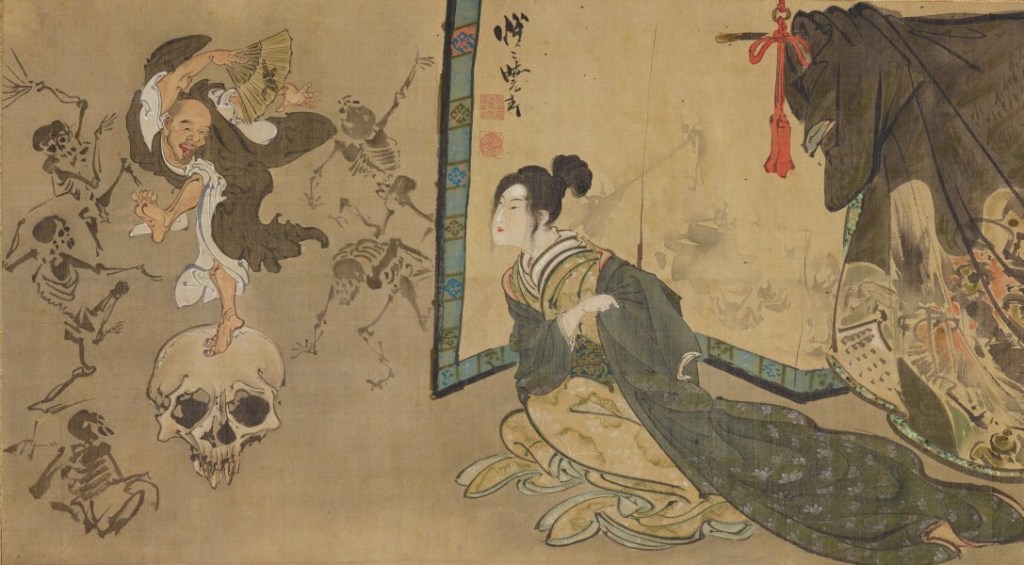
[Jigoku observes Ikkyū dancing with the skeletons, Kawanabe Kyōsai (19th century). Notice how her famous Hell-robe is hanging up behind her.]
Either way, though, sharp-eyed people will have noticed that the Hell Courtesan is a regular girl, not a creature or spirit, so she doesn’t strike one as a yōkai. Now, people can become yōkai, usually through violent death, or being otherwise wronged in such a way that they gain supernatural powers with which to exact their revenge (I’ll touch on a few examples of that in a bit). But this doesn’t really apply to Jigoku, and although we are told that she eventually achieves supreme enlightenment, this sort of positive transformation is not usually classed with even the more benevolent yōkai—she’d be more likely to be considered a kami, or more Buddhistically, a bodhisattva. But I think it’s the legend of Ikkyū’s skeleton dance, and Jigoku’s evocative Hell-robe, that class her legend with the ghost stories typically collated with yōkai folklore (and the visual arts that popularized this folklore), and she just gets absorbed in the process. But as a result, some yōkai compilations will list her and others won’t. As my readers know, neither of Jigoku’s origin stories are what I use for my adaptation of the Hell Courtesan character in Lady Safflower. Taking the liberties offered by those yōkai collections that include her, in my novel, Jigoku is straightforwardly a yōkai—specifically, a kijō.
I broadly call her a demon in my text—which isn’t entirely wrong—but kijō are a specifically female version of the much more prevalent male yōkai, oni, which is probably more accurately translated as ogre. Kijō were once human women, but their rage turned them into ogres once they died. Like oni, kijō are dangerous, punishing forces in our world and beyond. They kill and eat people and animals, and in Jigoku-the-place, they torture and dismember those marked for punishment by Enma-Ō. This latter function is where I got the idea to adapt Jigoku-the-entity into an assistant to Enma-Ō in the underworld in my book, using her identification as a courtesan to make her a correction on lust as much as the oni/kijō are an embodiment of wrath. But her leaving the Hell-realms to help Nagako and Jūrō is a callback to her folkloric destiny as a figure seeking enlightenment, and I make that yearning in her both a nod to this, as well as to reference how even yōkai are not necessarily bound to their natures for all time.

[One of the most famous oni is Shuten-dōji (酒呑童子), whose severed head could continue to attack the heroic Minamoto no Raikō who ultimately defeated him.]

[Incidentally, at the threat of dating myself even more than I did with my “spoopy” reference, in the 1980s anime known stateside as Ronin Warriors (Yoroiden Samurai Torūpā), if you’re American, you know the leader of the Dark Warlords from the dub as Anubis, but in the original Japanese, he is named Shutendoji in reference to the infamous oni. This is reflected in the design of his armor’s red mask, and when he is forced to don his armor again at the end of his (honestly wonderful, especially given how otherwise facile this anime is) redemption arc, he refers to having to “become the ogre once more”—phrasing that is likely lost on an English-speaking audience, but makes sense in a Japanese cultural context.]
So we’ve seen a complicated type of yōkai, one that defies one’s ability to neatly categorize it—how about a simple, indisputable one like the kappa? Well, handily for us, my novel has one of those, too, in the form of Tamago, who is a hitotsume-kozō. Hitotsume-kozō, which roughly translates as “one-eyed priest boy,” sit at a strange intersection of weird-little-boy yōkai and yōkai imitating Buddhist monks. Like their two-eyed counterpart, the tofu-kozō (“tofu priest boy”), hitotsume-kozō are more mischievous than harmful, pranksters who like sneaking up on people to startle them and nicking their favorite bean curd from pantries. Hitotsume-kozō, as the kozō part implies, look like child initiates (ages 6-10ish) to Buddhist monasteries, wearing little monk’s robes and geta sandals on their bare feet. They are sometimes depicted with clawed fingers and toes, or with small, demonic fangs, but as the other part of their name implies, their distinguishing characteristic is their one, cyclopic eye. The one-eyed look of a hitotsume-kozō is a good example of how yōkai are folkloric manifestations of distorted, unsettling things one might see in a dream, or imagine out of the corner of your eye in an unfamiliar place.

The last major yōkai creature in Lady Safflower is arguably the most classic: a devastatingly beautiful kitsune, or magical fox maiden. But like with the specific ogre Shuten-dōji in yōkai legends, rather than simply have an ordinary fox spirit as an antagonist, I wanted to showcase the most famous and deadly of the folkloric kitsune, Tamamo no Mae.
Like many yōkai, Tamamo no Mae’s legends aren’t a single, unified mythology, but there are some dominant threads. One of the likely later-arriving parts of her story, but almost instantly among the most solidified—because it bolsters her reputation as a serious threat—is that Tamamo no Mae is only the name she adopted when she arrived in Japan, and that Tamamo no Mae is the legendary Chinese nine-tailed fox maiden who had caused devastation at several points in Southeast Asian history. The most readily known of her previous incarnation was Su Daji, a concubine of Emperor Zhou, whose power over him led to the downfall of the Shang dynasty. After the Shang are overrun, Chinese legends have the fox maiden flee the kingdom of Tianzhu (roughly modern Bihar in India), where she becomes Lady Kayō, a concubine to Prince Banzoku, whom she convinces to decapitate a thousand men before she is defeat and must flee again. She returns to China as Bao Si, another concubine who cases war and chaos, this time among the Zhou dynasty.
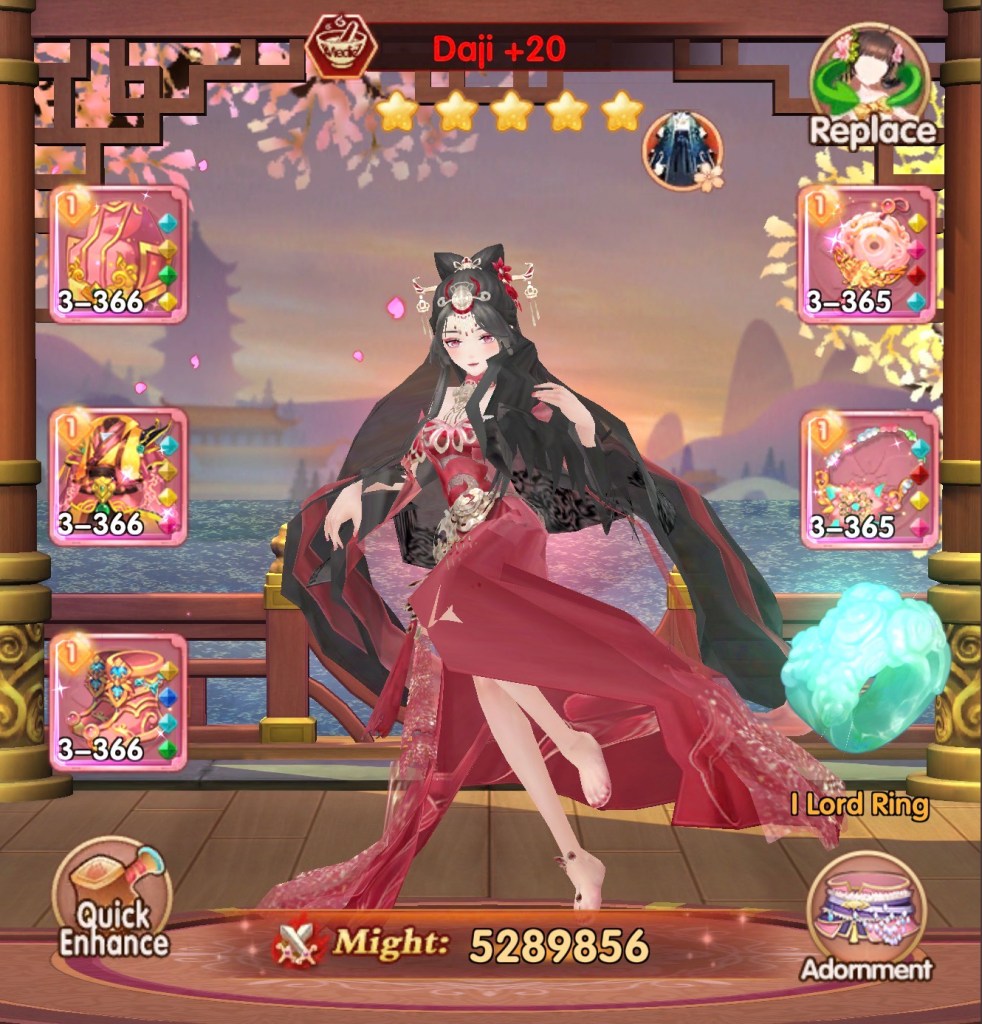
[Like Shuten-dōji, Daiji maintains an active presence in modern yōkai-referencing media. Here she is as a playable character in the Chinese mobile game, Royal Chaos. Her first international adventure in India is thought to be a garbled Chinese version of the story of Kalmashapada, a prince turned into a rakshasa whose story comes up on both the Ramayana and the Mahabharata. In those narratives, Kalmashapada is cursed by a male rishi named Shakti, but a foreign Chinese audience might have mistaken this for the great Hindu goddess of the same name and attributed the curse to a female figure.]
Once she’s done wrecking havoc in China, the kitsune’s trail goes cold for a few centuries until she turns up in the early twelfth century as a girl named Mikuzume who becomes the favorite concubine of Emperor Toba, who gives her the name Tamamo no Mae (Lady Duckweed). But here is where the story gets a little confusing, as multiple traditions tried to graft the character of Tamamo no Mae onto historical events surrounding Toba’s reign and the succession crisis that erupted between his sons Emperor Sutoku and Emperor Konoe. We’ll get way deeper into this in my threatened upcoming emperors entry, but the short version here is that Sutoku was the older prince, but also the son of Toba’s less-favored empress Shōshi, while Konoe was the son of his favorite empress, generally best known by her tonsured name, Bifukumon-in. Toba, as retired emperor, eventually forced Sutoku to abdicate in favor of Konoe, but when Konoe died prematurely, this lead to the abortive Hōgen Rebellion where Sutoku and his younger full-brother, Go-Shirakawa, would fight for supremacy.
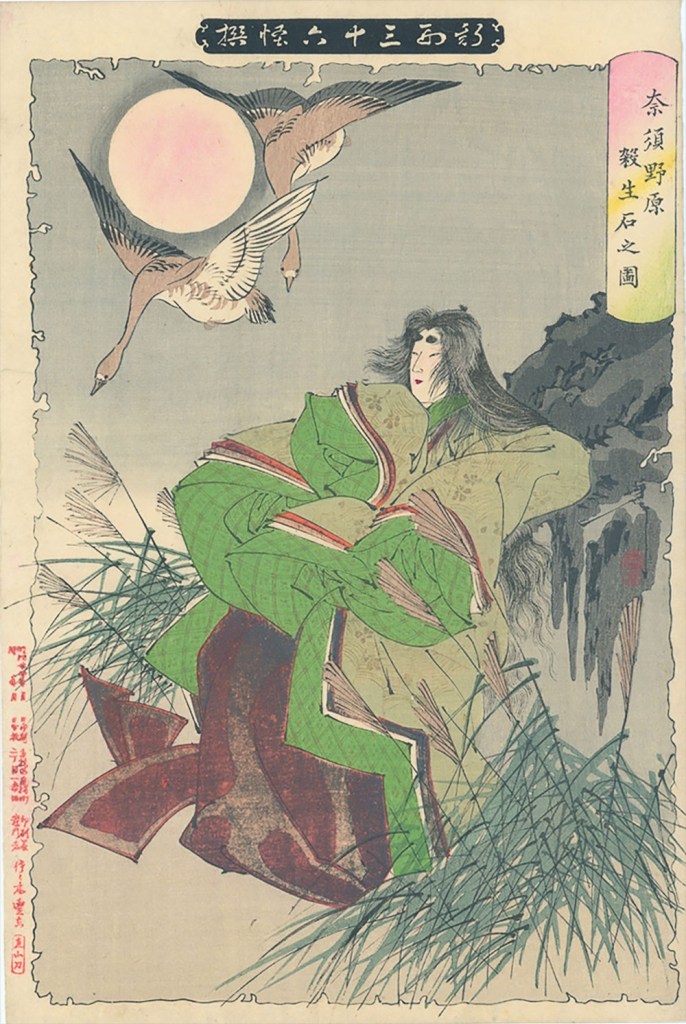
There is a rich narrative tradition that suggests that Bifukumon-in was actually Tamamo no Mae, and it was she who manipulated Toba into forcing Sutoku to abdicate, which if he hadn’t might have prevented the Hōgen Rebellion and ultimately the rise of the feudal shōgunate. But because of Sutoku’s posthumous fate (we’ll get there), I have also seen versions where Tamamo no Mae is his mother Shōshi instead, or even a beloved concubine of Emperor Konoe (who is the cause of his early death). This, combined with a version where she—still as Toba’s concubine—is driven away through an exorcism after she almost kills him, are all clearly post-Heian attempts to use folklore to explain the catastrophic collapse of imperial power surrounding the time period I explore in Lady Safflower. How could have the emperor and the Fujiwaras have been so annihilated expect by supernatural forces? And who better to blame than a legendary kitsune who’d done as much at least three times before?

[Eventually, Toba sends two heroes to kill Tamamo no Mae, which they supposedly do in the mountains of Nasu. Tamamo no Mae’s body was then thought to turn into another yōkai (one that falls into the category of possessed objects), Sesshō-seki (殺生石), or “Killing Stone,” a sacred rock sitting on the slopes of one of the mountains. Potentially unfortunately for all of us, a major fissure in the stone broke apart in 2022, and there is less-than-idle speculation that Tamamo no Mae might be free again. Certainly little about the last four years suggests to me that there isn’t a stupid-powerful fox lady meddling in world affairs again…]
The unsettling world around the politico-cultural shift from Heian Japan to Kamakura Japan threw up a lot of this politics-by-yōkai in the folklore that would be recorded by future generations. Tesso (鉄鼠) was a yōkai that was also categorized as an onryō (“vengeful spirit”), created by a reneged promise to a powerful priest. Supposedly, Emperor Shirakawa (whose exercise of power as a retired emperor was thought by many in later eras to have led to the collapse of the Heian) asked the priest Raigō to say prayers over his only son, crown prince Atsufumi, in exchange for an addition to Mii-dera Temple. Raigō does so, but Shirakawa doesn’t follow through on the construction, so the priest prays himself to death. Soon after, Atsufumi dies at the age of four, and everyone fears that it is Raigō’s vengeful spirit that killed the prince. Also, an unstoppable swarm of rats descends upon Enryaku-ji Temple (Mii-dera’s rival, and thought to have help persuade Shirakawa to ignore Raigō’s request). Grieving and grossed out, Shirakawa builds a shrine to Raigō-Tesso in Mii-dera, but it is only after the shrine is consecrated that the rats disperse from Enryaku-ji and Shirakawa gets a replacement heir (the future Emperor Horikawa). Indeed, Horikawa’s lifelong poor health and relatively early death was seen by many as a possible aftershock of Raigō’s original curse.
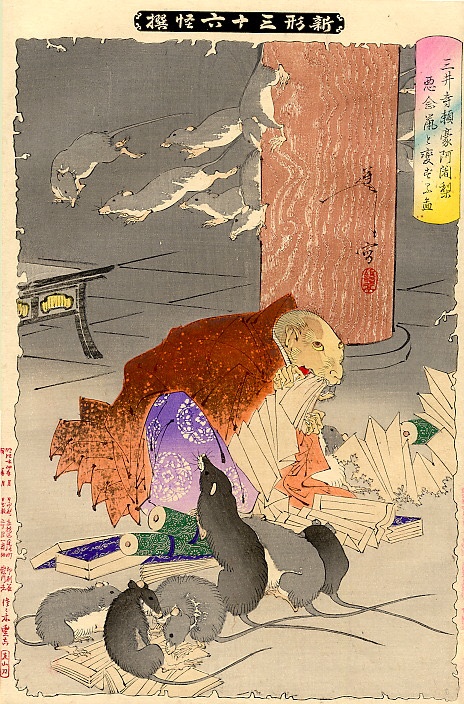
[Despite supposedly looking like an ogre when he died, because of the infamous rat swarm, Raigō in Tesso form is invariably depicted as a big, rat-shaped, Master Splinter-looking guy.]
But the post-Hōgen borderland, where imperial/Fujiwara power was about to tip into the abyss of the era of warlords and samurai, would be full of supposed onryō like Tesso, who occasionally get lumped in with more standard(?) yōkai. “Regular” yōkai like Raijū, a dog that falls from the sky in lightning bolts. Or Chōchin-obake, the (paper) lantern spook. Or the Jatai, a possessed folding screen. Or the Japanese version of Sun Wukong, the Chinese Monkey King from Journey to West, whom the Japanese called Son Gokū.
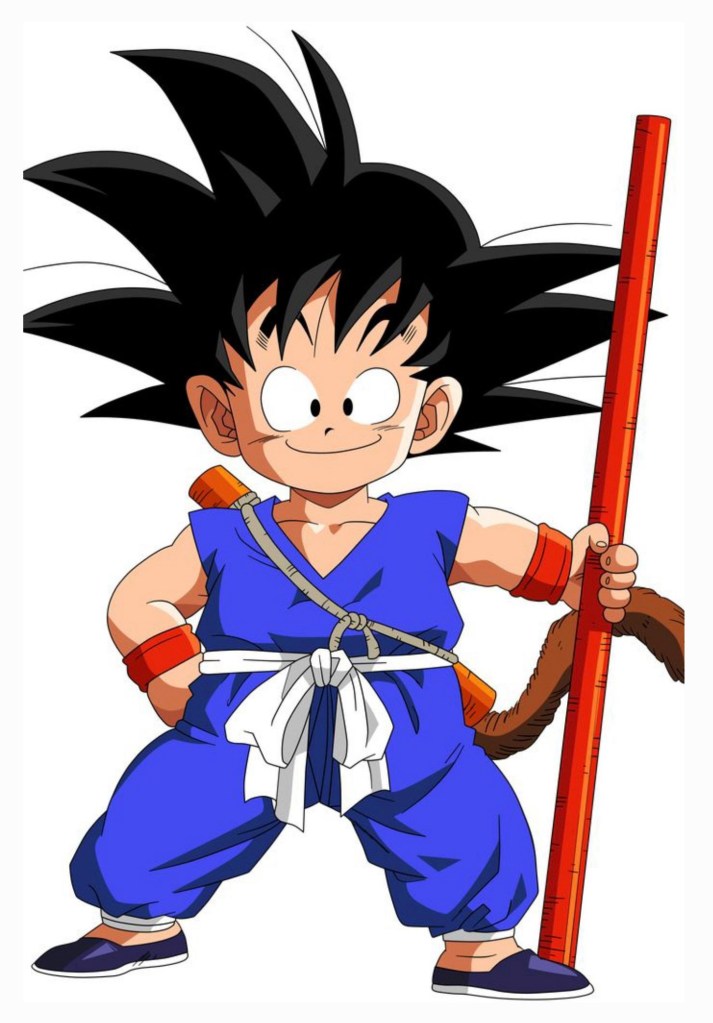
[Ooooooooh…]
The post-Hōgen onryō were obviously those who had picked the losing—but still morally valid—side of the dispute, and it was this element of not really being in the wrong that seems to given them the power to exact revenge on the winners. Part of the reason that the rebellion brought down the Fujiwaras alongside the imperial house is because the clan failed to uniformly pick a side in the conflict and they were ultimately destroyed in detail. The ruling regent, Fujiwara no Tadamichi, correctly backed the winner, Emperor Go-Shirakawa, but his father, the former regent and clan head Fujiwara no Tadazane, and Tadamichi’s younger brother, Yorinaga, supported retired emperor Sutoku. Tadazane would live another decade beyond the rebellion, but he was even more sidelined by Tadamichi than he’d been previously, and many thought that the eventual destruction of the Fujiwaras’ power was the result of influence from his vengeful ghost against his unfilial eldest son.
The now completely powerless Sutoku was exiled from court and took monastic vows, but his shunning from the capital—combined with his alleged performances of piety while in exile—were said to have turned him into one of the most powerful onryō ever created and that he was the true cause of the total collapse of imperial power that occurred at the conclusion of the apocalyptic Genpei War (1180-85 CE).

[Sutoku (top left) as an onryō, probably drowning his last relative, the young emperor Antoku and his grandmother at the disastrous Battle of Dan-no-ura in 1185.]
So yeah, this gives you a sort of taste for the breadth in which yōkai operated—and continue to operate—in Japanese culture. Like their European counterparts (domovoy and WWII-era gremlins leap to mind), yōkai exist to answer questions as mundane as “why aren’t my keys where I thought I left them?” and as existential as “why did the people in charge make the decisions they did?” The world can be as big and hard to comprehend today as it was to our ancestors living at the edges of impenetrable dark forests, and I think the continued cross-cultural existence of yōkai and similar modern urban legends and cryptid creatures speaks to this. Humans love the strange, the cute, and the mysterious—what are yōkai but some of the most creative expressions of these desires?
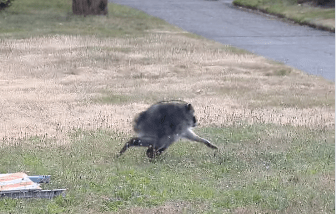
[What is Seattle’s Jimothy if not Japanese yōkai tanuki in an American outfit?]


Leave a Reply