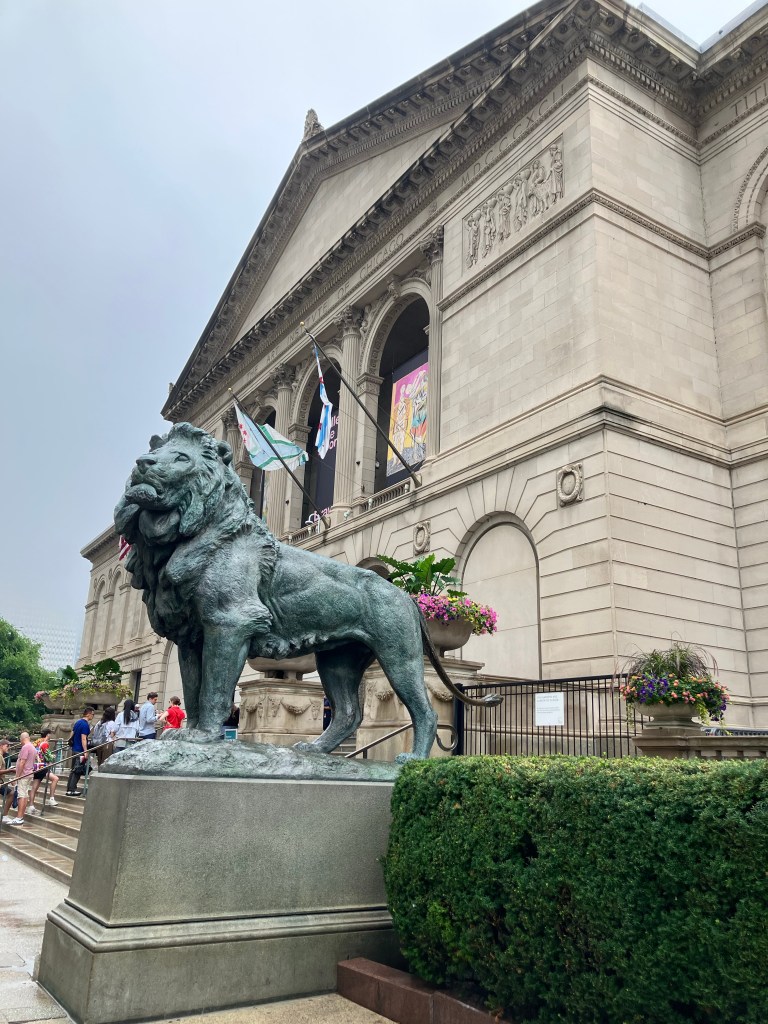
So last time I promised you all a “beach episode,” and still made you learn stuff about medieval Japan, which was arguably kind of an abuse of the term beach episode. So this week, I thought I’d give you a real break from our current stream and do a museum entry instead!
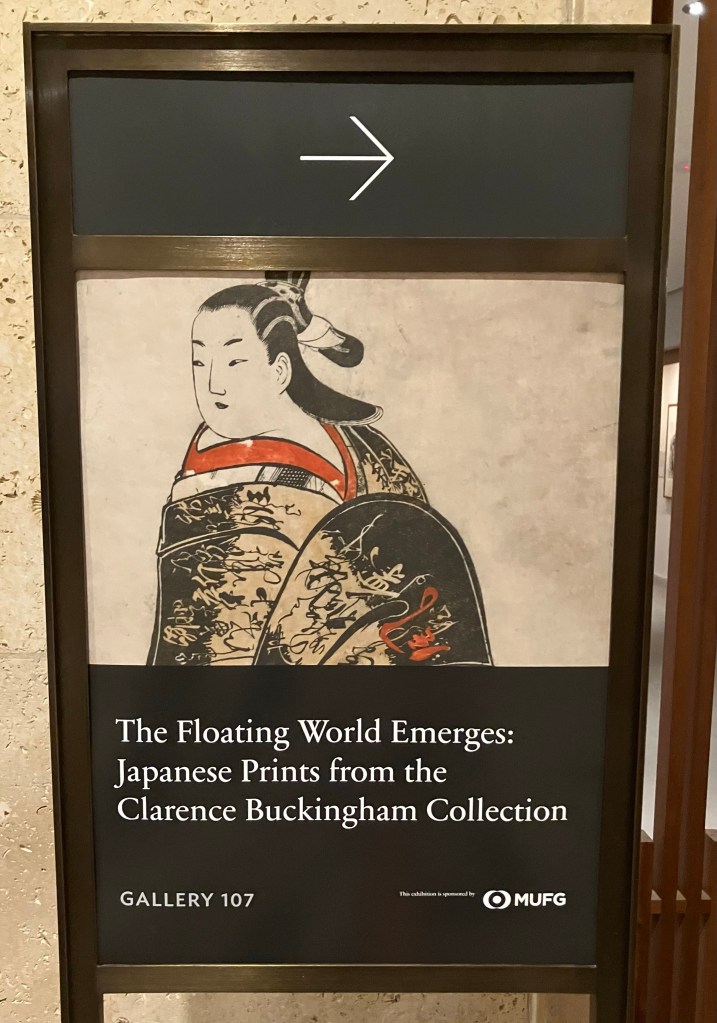
[Okay, there might still be some Japanese stuff…]
Because last week my wife and I spent some time in Chicago, and while we did all the other touristy things—observation deck at Willis Tower (0% visibility), riverboat tour (85% humidity), cross-town Cubs/Sox game (actual decent weather!)—we also spent a (rainy) day at the Art Institute, and since I’d never been, I have feelings. So like my Met entries from a couple of years ago, I thought I’d take you all around with me and gander at what caught my eye.
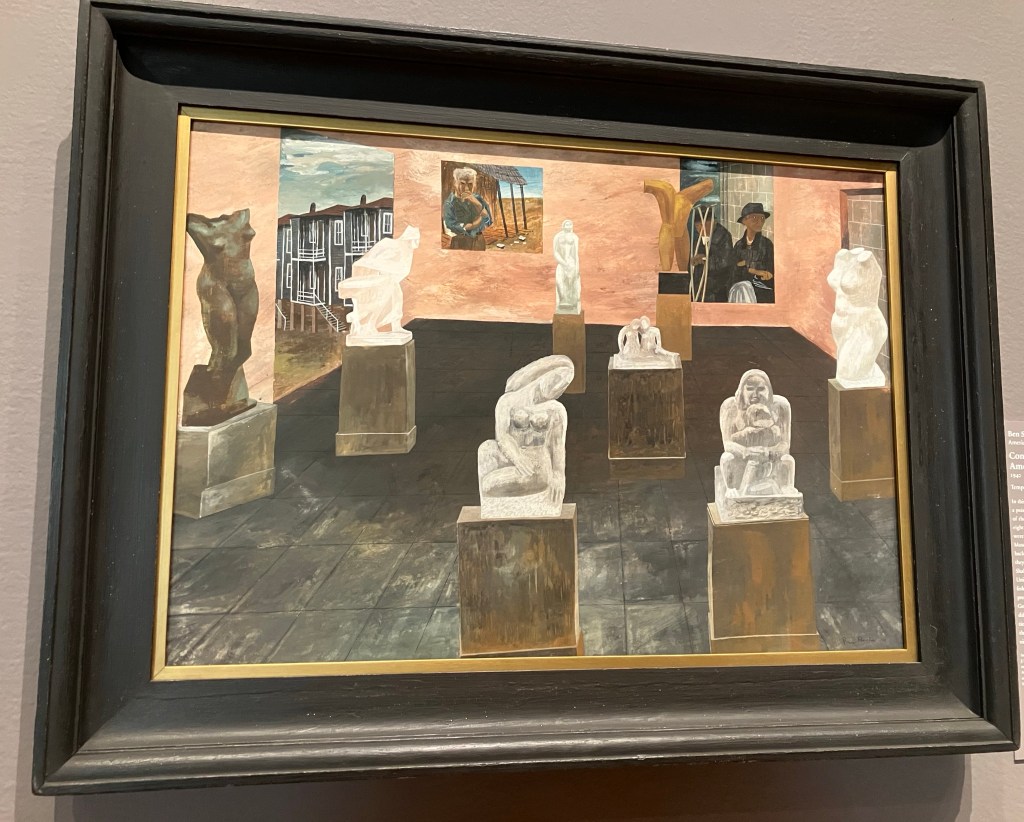
[American Sculpture, Ben Shahn (1940)]
This is something a little easier to do with AIC than the Met because it’s what I’d consider a mid-sized art museum. It’s bigger than CMOA—if you want to see everything, you really do have to devote the day to it—but unlike the Met, I do think it is actually possible to thoughtfully view the whole thing in a single (long) day. But let’s take a look around!
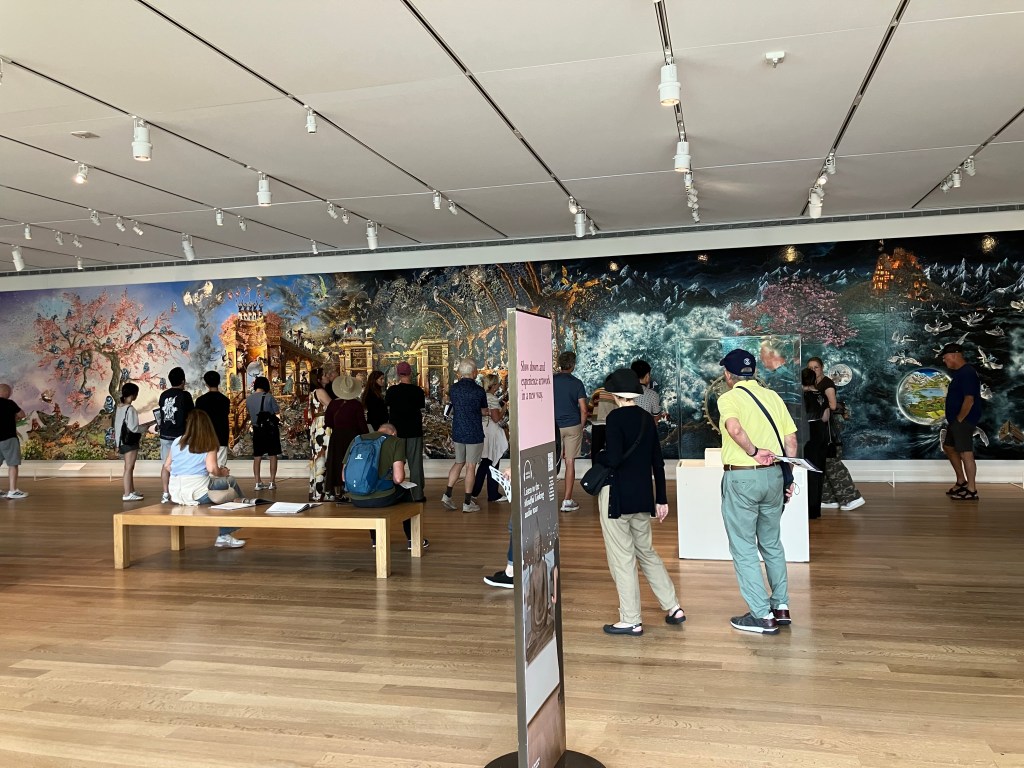
[Paradise Lost, Raqib Shaw (2009-25)]
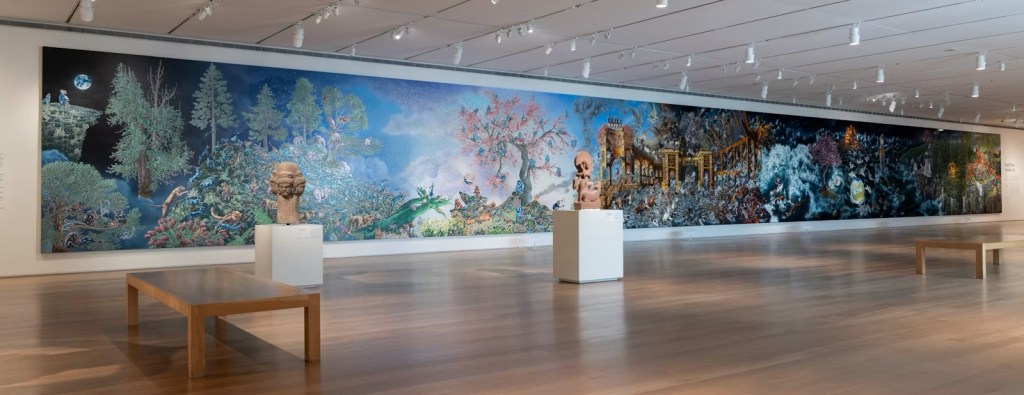
[Here’s a picture from AIC, so you can get a sense of it without the Saturday crowds]
While not literally the first thing I saw, London-based Kashmiri artist Raqib Shaw’s magnum opus, Paradise Lost, was impossible to ignore—and not just because I had to crisscross the Southeast Asian annex it was in six million times getting from here to there during the day. Unfortunately pictures just can’t do justice to the sheer scope and beauty of this piece. Because of its size, Paradise Lost is often exhibited in pieces, but AIC has all four panels on loan together through mid-November, and having seen them as a whole, I can’t imagine them apart. The museum literature says that Shaw isn’t directly referencing the Milton poem, but instead rather dialoguing with it through the lens of Kashmir’s fraught political history and Shaw’s wide-ranging interest in both eastern and western art and mythology. And while nothing specifically references it, my first thought walking in on it was, “Oh, it’s like someone trying to express the Mahabharata in a single painting!”

[Paradise Lost (detail)]
Aside from its jaw-dropping size and eye-catching color palette, the other thing that arrests about Shaw’s style is his use of enameling techniques that give his paintings both texture and an almost cloisonné-like appearance.
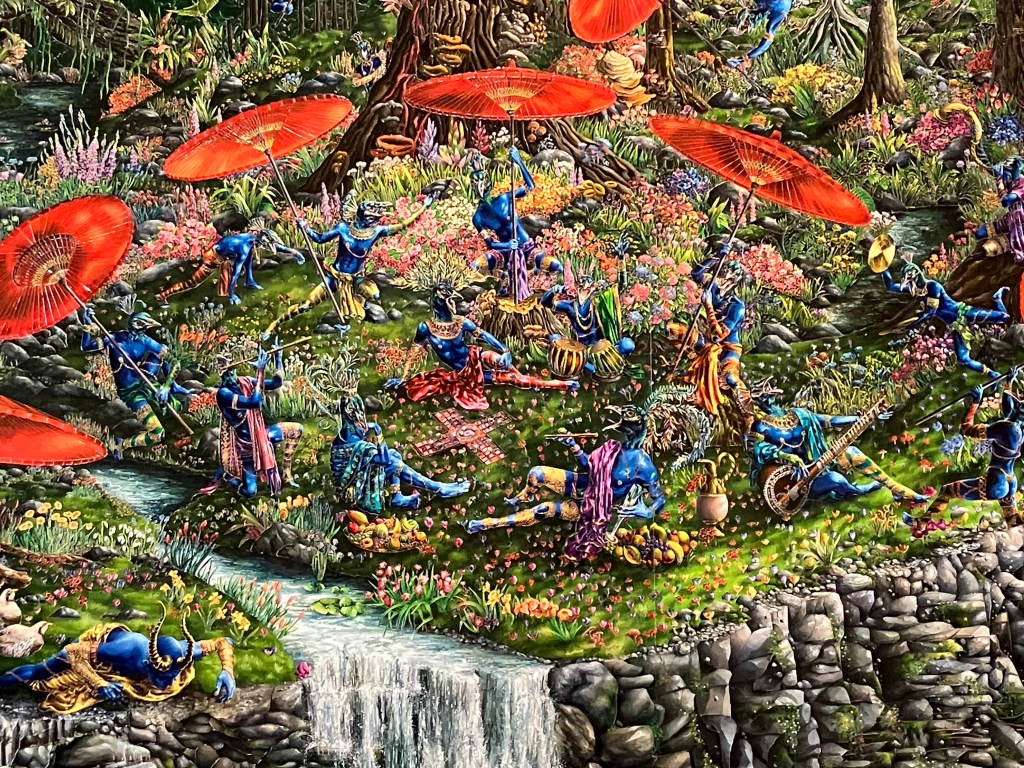
[Paradise Lost (detail)]
But so we don’t spend the whole entry on just one (amazing) painting, let’s see what else we can find…
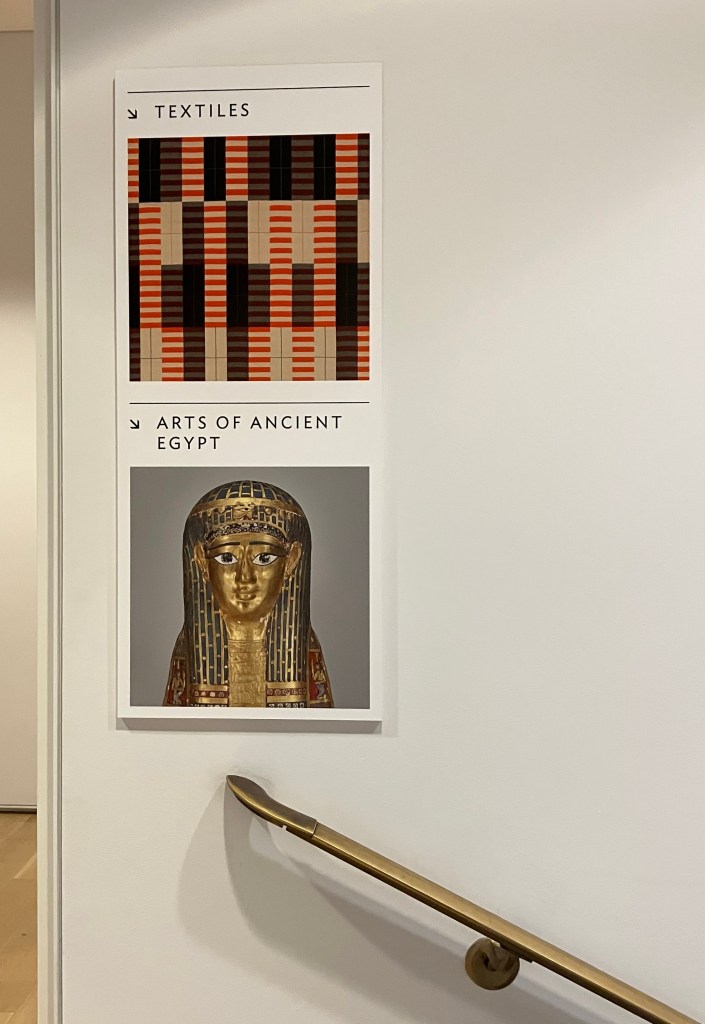
[Let’s follow mother into the basement!]
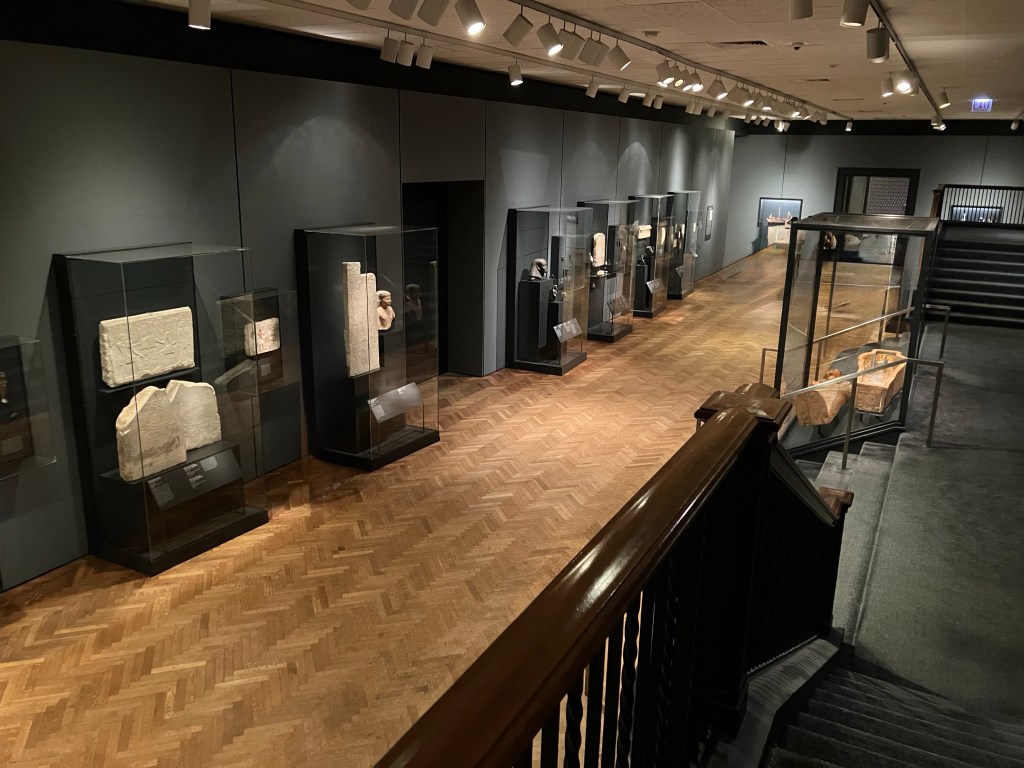
[AIC’s Egypt gallery]
As you can see, like CMOA/CMNH, AIC doesn’t have an extensive Egyptian collection, but there were some pieces of interest. One them is a relatively famous, relatively rare beaded mummy portrait covering (see below). The design over the neck is of Khepri in his scarab beetle form as an amulet symbol of rebirth and resurrection.
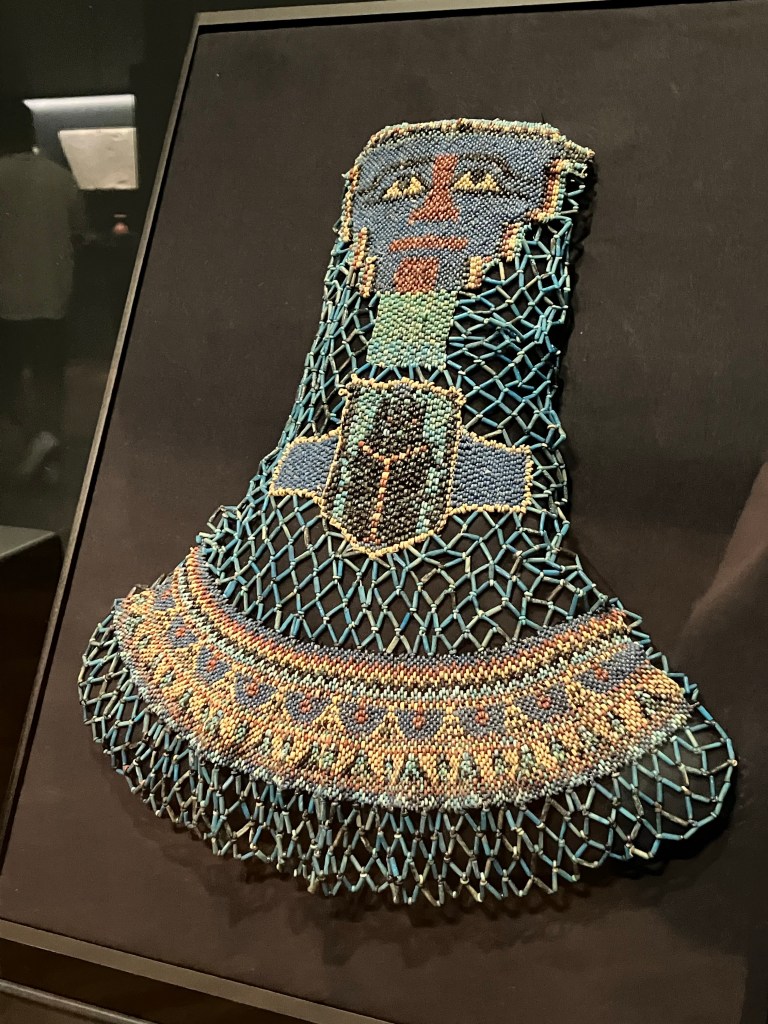
[Bead Net Mummy Shroud, Late Period, Dynasty 26 (664-525 BCE); Faience beads]

And speaking of mummies, as perhaps befitting an institution bigger than CMOA, but smaller than the Met, AIC is apparently staking out a middle-of-the-road position in the display of remains debate. They have only one mummy (on display), a man named Pa-ankh-en-Amun, who served in the ceremonial role of doorkeeper to a temple of Amun, and he is here, but only within his coffin and not visible to the public. You all know how I’m always hesitant to share remains on main here, but Pa-ankh-en-Amun’s coffin is a really beautiful specimen and is worth seeing, and I can understand—particularly in light of Egyptian burial beliefs—AIC’s decision that it is potentially less disrespectful to not separate Pa-ankh-en-Amun from his coffin, while trying to honor his dignity by not leaving his body visible.
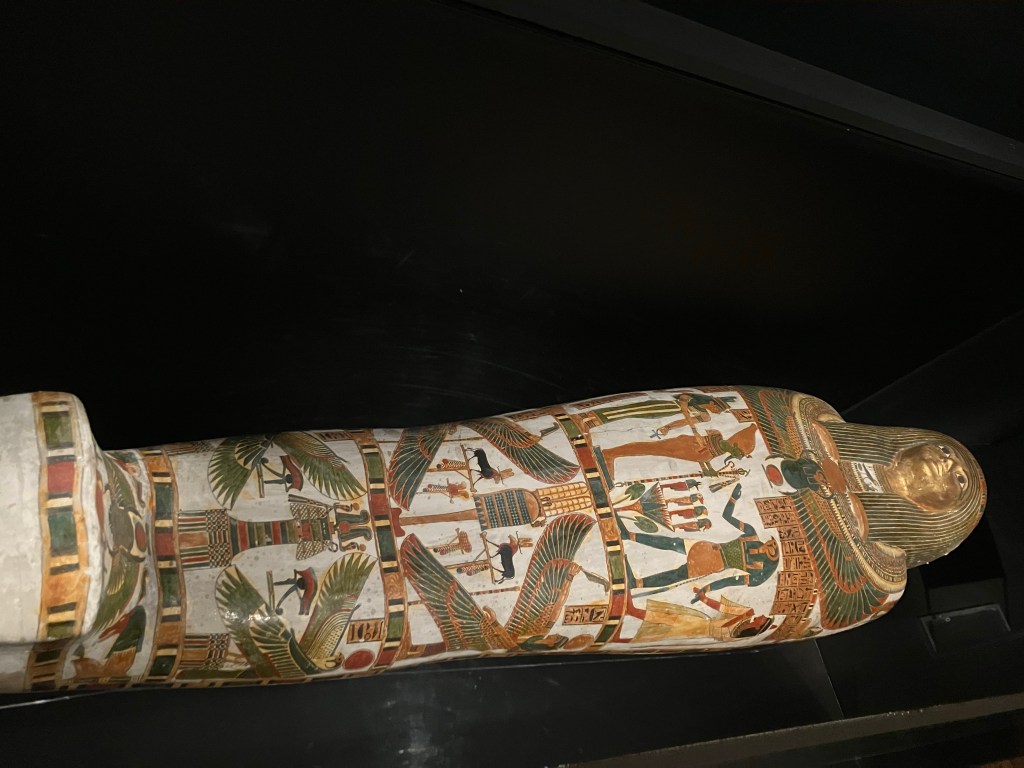
[Coffin and Mummy of Pa-ankh-en-Amun, Third Intermediate Period, Dynasty 22 (about 945-715 BCE); Cartonnage, gold leaf, pigment, and mummified human remains. ***May the passages of the West be straightened under the feet of Pa-ankh-en-Amun for sharing himself with us***]
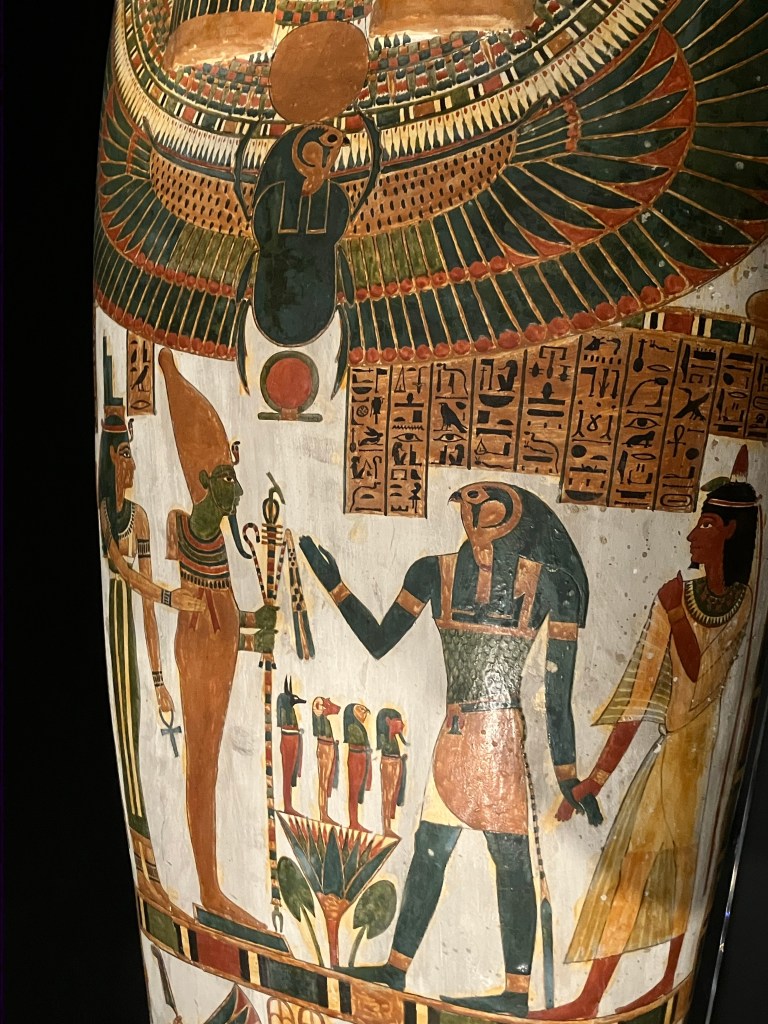
[Coffin of Pa-ankh-en-Amun (detail)—check out these gorgeous colors. Here you can see Horus (center R) leading Pa-ankh-en-Amun (far R) before Osiris (center L) and Isis (far L), as well as Horus’ four sons Duamutef, Hapi, Qebehsenuef, and Imsety at Osiris’ feet.]
Speaking of the Horus’ Fab Foursome, AIC has a really beautiful set of canopic jars as well, although this set—as is sometimes the case—uses human heads for all the jars, rather than differentiating the three gods who are not Imsety by their animal-headed iterations. Also, like most canopic jars you’ll see in a museum, these ones lost the organs preserved within them long ago, and are therefore usually not a part of the display of remains debate.
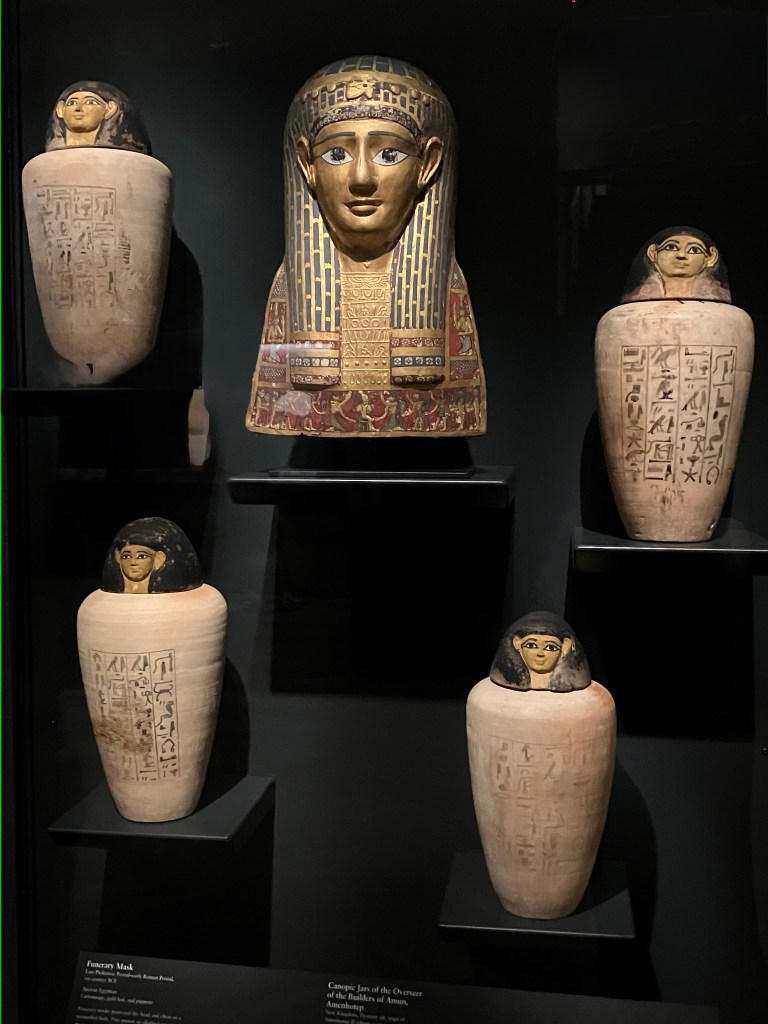
[Canopic Jars of the Overseer of the Builders of Amun, Amenhotep—New Kingdom, Dynasty 18, reign of Amenhotep I (about 1427-1400 BCE); Ceramic and pigment. Incidentally, the funerary mask at center doesn’t belong to Amenhotep—it’s a later Ptolemaic/Roman-era mask (you can kind of tell by its wider-eyed, less strictly-classical Egyptian style)]
Gosh, there’s more I could go on about even in this tiny Egyptian gallery, but we gotta get out of the basement or this entry will be a billion pages long. So let’s go to the real treat of a surprise for the whole day: the extensiveness of AIC’s Greco-Roman gallery!
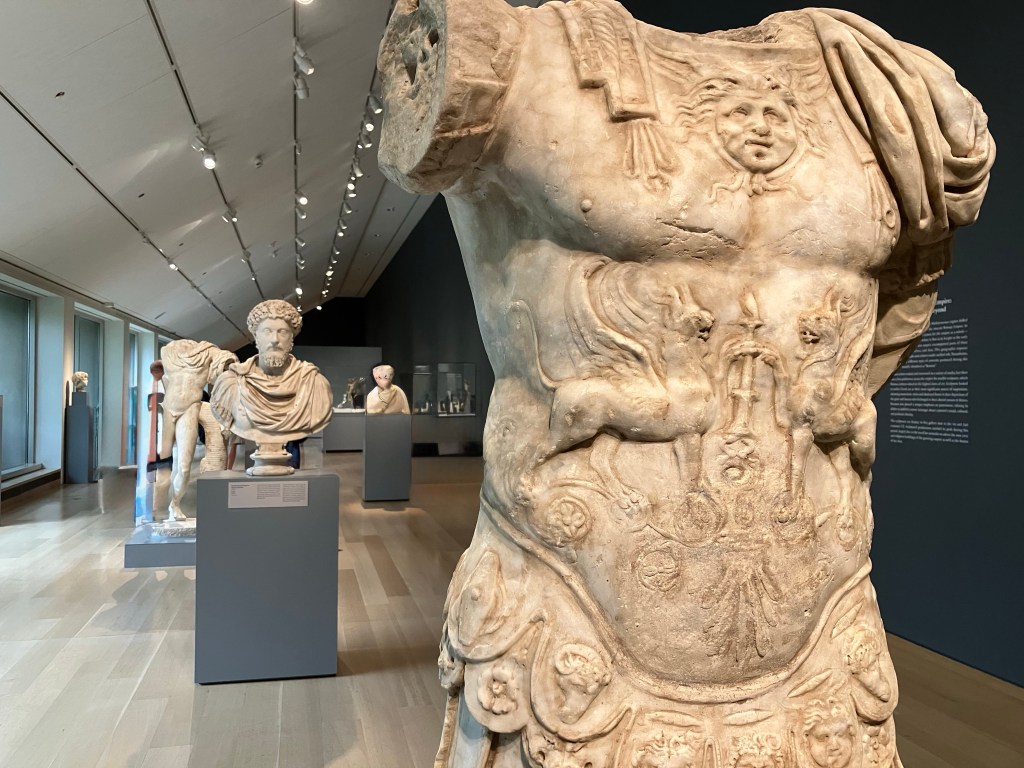
After the size of the Egyptian section, I had tempered my expectations, but if I really wanted to bore you all, I could probably do a whole entry just on this gallery because there was a ton of interesting stuff to see. One of the big surprises was how gorgeous their collection of kraters, kylixes, and other Greco-Italian pottery was. I like classical pottery, but I frankly found the Met’s collection overwhelming in scope, and this was much more manageable.
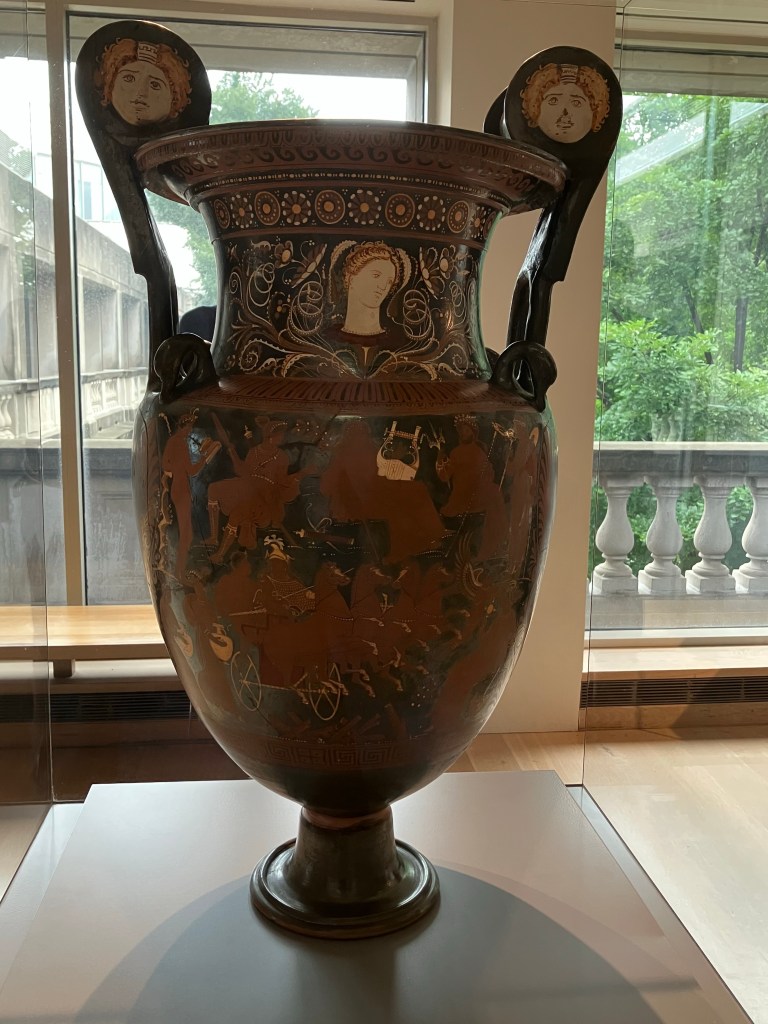
[Like, this krater (a vessel for mixing liquids, primarily adding water to wine, is beautiful. The red figure gods didn’t photograph particularly well, but the white bust up top is such an arresting contrast.]
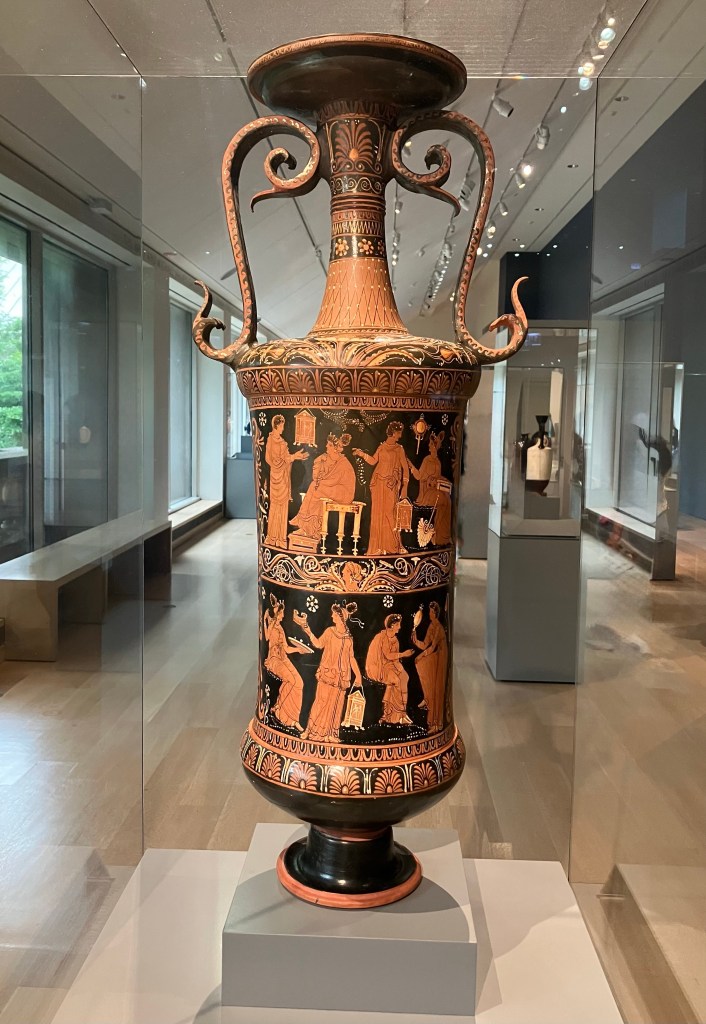
[Or check out the elaborate beauty of this loutrophoros, a vessel designed for transporting bathwater. This is an especially intricate version of this type of vessel, likely specifically—based on its design and the illustrations of dressing on it—meant for the ritual baths preceding a bride’s wedding day.]
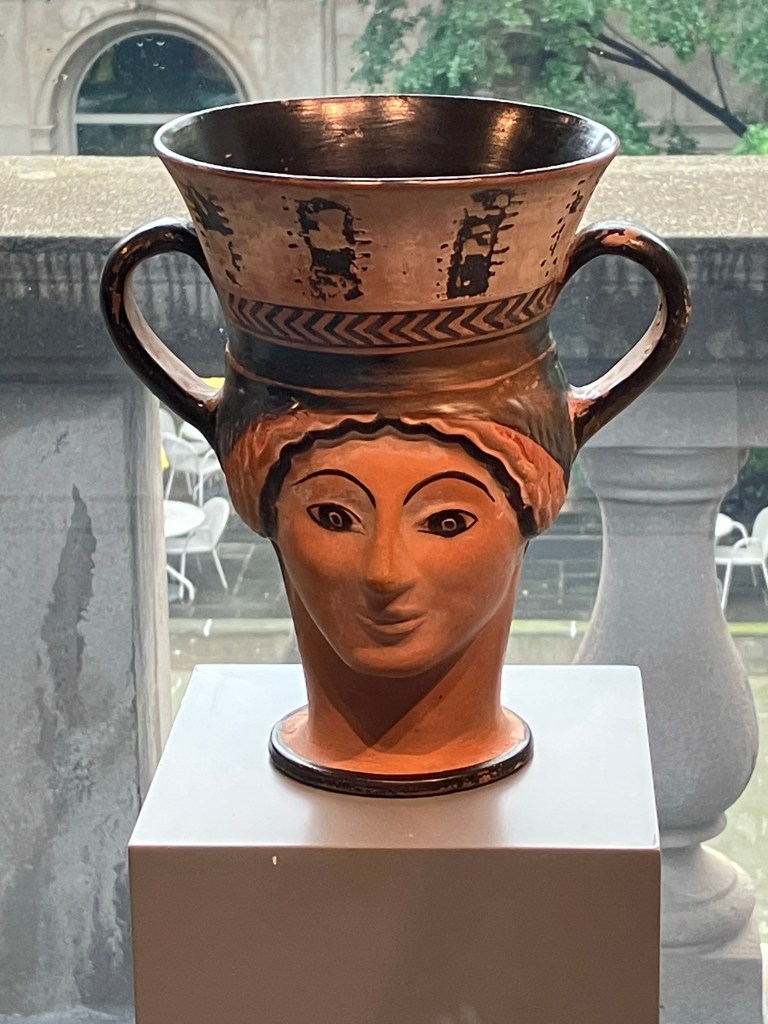
[Or how about this vessel shaped like a woman’s head, with the rim looking like a diadem?]
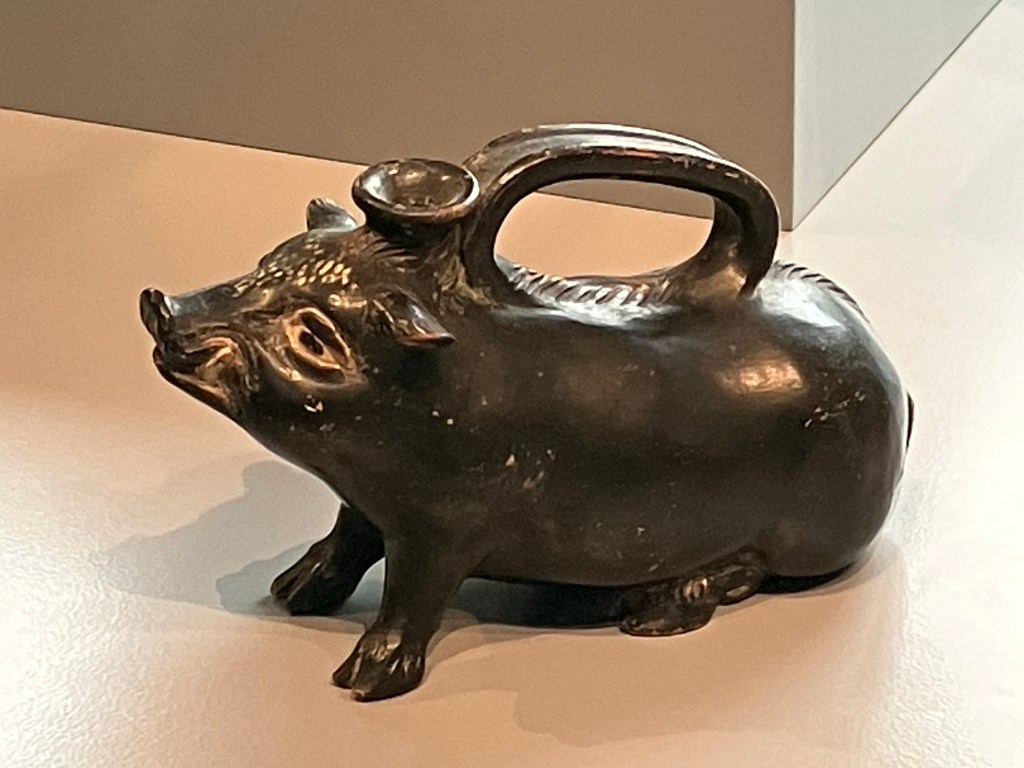
[And it might not be a Boar Vessel 600-500 BC Etruscan Ceramic, but how about a Boar Askos (flask) Mid-4th century BCE Greek Terracotta?🐗😉. This was adorable in person—if they had been selling a replica in the gift shop, I would have bought one, no questions asked.]
Okay, so AIC has a lot of vases. What else do they have? Honestly, some really high-quality marble busts and statuary.
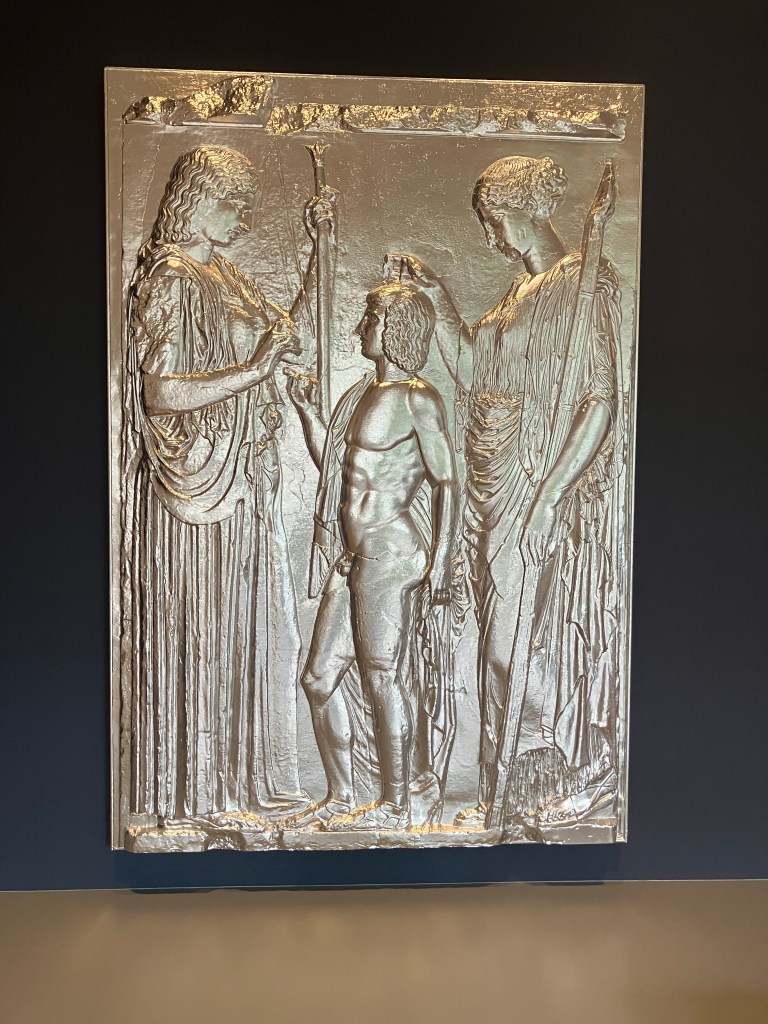
[Also, our old friend, yet another copy of The Great Eleusinian Relief. This one is a copy made of machined aluminum by the American artist Charles Ray (b. 1953) as a contemporary spin on a classical piece. But as a result, we have now crossed some kind of Sculpture Event Horizon, as this is basically a (American) copy of a (Roman) copy of a (Greek) copy. Truly, the Inception of Greek bas relief.]
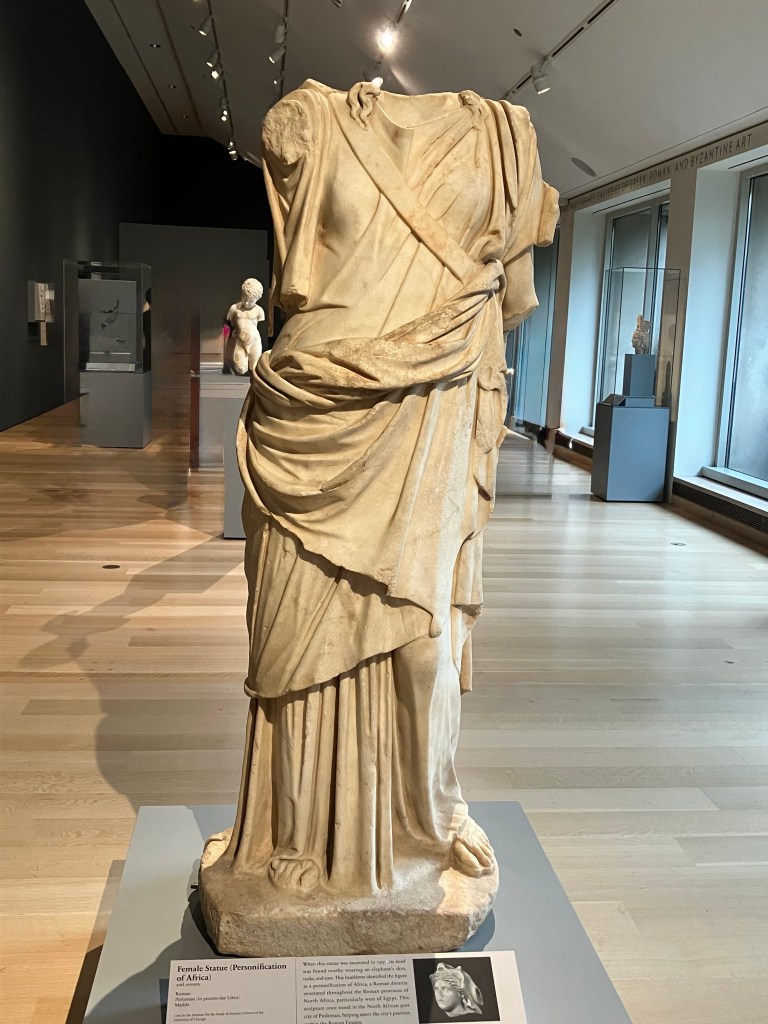
[I love the detail on this Personification of Africa found in excavations of Ptolemais in modern day Libya. I only wish AIC had her head, which apparently has an elephant-head hood (see the photo on the exhibit label below the base)]
I cleaned up a lot of my photos in this gallery to get other patrons out of my shots so you can’t see him anymore, but when I looked past Africa here, I was met by the gaze of an extremely idealized bust of a handsome man in an Egyptian nemes headdress, so it was time to play one of my favorite classical sculpture games: Augustus Or Antinous???
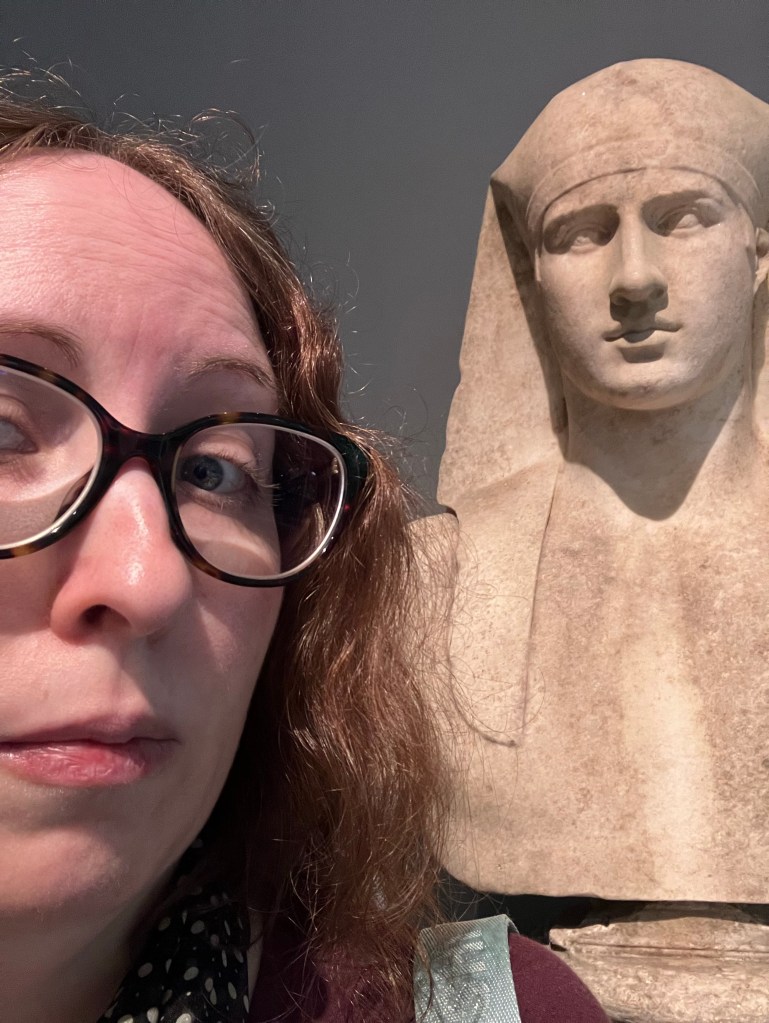
[It’s Antinous! (excuse my hair—see the aforementioned 80%+ humidity discussion) Specifically, Emperor Hadrian’s deified lover here is in his syncretic god form as an incarnation of Osiris. Antinous did a bang-up job of being easily absorbed by several local deities throughout the empire, but in Egypt, he is usually identified with Osiris—in part because Antinous’ untimely death occurred during the god’s Opet Festival, and also because of Osiris’ connection with all Mediterranean-adjacent resurrection and rebirth cycles. Having Osiris’ power combined with Adonis/Tammuz’s beauty is part of the reason that Antinous was Christ’s Final pagan Boss in Egypt (and arguably why some early Church fathers made it a point of pride to describe Jesus as humble in human appearance: to differentiate him from the “shallow” physical attractiveness of the deified boy toy next door.]
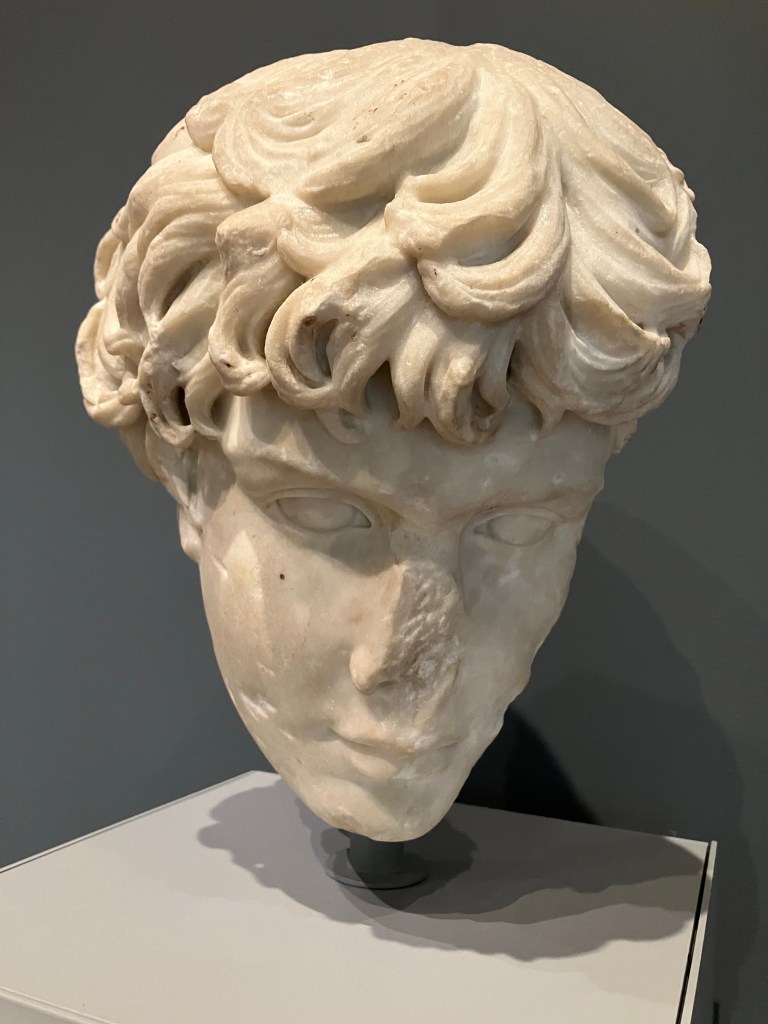
[AIC also has a fragment of a bust of Antinous in his more Greco-Roman deified style. In these portraits, Antinous’ youth is usually emphasized (by his loose, wavy hair), and he is connected with youthful Greek gods like Dionysus and Apollo.]
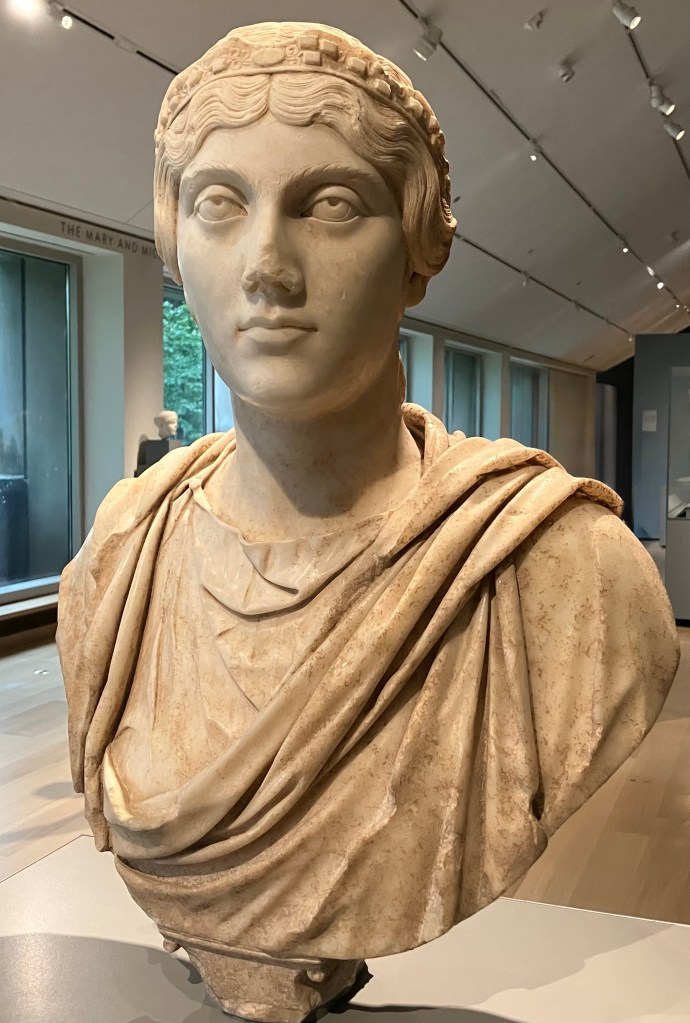
[As for the ladies, one of the crown jewels of the sculpture collection is the bust of an unknown woman from the mid-2nd century. The amount of detail is just incredible up close, and AIC notes that the tasteful-but-discernible outline of the subject’s right breast through her stola is extremely unusual in a bust of a Roman matron.]
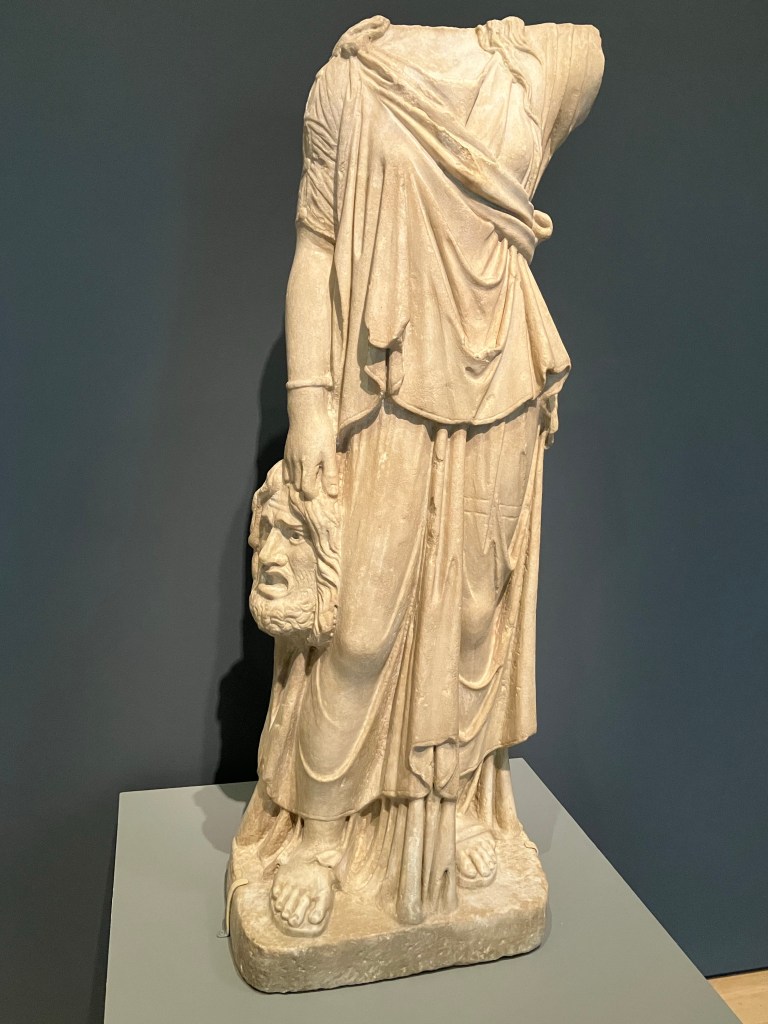
[And in a final note, we have another great headless sculpture—this time of Melpomene, the Greek muse of tragedy (we can tell it’s her by the tragic stage mask she’s holding). It’s on the early side of the process, but I have a fully copy-edited manuscript that might be relevant to her (and her sisters) coming down the pike… Stay tuned in the fall for more details!🎭🤫]
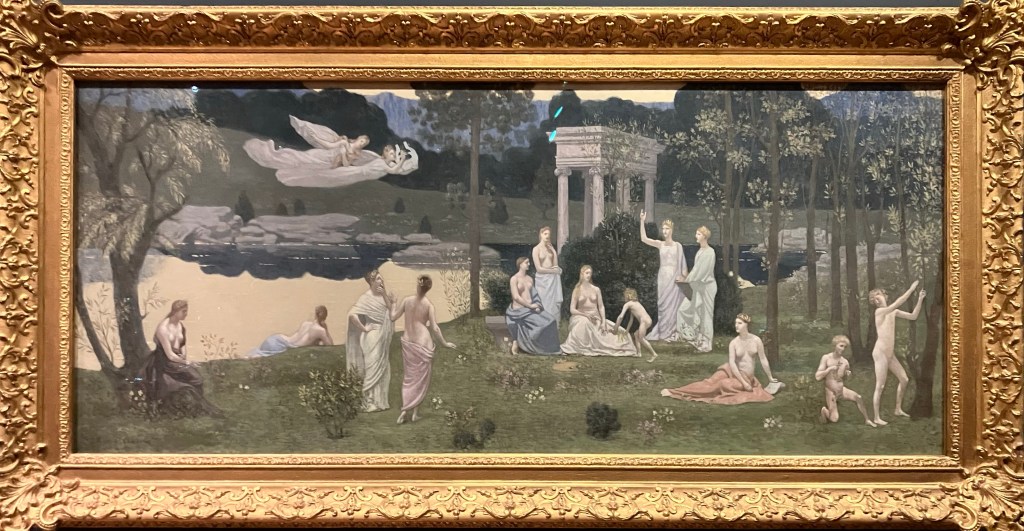
[The Sacred Grove, Beloved of the Arts and the Muses, Pierre Puvis de Chavannes (1884-89)]
Melpomene is a good segue for us to use to go fight the heaviest crowds up in the Impressionism galleries, where we find her with her sisters in Pierre Puvis de Chavannes’ oil painting, The Sacred Grove, Beloved of the Arts and the Muses. Chavannes was primarily a muralist and the style of Sacred Grove is meant to evoke Roman-era wall frescoes. Those of you who are math-inclined might have noticed that there are more than nine women in this painting, and that’s because Chavannes has added personifications of the beaux plastic (in the older sense of the word, meaning molding or shaping) arts—sculpture, painting, and architecture—to the muses’ grove. They are the three seated figures at center (see the detail below), and you can see that Chavannes has differentiated them from the goddesses by their bare heads, while the muses all wear gold-leaf laurels.
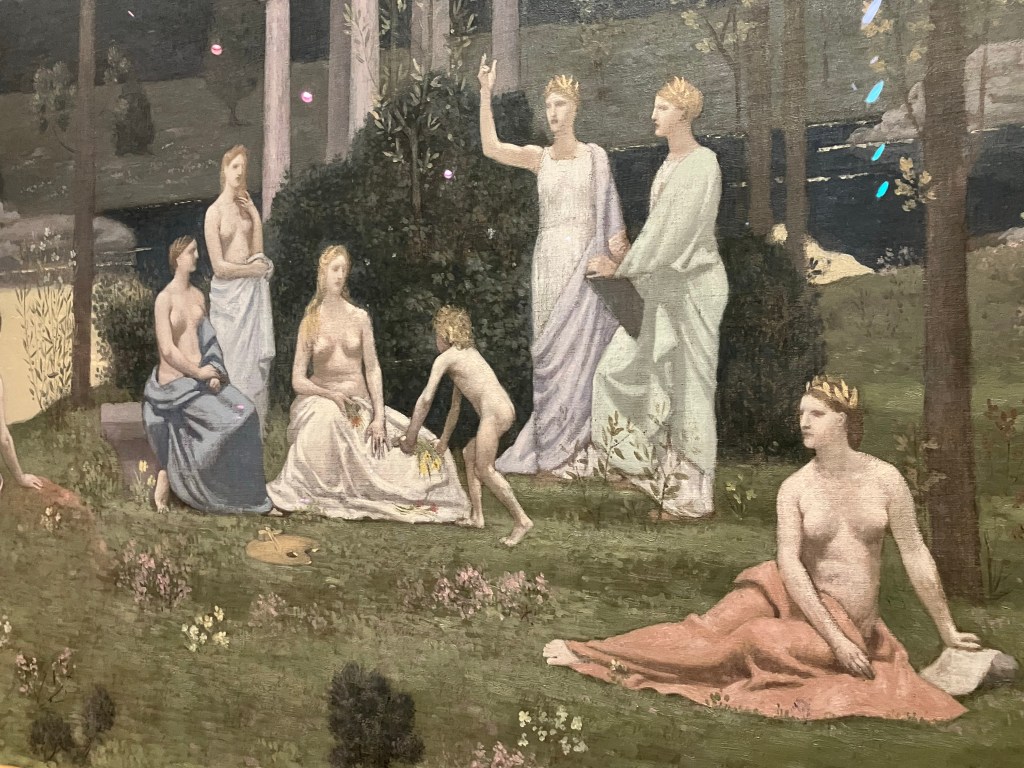
[The Sacred Grove, Beloved of the Arts and the Muses (center detail)]
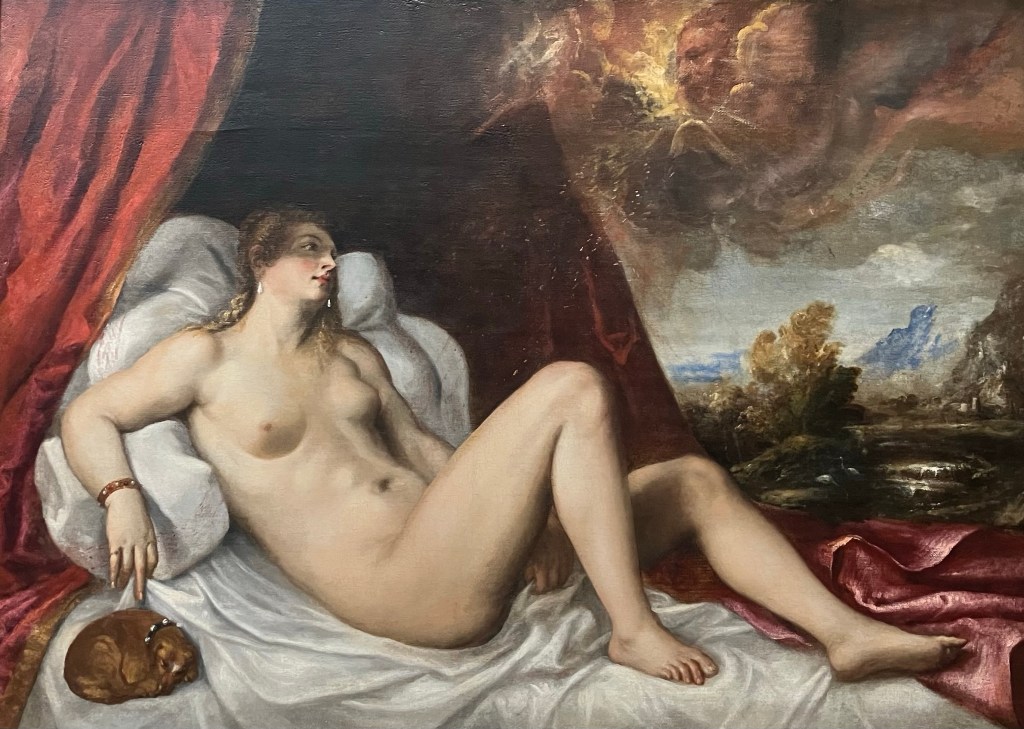
[Incidentally on the mythological front, AIC also has this lovely contemporary workshop copy of Titian’s Danaë painting (the official Titian work is in the National Museum of Capodimonte in Naples.]
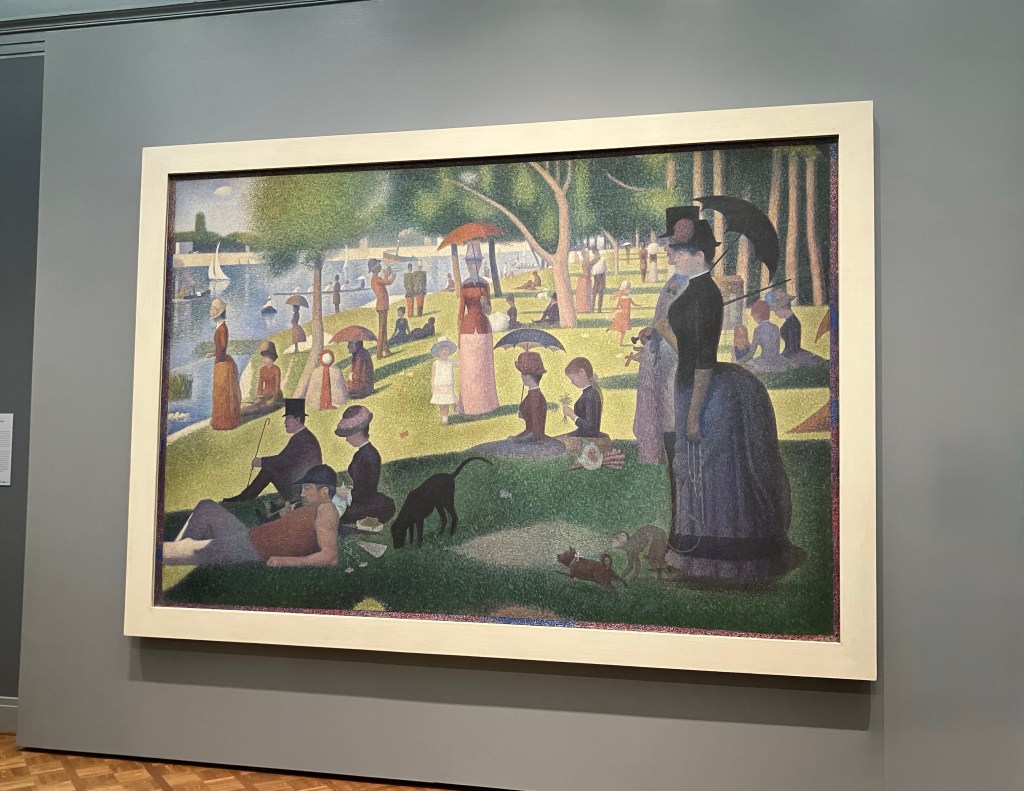
[A Sunday on La Grande Jatte, Georges Seurat (1884-6)]
And while everyone is here to see Georges Seurat’s famous pointillist masterpiece, A Sunday on La Grande Jatte, I was actually more intrigued by AIC’s small oil sketch (see below) that Seurat did as a test for the larger piece. It was interesting to compare and contrast the two to see how Seurat’s vision for the final composition evolved over time.
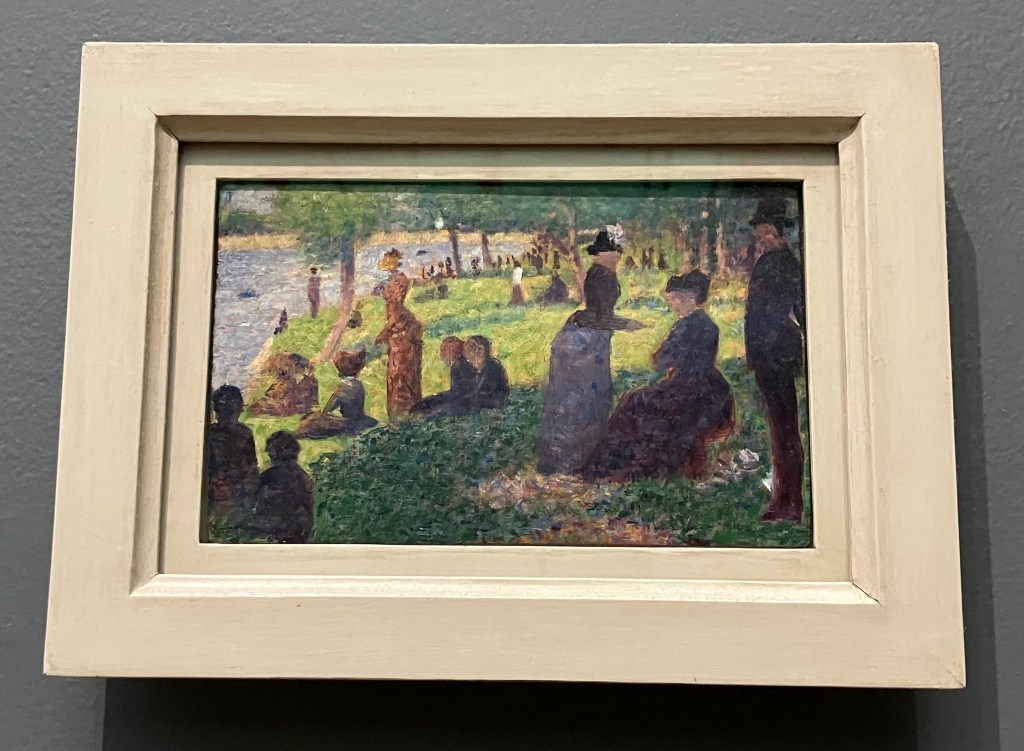
[Oil Sketch for A Sunday on La Grande Jatte, Georges Seurat (1884)]
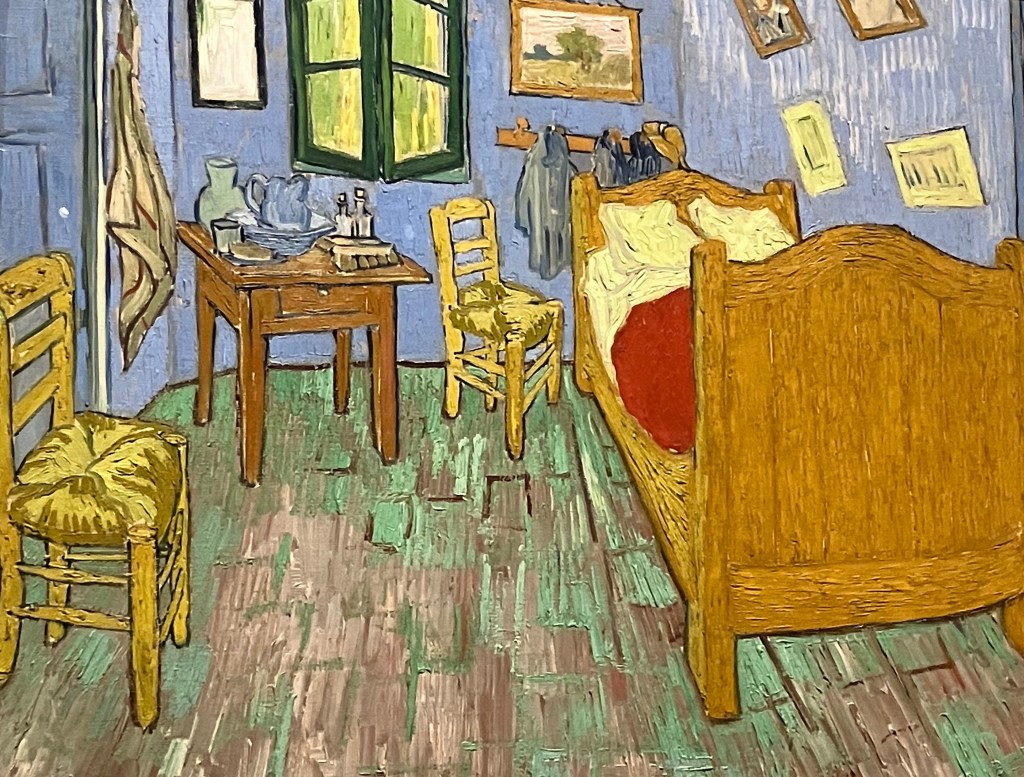
[The Bedroom, Vincent Van Gogh (1889)]
AIC also has several really nice Van Gogh pieces, including most famously The Bedroom above; their collection isn’t as large as the Met’s, but unlike the Met, they have a really nice spread of paintings from all points in the artist’s career, from his earlier, less personally-distinctive paintings to later works that really highlight his experimental approach to form and color that would ultimately lead Post-Impressionism into Modernism and Cubism.

[Like AIC’s iteration of La Berceuse (Augustine Roulin) (1889)]
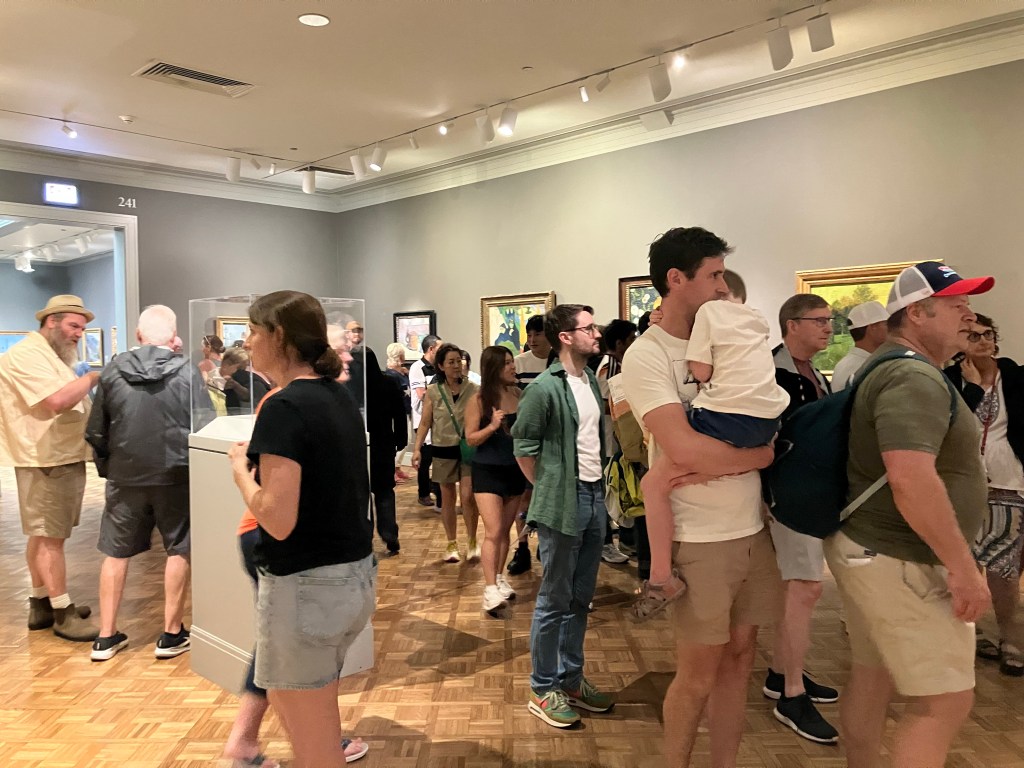
[It is both hilarious and heartbreaking that Van Gogh’s rooms are usually the most crowded in any museum. I’m sorry he never got to see people “getting” his art, but he’s the perfect example of the importance of artistic creation itself. Sometimes we make art for those yet to be born.]
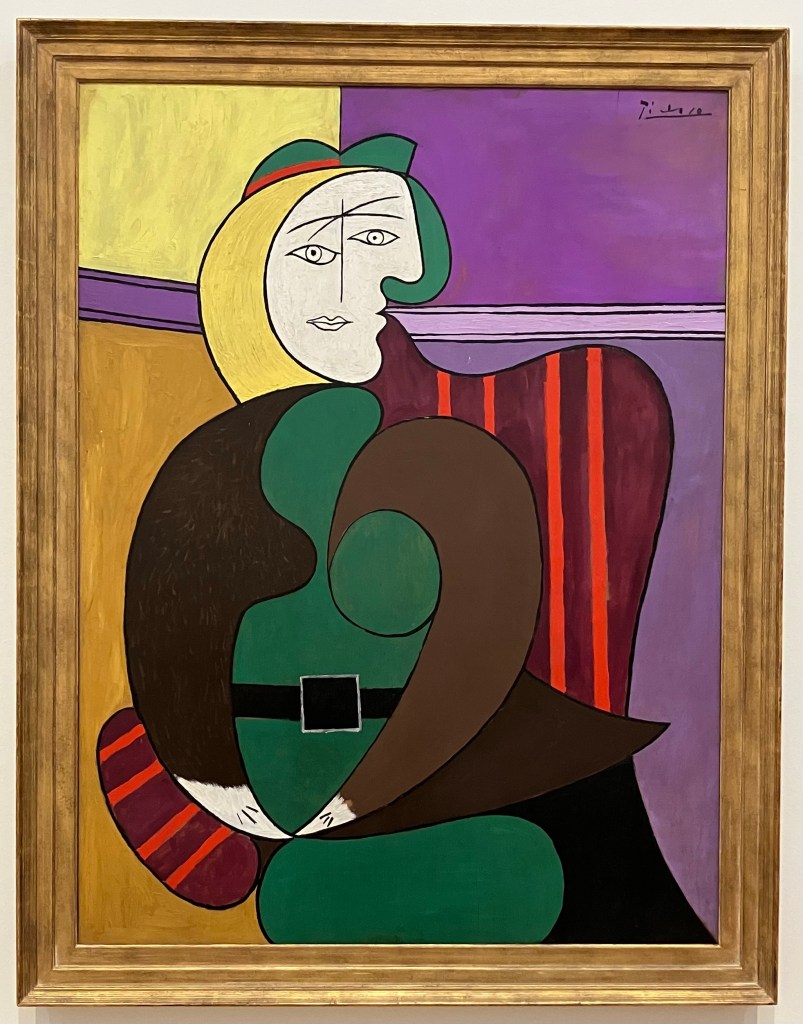
[The Red Armchair, Pablo Picasso (1931)]
Indeed, La Berceuse seems to specifically presage one of AIC’s other most-desired works, Picasso’s portrait of Marie-Thérèse Walter in The Red Armchair. And I know it sounds super-basic to praise a painting they sell on magnets in the gift shop, but it is a truly beautiful painting to see in person. AIC is blessed to have several Picassos, but his use of color in this particular piece is the most striking. The only other one that even came close for me was the lovely painting of Sylvette David below, which is ignobly hanging next to an emergency stairwell.
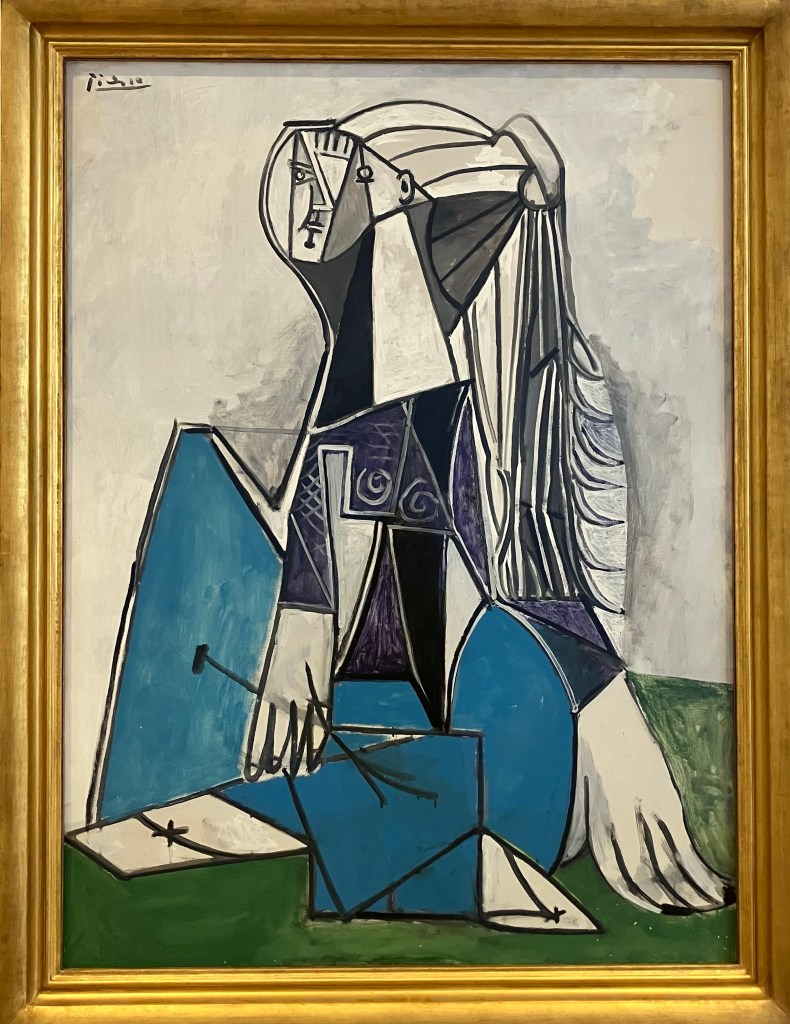
[Portrait of Sylvette David, Pablo Picasso (1954)]
The other most-crowded gallery in AIC probably belongs to Edward Hopper’s Nighthawks (1942) and Grant Wood’s American Gothic (1930), but here I will buck trend and give you the two other pieces you might miss while waiting in clusters to see those:
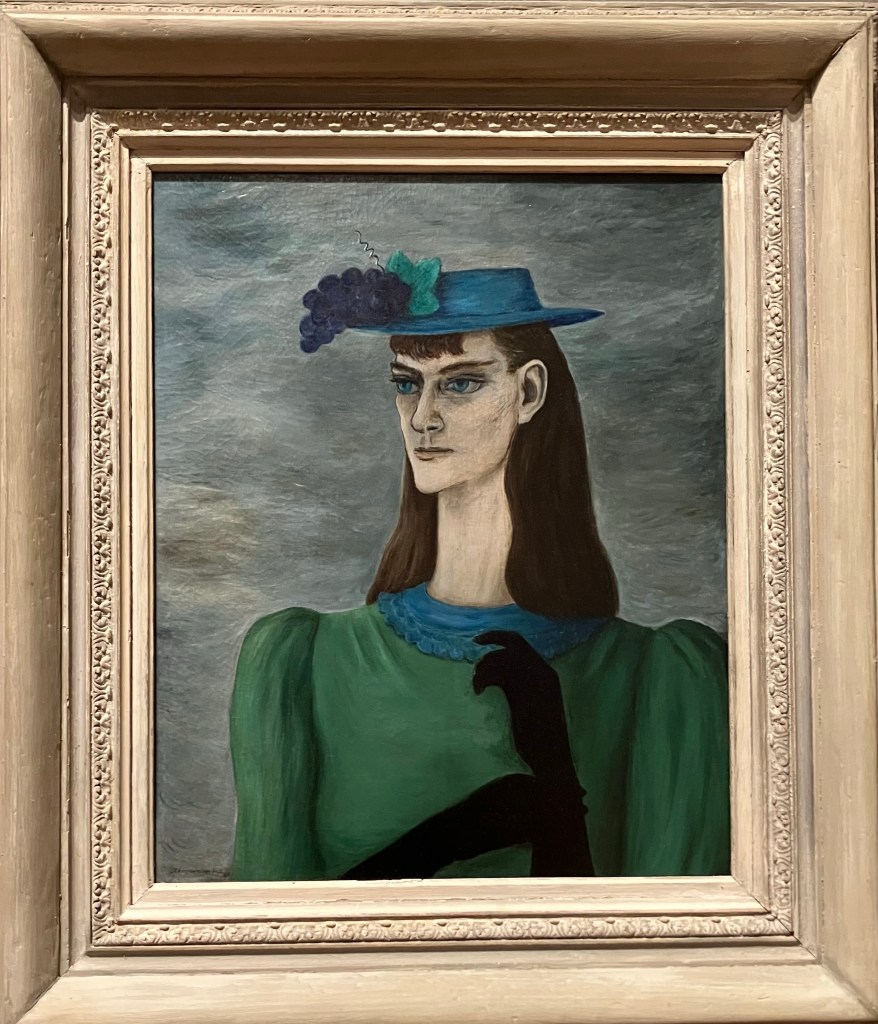
[First being my girl, Chicago’s own Gertrude Abercrombie’s Self-Portrait of My Sister (1941). Like we discussed during CMOA’s exhibition, the joke in this painting is that Abercrombie doesn’t have a sister (hence why it’s a self portrait), and like all of her paintings, the woman is one the many versions of herself that appear in her oeuvre.]
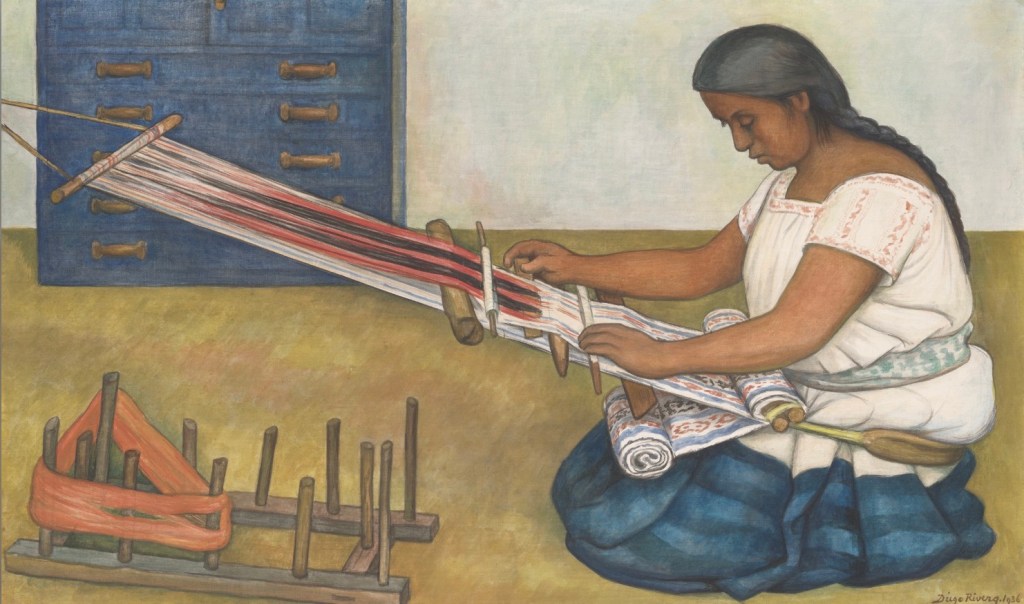
[The other is Weaving (1936), which attracted me from across the room even before I saw that it was by Diego Rivera. Normally, I consider Rivera hopelessly outclassed as an artist by his wife, Frida Kahlo, but with no Kahlos about to distract me, I appreciated the simple lines and composition of this piece.]
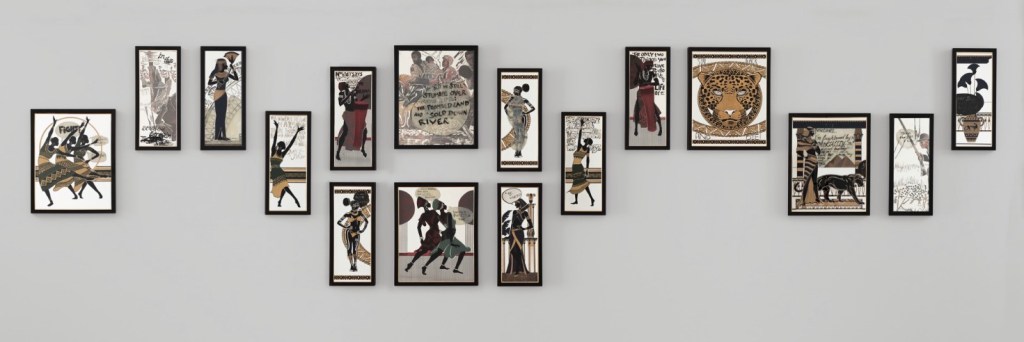
[Free, Black, and Passive Aggressive, Kara Walker (1998)]
I’m going to have to start rapid-firing through some of this as I’ve already gone on too long, but I have to give a particular shout out to another crammed-in-a-nook piece that I just loved, which is Kara Walker’s Free, Black, and Passive Aggressive. Walker used thrifted mirrors to paint a conversation about Black identity and the limits of Afrocentrism, and this was another piece that was just very striking in person.
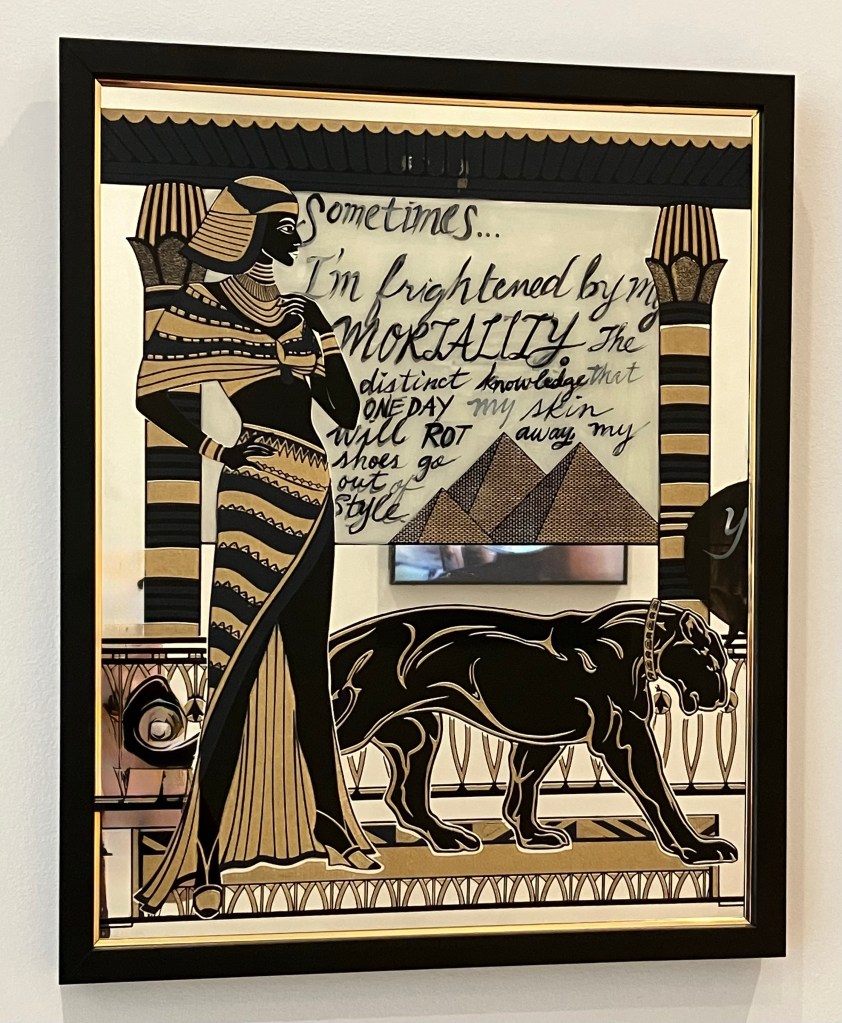
[Free, Black, and Passive Aggressive (detail)]
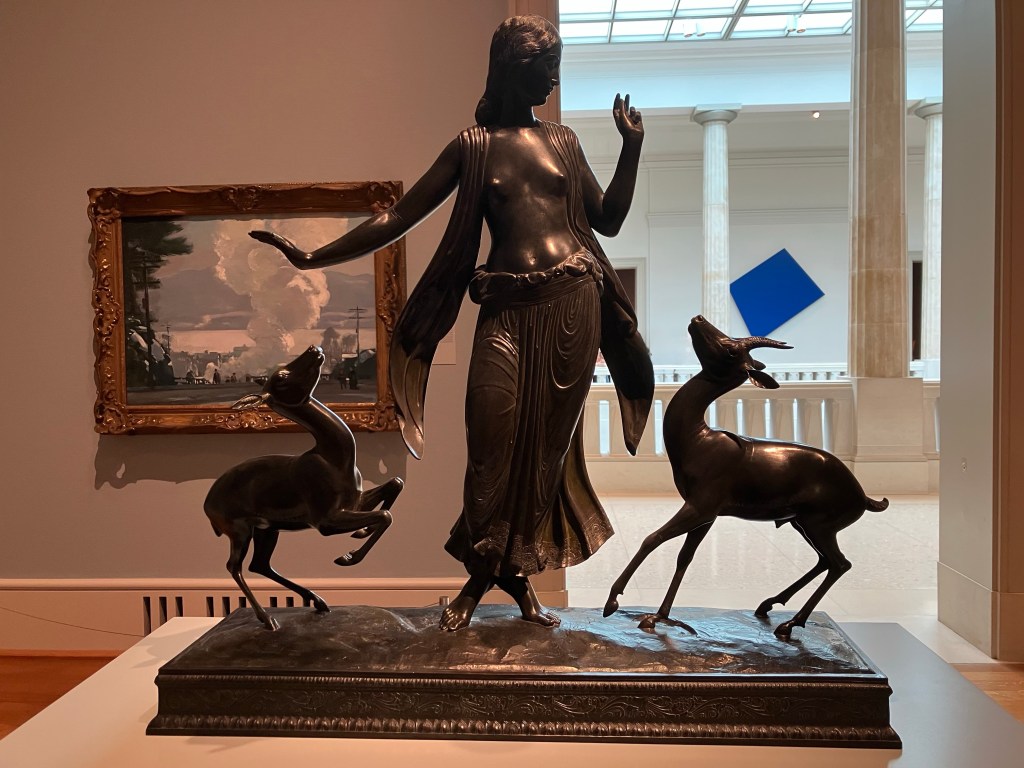
[I was delighted to discover that AIC is home to one of my favorite Paul Manship sculptures, Dancer and Gazelles (1916). Like the Artemis sculpture copy CMOA has, Dancer is somewhat classically-inspired, but its main inspiration for pose and movement is actually Indian classical dance. In this way, the female figure at center is part Artemis with her herd and part Sita in forest, blending both in the Art deco style Manship is famous for.
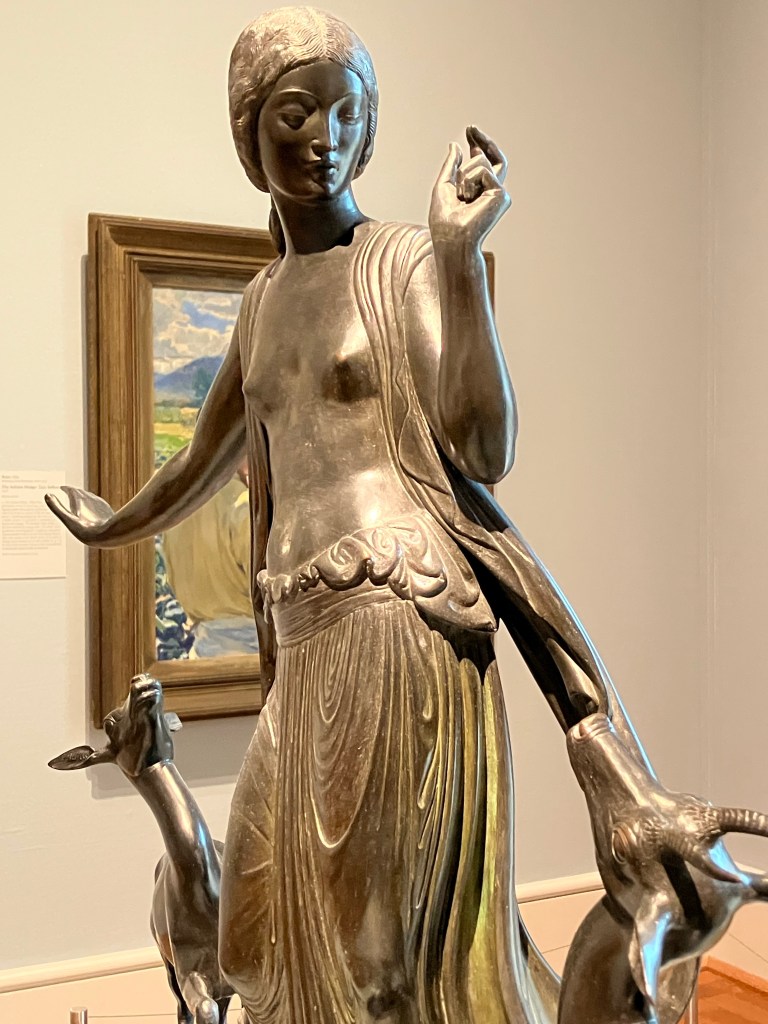
[Dancer and Gazelles (detail)]
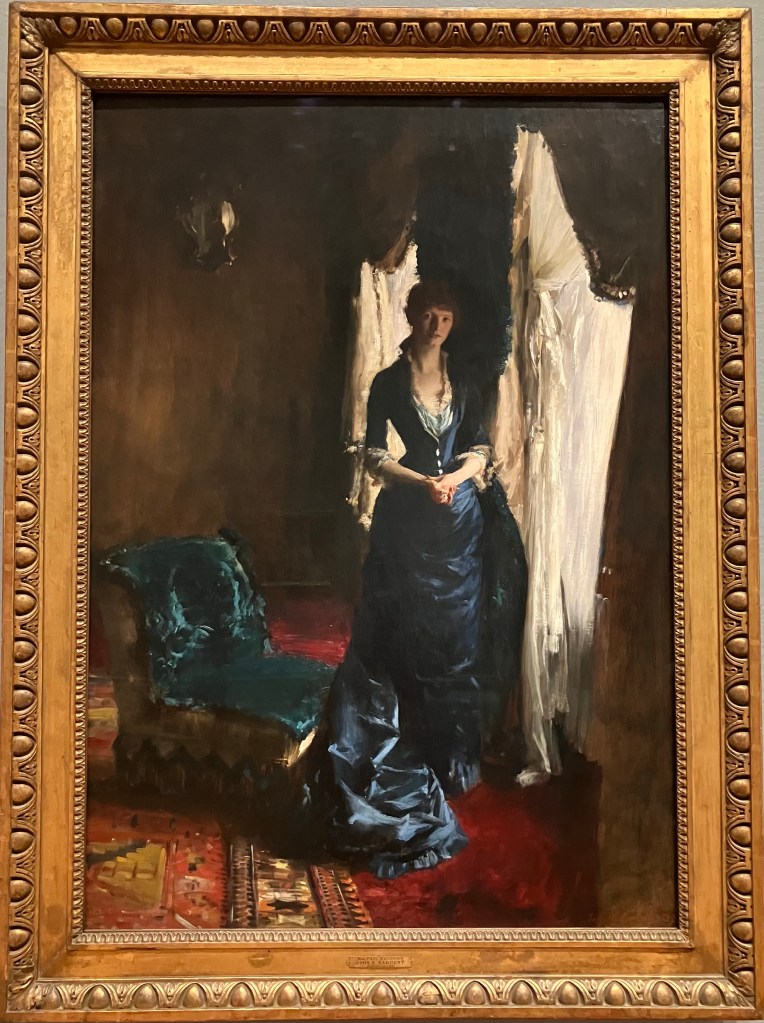
[Like the frustrated artist himself, I don’t tend to go wild for John Singer Sargent’s endless society portraits, but I did like this one of Louise Escudier, because it’s fascinating blending of historical techniques, combining the looser brushstrokes of Impressionism and the play of light more reminiscent of da Vinci and Diego Velázquez. It highlights that Sargent really was a really good painter when he was given anything interesting to do.]

[Saint George and the Dragon (detail), Bernat Martorell (1434/5)
My hottest take of the trip is that I think AIC’s medieval art collection is more interesting than the Met’s, but as with everything else there’s way too much to show, so I’ll just do a couple that stand out.
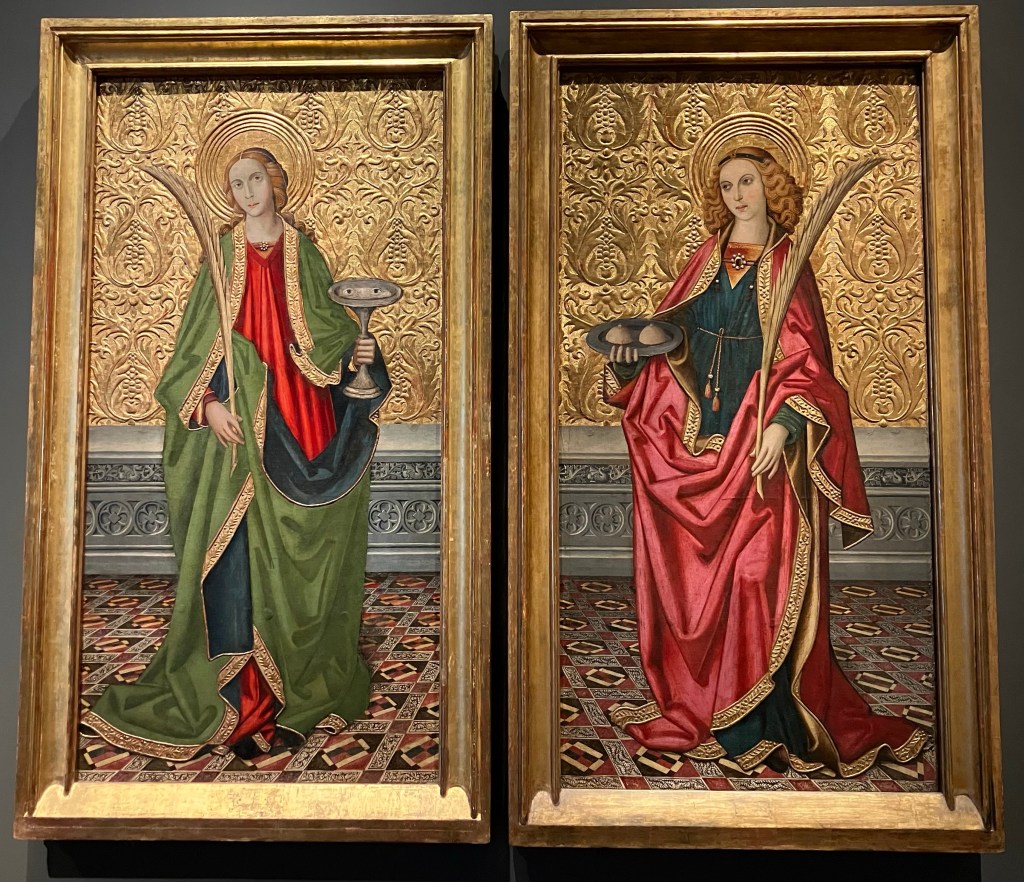
[Like these large gilded altarpieces of St. Lucy (Lucia) and St. Agatha from 16th century Spain. And if you’re wondering why Agatha has a plate of boobs, it’s because part of her martyrdom torture was having her breasts twisted off with tongs (it’s also why she’s the patron saint of breast cancer sufferers and survivors). And yes, Lucy’s plate of eyeballs are also a reference to her getting her eyes gouged out (and being the patron saint of blindness and eye diseases). However, they are also a reference to her name: Lucy coming from the same Latin root as the Roman name Lucius, lux, meaning “light,” best exemplified by sight.]
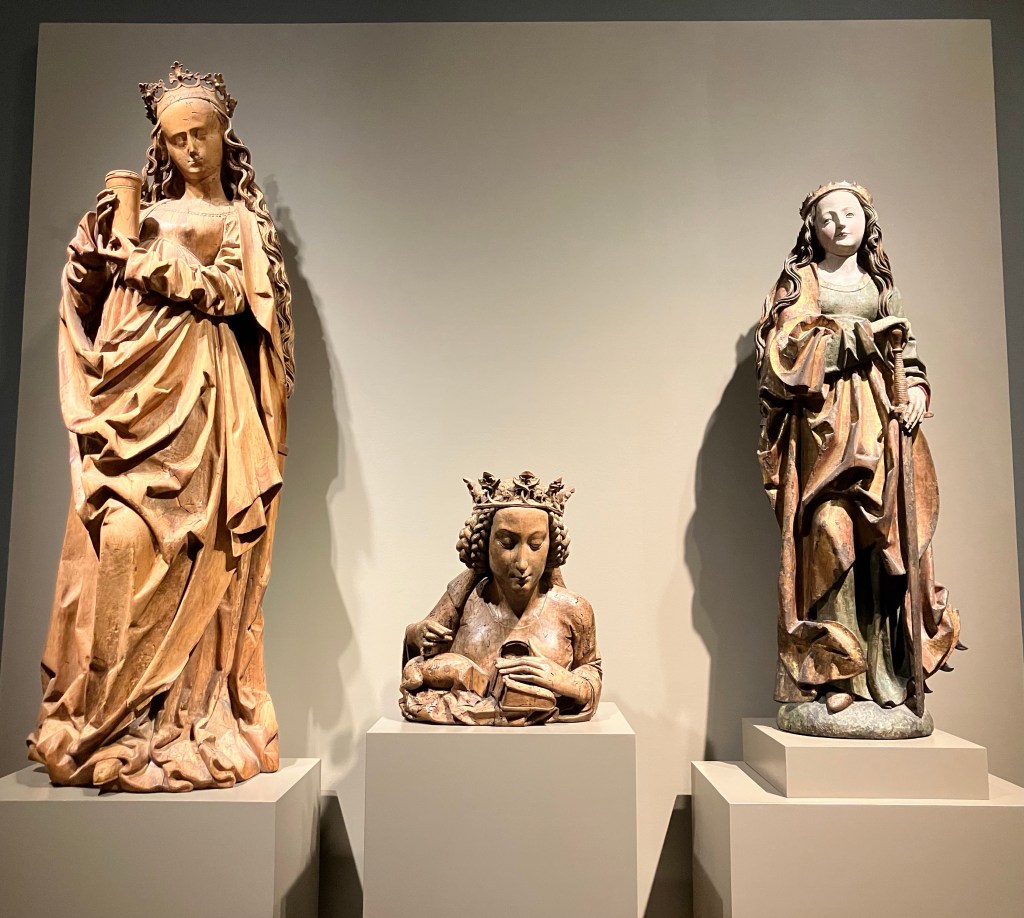
[Or the two standing altarpieces of St. Barbara (L) and St. Catherine of Alexandria (R), with a nifty reliquary bust of Saint Margaret of Antioch in the middle.]
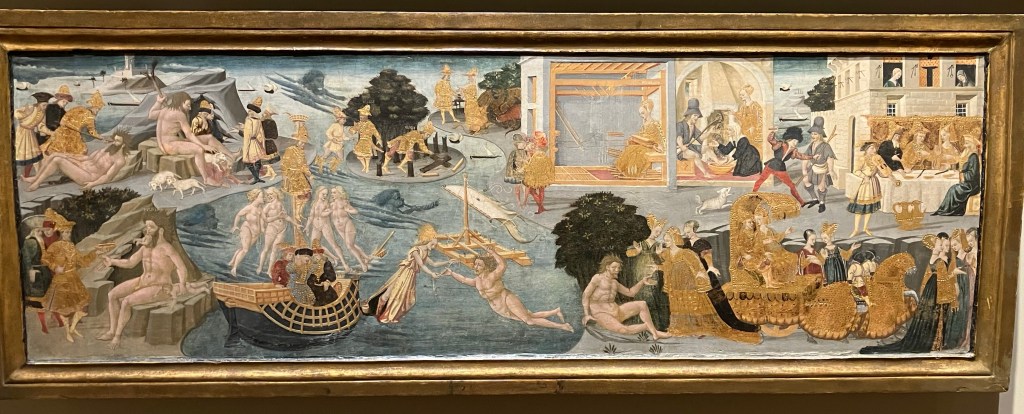
[Or, to be on trend, this long panel painting of various episodes from the Odyssey by Apollonio di Giovanni. As was common in the 15th century, Odysseus (called in the painting by his Roman name, Ulysses) and the other characters are dressed in contemporary medieval clothes rather than classical ones.]
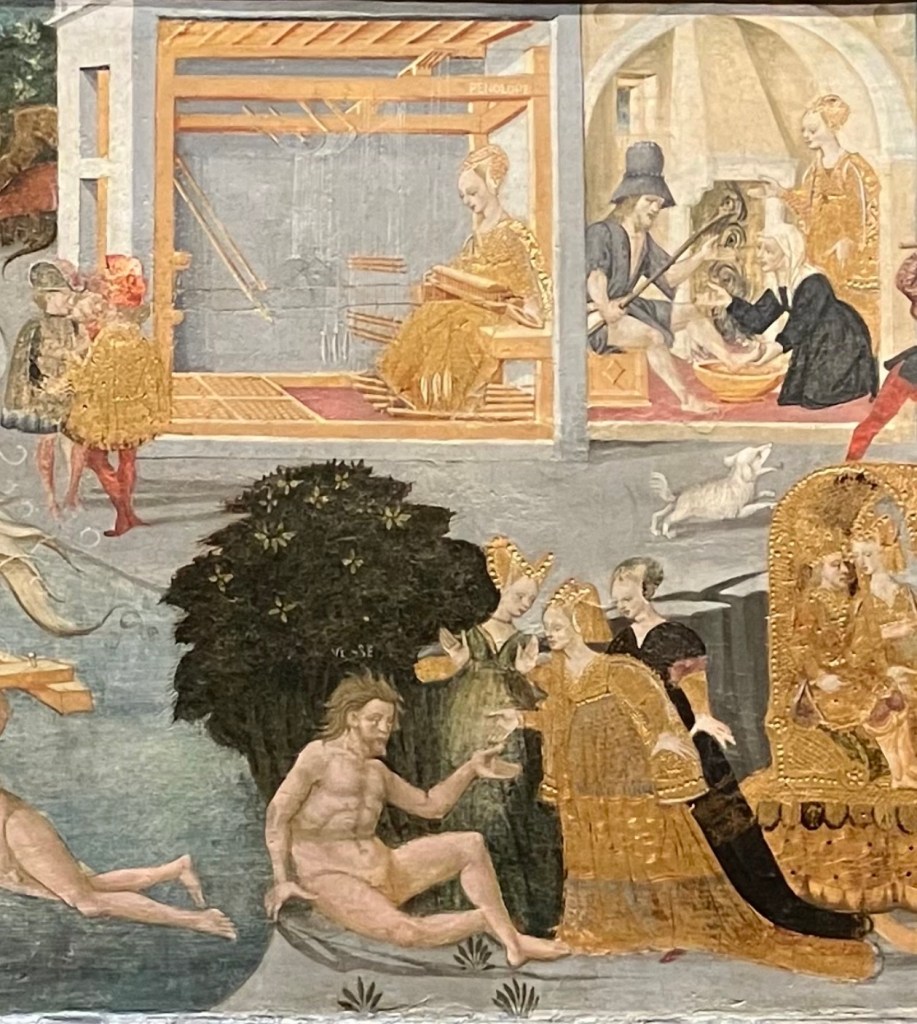
[The Adventures of Ulysses (detail). Here you can see Odysseus meeting Nausicaa in the foreground, with Penelope weaving her shroud in the back, Eurycleia recognizing Odysseus’ scar as she washes his feet, and even Odysseus’ faithful dog Argos at the center.]
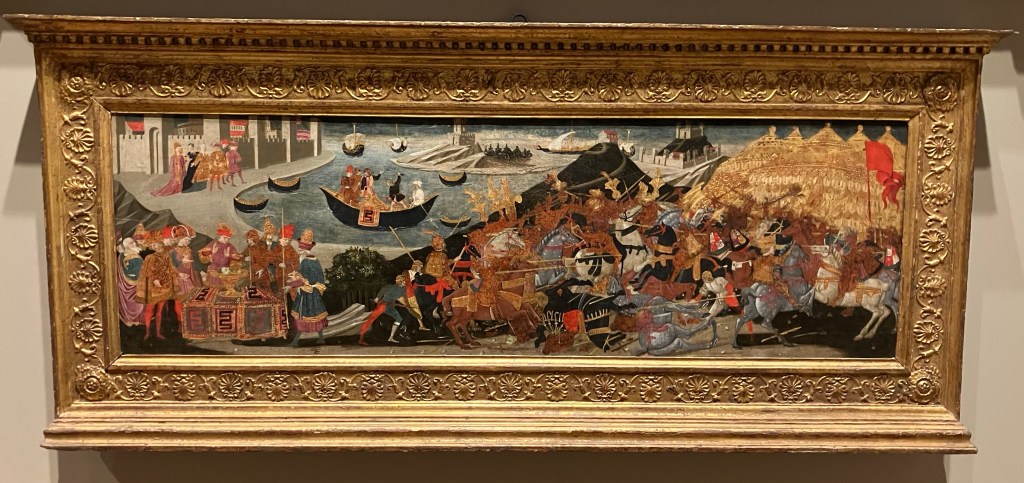
[The Battle of Pharsalus and the Death of Pompey, workshop of Apollonio di Giovanni (1455/60)]
But it was another episodic panel painting of Giovanni’s about the Battle of Pharsalus and the death of Pompey Magnus that had me snorting out loud and probably scaring the other three people in the room with me. Like with the earlier Odyssey painting, Giovanni’s Romans wear medieval Italian clothes instead of togas, and while I think the Pharsalus part of the painting is very well done in a medieval battle painting way, the left half of the painting just had my God’s Wife-loving heart dying with laughter.
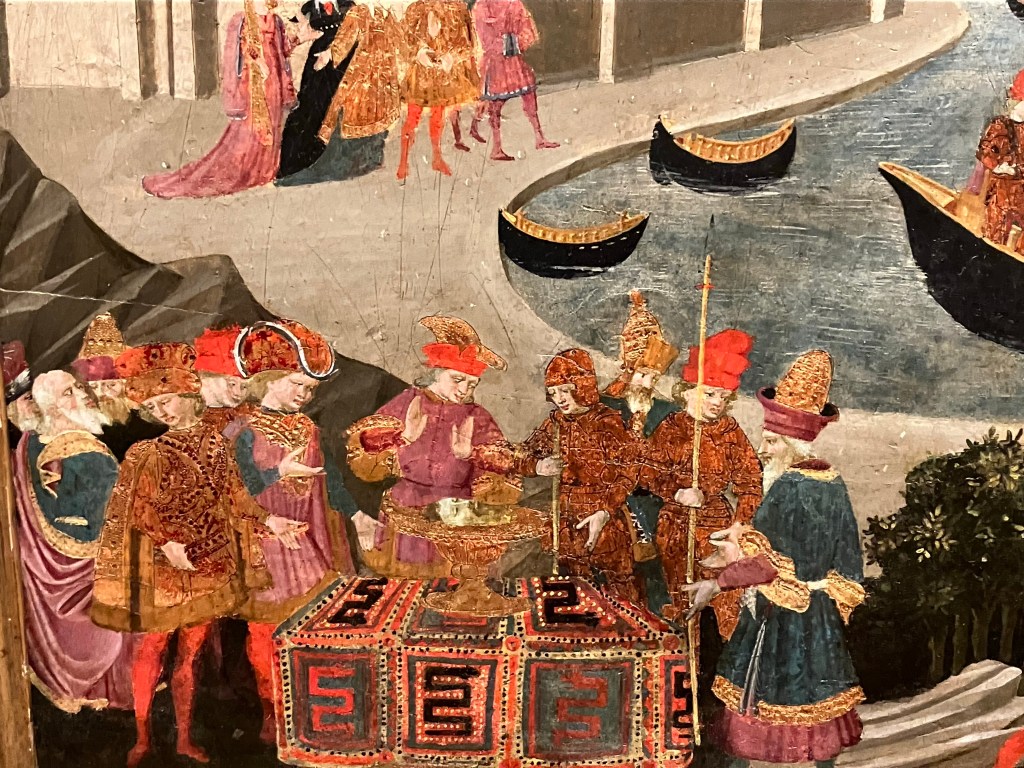
[To jump ahead, I just love this foreground scene of Caesar being given Pompey’s head by Ptolemy et al. Ptolemy’s all like, “Eh???”, and Julius looks like a man trying to convey to a waiter that this is not what he ordered…]
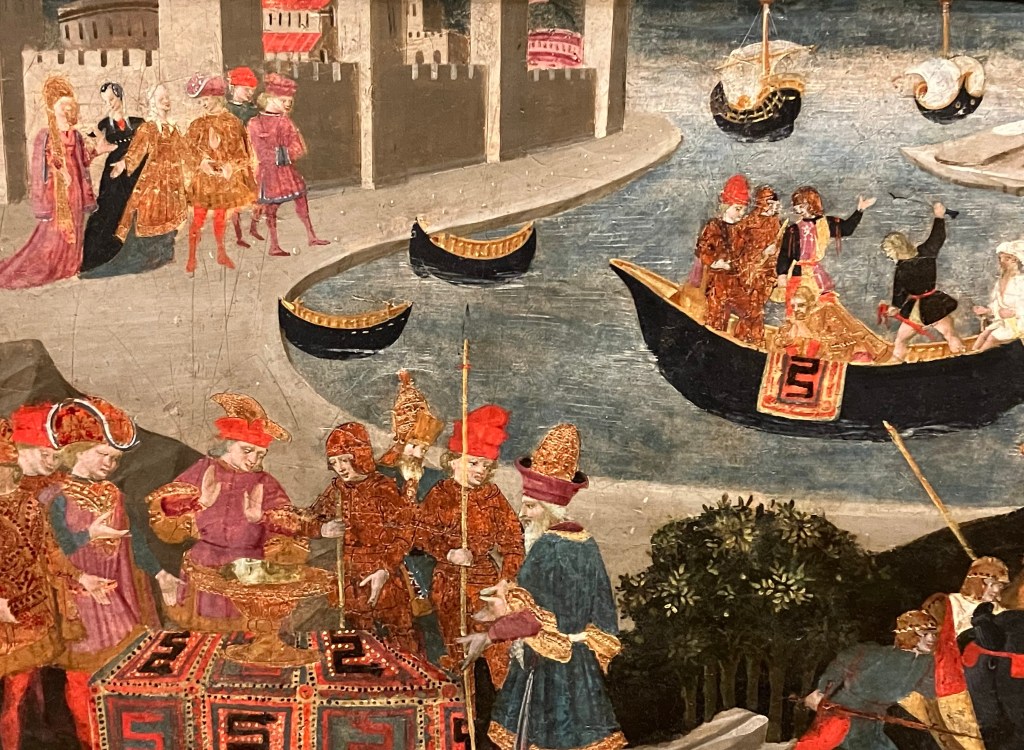
[Up top, we see Pompey getting the decapitation treatment on a boat, while (presumably) his wife Cornelia Metella looks on in horror from the shore.]
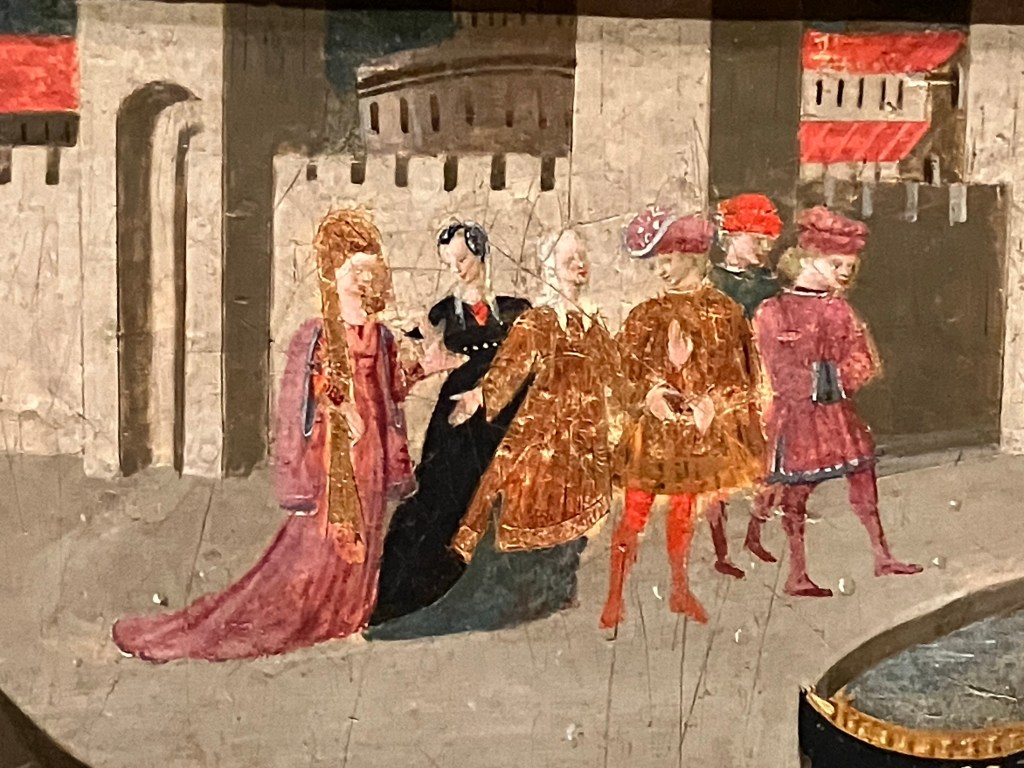
[However, my head canon is that rather than Cornelia’s side, this group is the Egyptian welcoming committee. Out front, we have Cleopatra (L) gesturing “Omg, what are doing?? Are you stupid??” to Ptolemy (R) gesturing “No, it’s totally fine. I have a plan!” back at her. Behind them, in the murex purple robes, Arsinoë (L) is saying “Oh, this is going to end badly…” to her girl and mine in the less opulent lady-in-waiting robes, Mudjet (R), who’s saying “I know that and you know that, but we’re just going to have to keep our heads down.” Cinema!]
To wrap up by linking up my first book with my latest, we’ll duck into the Japanese art gallery to see what’s shaking…
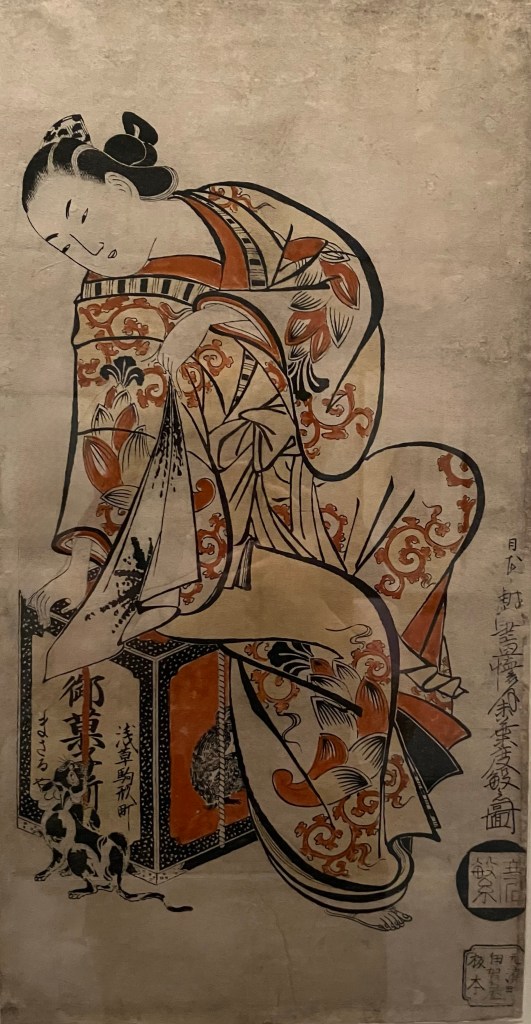
[The prints they had in rotation from the Charles Buckingham collection were good, if not particularly exceptional. Like this Kaigetsudo Dohan print of a courtesan playing with a cat.]
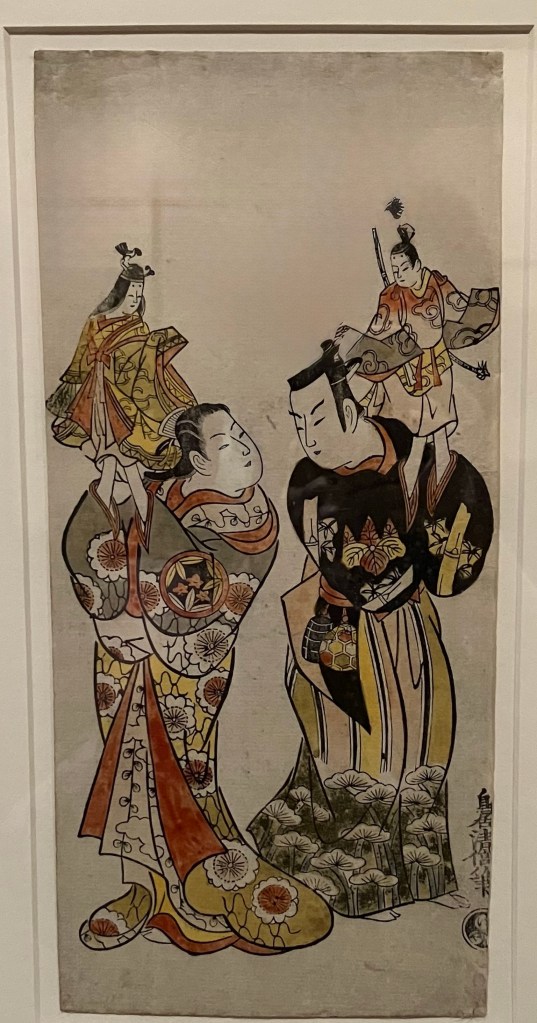
[But I did like this one of ningyōzukai (puppeteers in the traditional Japanese stage art of bunraku) by Torii Kiyomasu II. AIC’s placard says that the puppet characters the puppeteers are holding are of the emperor and empress from the play Diary Kept on a Journey by Sea to Izu, which the Ichimura theater in Edo (Tokyo) presented in April 1725. Bunraku is performed by the puppeteers, along with musicians playing the shamisen and a narrator (tayū) who chants expository dialogue, much in the way Nōh is performed with human actors. The bunraku puppets can be quite complex, and much in the way Sichuan opera performers do onstage quick-change masks (bian lian), some puppet characters have intricate faces that can be manipulated by strings to reveal a character is actually a demon, etc. Indeed, one of the most famous puppets like this is Tamamo no Mae, whose puppet’s face can change from that of a woman to that of a fox.]
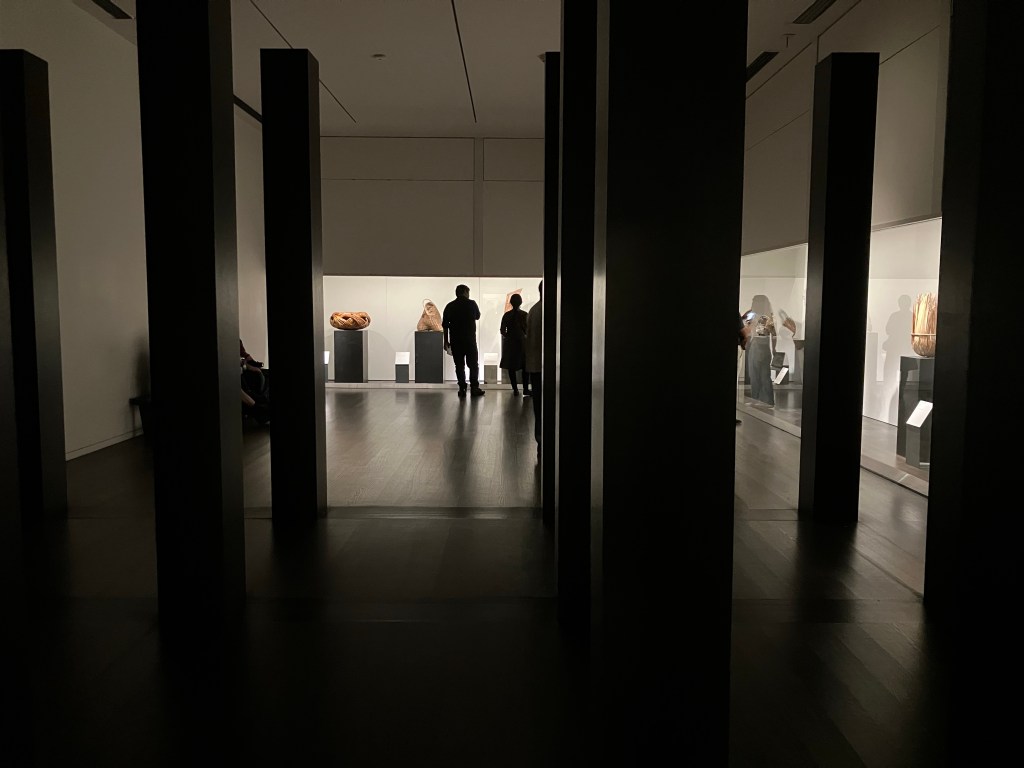
[The Ando Gallery]
But for me, the most exciting part of the Japanese wing was the Ando Gallery, designed by architect Tadao Ando. Meant to be a modernist take on a traditional Japanese interior space, this small gallery uses its own clean lines of black wood pillars and frameless glass cases to showcase contemporary Japanese art. In this instance, some contemporary takes on traditional bamboo art, but is using older techniques to make modern organic sculptures. Much of this art comes out of hanakago, woven bamboo flower baskets, one of many possible traditional stagings for ikebana, traditional flower arranging.
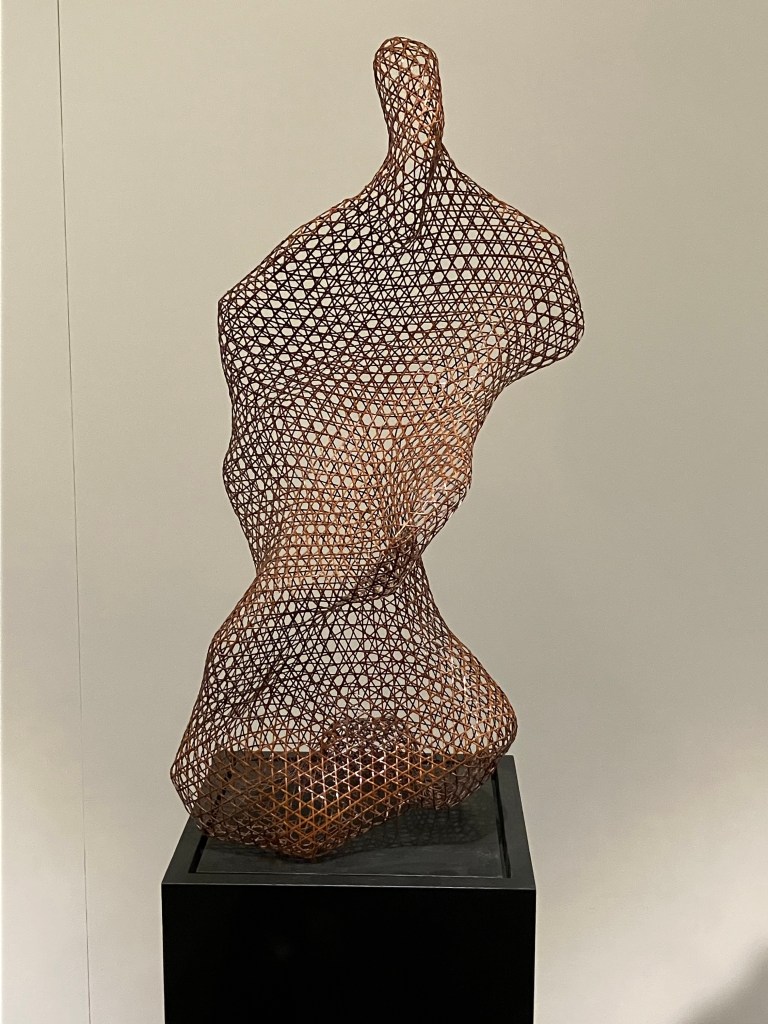
[An Alluring Fragrance, Morigami Jin (2008)]
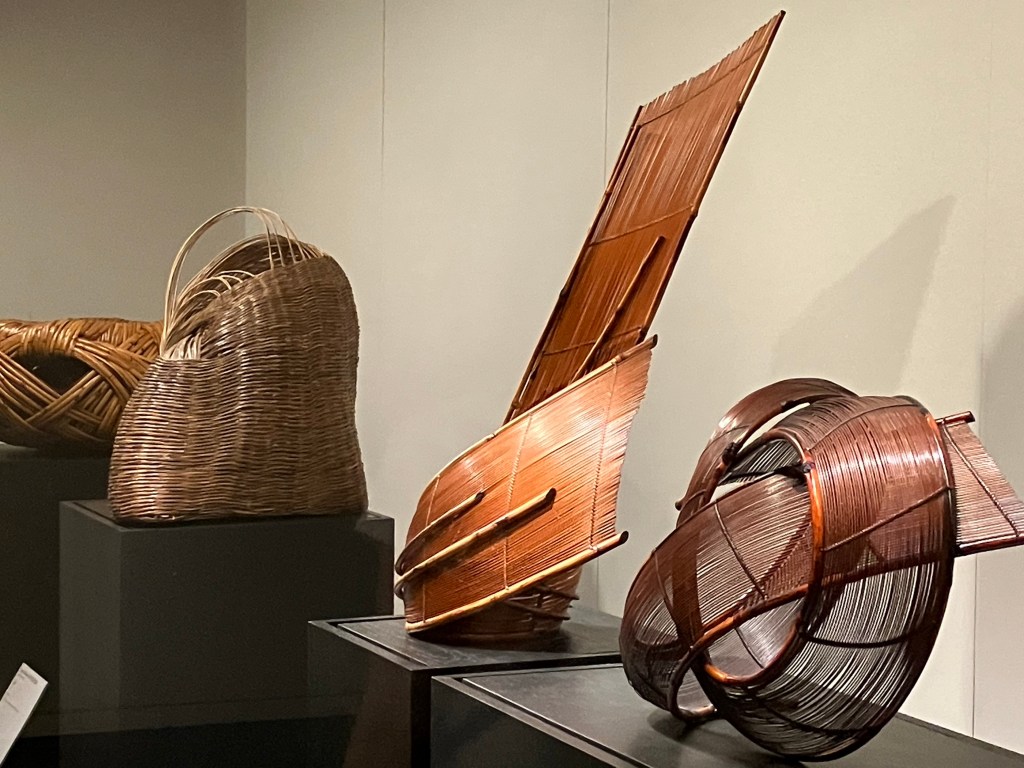
[Works by Shono Tokuzo and Fujinuma Nobor, the latter of which has been awarded the status of Living National Treasure (Ningen Kokuhō) by the Japanese Ministry of Education, Culture, Sports, Science, and Technology. The designation, awarded on an individual or group basis for artistic collectives, helps Japan preserve many of its traditional arts and crafts, while providing a yearly subsidy allowance to the artists for life that allows them to continue to practice their craft. I think it’s more than worth it—these pieces are amazing, and Japan couldn’t make a grant big enough to help me productively make something out of all the bamboo in my yard…]
So yeah, this was a sprinting look at just some of the stuff I saw (didn’t even get to show you any Matisse, or Magritte, or Tang pottery, or medieval armor, or the special exhibition they had on de Kooning…). But if you’re in Chicagoland and you’ve never been to the Art Institute (or it’s been a while), I really would recommend it. There’s a little bit of everything for every taste, with enough space to grow and attract interesting rotating exhibits. It’s very difficult for one art museum to encapsulate the breadth of both ancient and modern art in a way that doesn’t feel overwhelming, but AIC does a pretty darn good job of it.
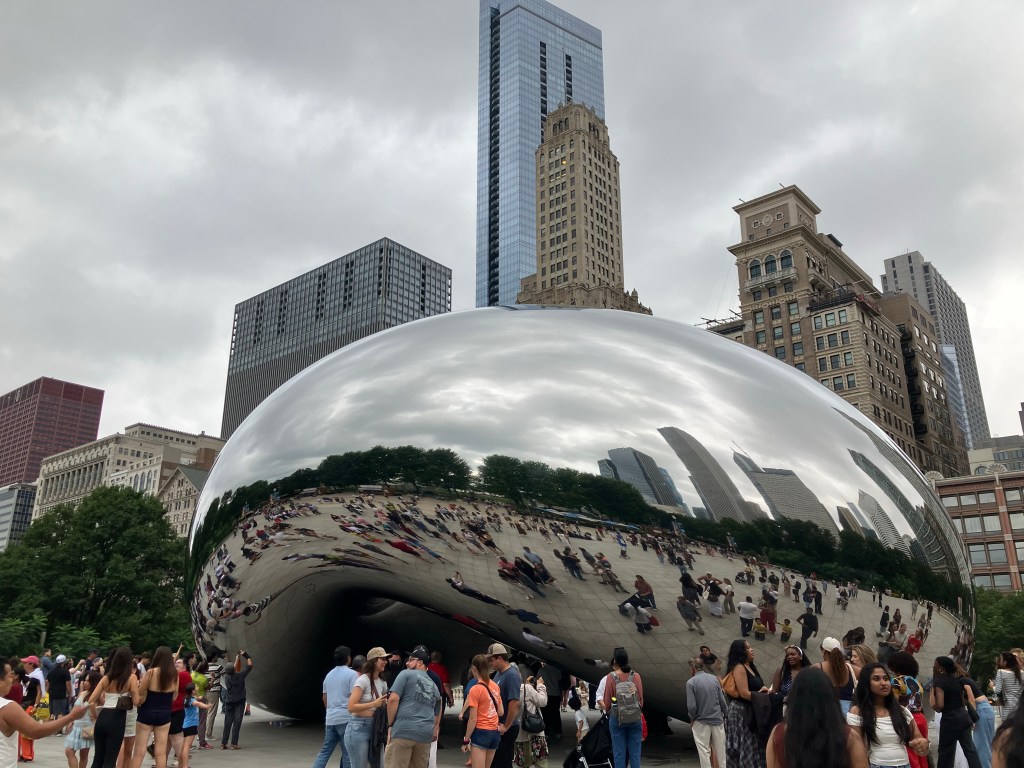
[Plus the Bean (Cloud Gate, 2004-6) is right next door!]
 Sarah Holz
Leave a comment