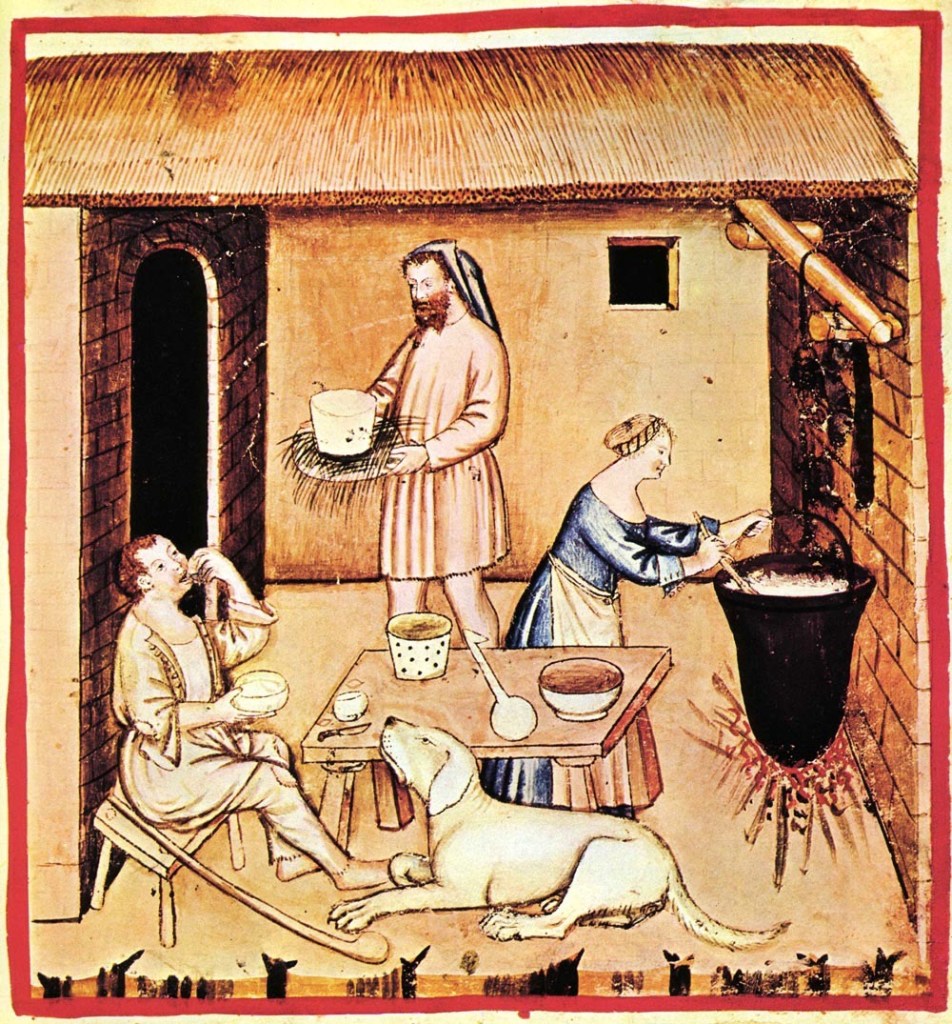
Taqwīm as‑Siḥḥa. I’m the dude on the left who’s just sitting around eating the cheese…]
Since it’s been over a year since I taste tested garum for y’all, this week I wanted to do another semi-interactive food entry. But this time around, I wanted to take a peek at some medieval cuisine, and even trying my hand at a recipe reproduction from one of the seminal cookbooks of the era: the 14th century English guide, the Forme of Cury!
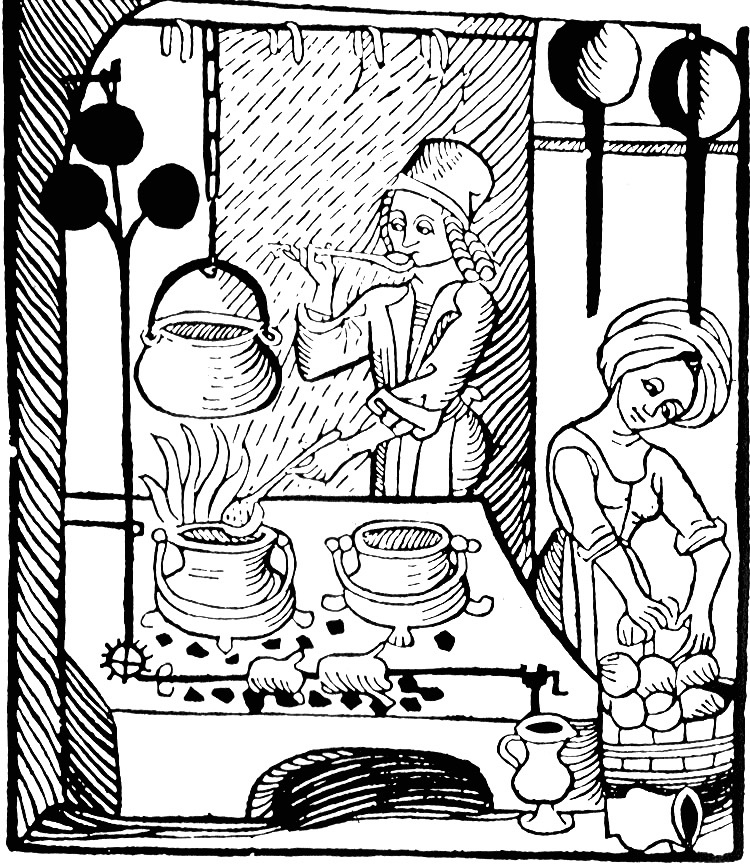
[Here, unlike my title reference to the Fauvel idiom, cury here is a Middle English gloss of the Old French queuerie—“cookery.”]
But don’t worry, this entry is going to have a little bit of everything: food history, English royal history, linguistics, literary culture, another weird book mystery among my personal collection, and perhaps the most entertaining part of all… me attempting to cook something!
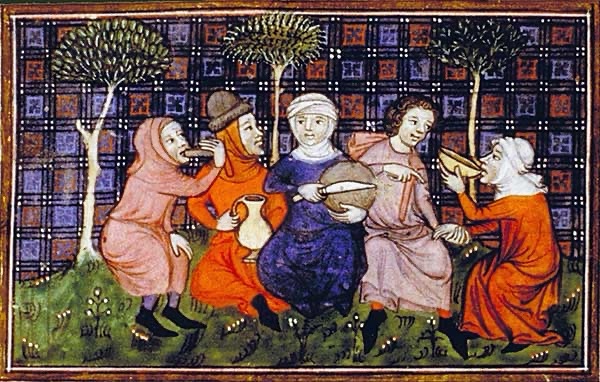
[Buckle up, Virginia 😬]
We believe that the Forme of Cury was compiled around 1390 CE by the master royal chefs of Richard II of England (1367-(?)1400) as a manual for both simple and complex dishes, presumably for an audience of cooks working in the houses of the nobility or higher (since somebody in the kitchen would likely have to be able to read it). Early medieval cuisine was marked by its limited ingredients and palate, but by the 14th century, increased trade across the southern Mediterranean and the Levant had opened this up some for at least the wealthy (though the following centuries would see an explosion of new foodstuffs from the New World that would fundamentally alter the diets of even the lower classes and the emerging merchant middle class), and the Forme of Cury reflects this shift. Cury itself is probably based on the older Latin cookbook, the Liber de Coquina, which is where Richard’s cooks would have been exposed to the recipes and ingredients that derive from the Islamic world and the Far East. As a result, Cury is considered the oldest extant documentation in English for an astonishing number of foreign ingredients, including cloves, olive oil (and olives), nutmeg (and its seed covering mace); as well as famously the oldest recipe for a sort of proto-macaroni and cheese.

[Straight line from the Forme of Cury to Cheesasaurus Rex]
And the Cury cooks would need all the help they could get, because their boss wouldn’t have been content with the bread and pottage the average Englishperson would have been eating on the regular. Richard II knew he was a king and had every intention of living like one during his controversial twenty-two years on the throne—something that would ultimately lead to his downfall. Born the grandson of the perhaps most beloved and successful medieval English king, Edward III, and the child of Edward’s most beloved son and namesake, the famous Black Prince, Richard was arguably in an enviable position popularity-wise when he inherited the throne in 1377, despite the inevitable uncertainty caused by a ten-year-old monarch. The Black Prince’s sudden and untimely death a year before his elderly father’s had generated a great deal of anxiety among the English nobility, not just because of the prospect of Richard’s lengthy minority rule, but because of the perceived threat to everyone else’s power and influence in the form of Richard’s most capable uncle, John of Gaunt.
Gaunt and his younger brother, Thomas of Woodstock, were feared and envied for their power at court, but they were only a part of a series of regency councils for the first years of Richard’s reign—the councils formed in part to prevent his uncles from holding a formal regency themselves—though this was as much a reaction to the memories of Edward III’s own detested regents, his mother Isabella of France and her lover Roger Mortimer, as it was mistrust of Gaunt and his brothers. Matters were not helped that while the nobility were fighting among themselves, they were all increasing hated by Parliment and the House of Commons, who consistently balked at their attempts at taxation on behalf of their boy king. This would culminate in the Peasants’ Revolt of 1381, the fallout of which Richard would largely be able to dodge by foisting the blame on what were perceived as his greedy regency councils.
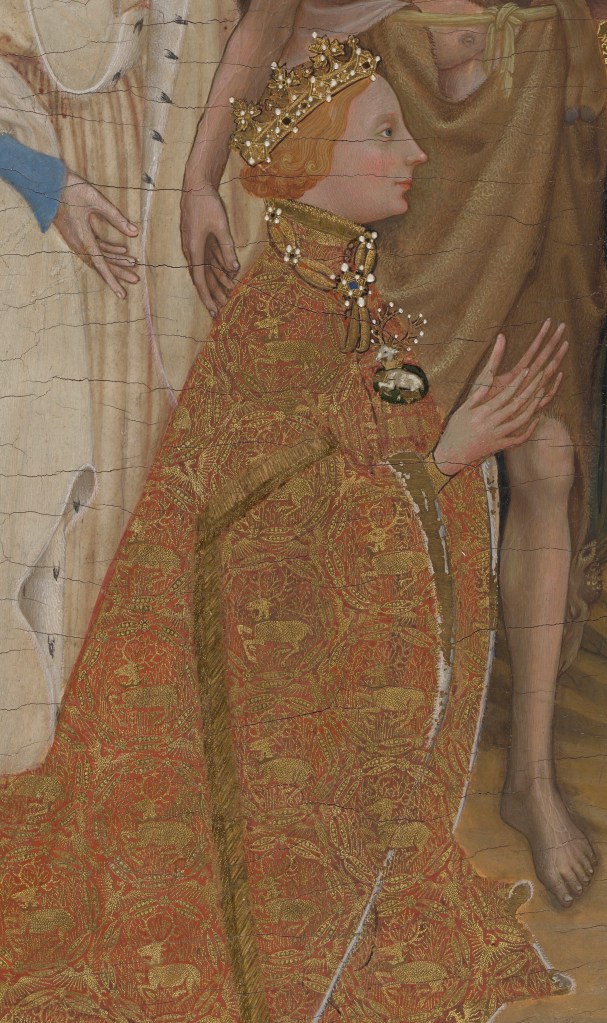
As a result, Richard’s coming of age was greeted by joy and relief by Parliament and the people—that classic fallacy of a “freed” good ruler who had just been ill-served by bad advisors. Unfortunately for England, this would largely prove to be untrue. From pretty much the start, Richard was openly resentful of any compromises with Parliament, seeing it as a check on his divine authority, and much of his reign would bounce around between him haranguing or dismissing them, trying to get his way. Part of the dispute was that Richard fervently believed in his right to a magnificent court that Parliament, the people responsible for funding it, found overly extravagant.
Richard wasn’t just bad at making friends in the House of Commons, though. He quickly created a clique of aristocratic favorites that alienated many of his most powerful and resource-rich nobles, among them John of Gaunt’s son, Henry Bolingbroke. This led to a series of open military revolts by them against Richard’s authority, revolts that would ultimately be successful in part because Richard loved the glitter of medieval kingship without fulfilling the other half of his prerogative: that is, being a dedicated military leader, like his grandfather and father had been. Richard was captured, compelled to abdicate in favor of his cousin Bolingbroke, and placed under house arrest in the Tower of London. The newly-crowned Henry IV claimed that he had every intention of letting Richard live, but when the specter of a possible counter revolt rose in the early months of Henry’s reign, Richard conveniently died. Because we have Richard’s skeleton, we know that he was not killed violently, but it is thought that he was starved to death in his captivity—though some historians argue that he stopped eating as a suicide, rather than Henry starving him. That much is impossible to know. But judging from the pretty much endless assassination attempts and revolts that Henry IV spent the rest of his life fending off, the general opinion seems to have thought it was murder.

Admittedly, the historical Richard we have is largely the legacy of his enemies, as Henry IV had to justify his usurpation and subsequent rule, born as it was out of Richard’s forced abdication and subsequent (likely) execution. This was an era where the killing of one’s anointed king still meant something, and Richard’s death would hang over his cousin’s rule, and some would blame Richard’s vengeful ghost as the ultimate cause of the War of Roses, the conflict that would serve Henry’s grandson, Henry VI, Richard’s exact fate. That said, the armed revolts against Henry IV were more the result of him essentially opening the floodgates on regicide, rather than evidence of widespread personal loyalty to Richard. Due to the secretive nature of his death, there were some attempts to claim that Richard had survived, but none of the pretenders ever gained much traction (certainly not as much as later iterations would for, say, the Princes in the Tower). Left with costly debts from Edward’s many wars, Richard’s refusal to curtail his own spending in any meaningful way only made a bad situation worse. This, coupled with his lack of military service and his high-handed personality that refused to treat his nobles as peers probably sealed his fate without the later Lancastrian slurs about his alleged homosexuality and insanity needing to be taken seriously. As medieval England’s Nero, Richard was probably not as bad as posterity (read: Shakespeare, etc) portrays, but that’s doesn’t mean he was good, either.
But it’s Richard’s fatal taste for the finer things that gives us the Forme of Cury, which claims that the king personally commissioned the book, and whose exquisite taste it subsequently praises as “the best and royallest viander of all Christian kings.” This is definitely reflected in the nearly two hundred recipes that comprise the Cury, where aside from the few basic items, are largely designed to show off the sophistication of Richard’s court. Medieval cuisine did this in two main ways: one, using expensive and exotic ingredients; and two, by creating elaborate dining presentations. Think ice swan sculptures, but with real cooked and dressed swans. Turduckens, but make it fancy. Dining with royalty was as much an entertainment event as it was a meal; there were musicians and acrobats of course, but the food itself was meant to be a show as well, and the masters of the Cury would have had an army working under them in the kitchen to make sure that the demanding Richard was able to impress the people he hadn’t ticked off yet.
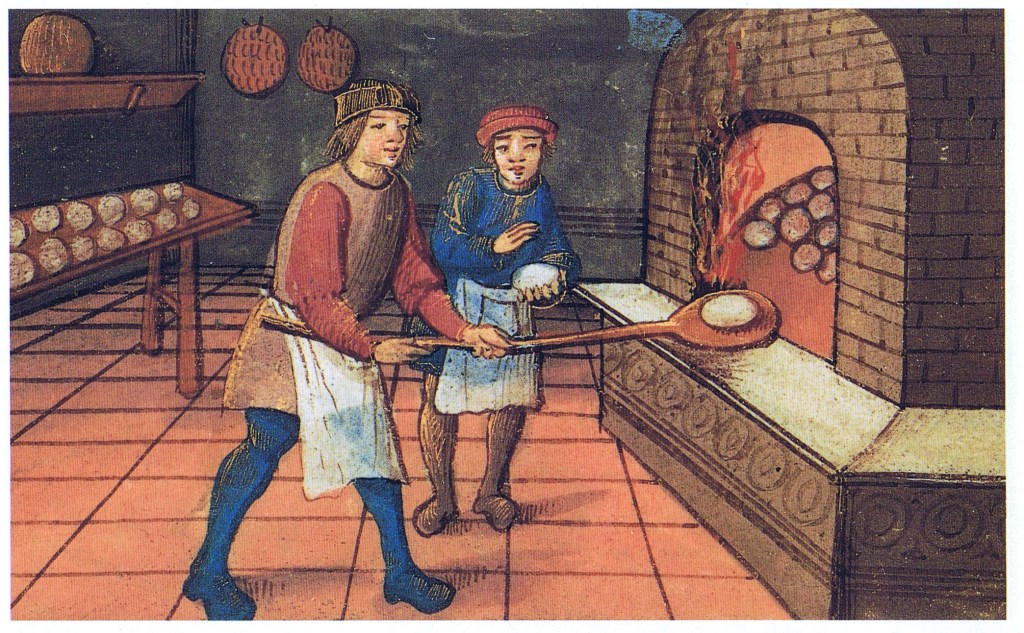
[Unfortunately for all of you, I did not attempt some crazy meat statue in all of this—hilarious as the results of that probably would have been. I am not the main chef in my house, and I am eminently aware of my culinary limitations…]
As my source for the Cury’s recipes, I used Lorna Sass’s 1975 cookbook adaptation, To the King’s Taste, which reproduces forty of the Cury’s two hundred recipes in conjunction with the Met’s archives. I ended up with my copy, which had been kicking around my parents’ house for years, after their last move, but it’s taken me an additional several years to really crack it up with the intention of making something in it. Imagine my surprise, then, when I found that our copy was a signed copy of Sass’s book. And not only signed, but specifically inscribed to my dad—possibly the last person in my life I’d try to give a medieval cookbook to. Ooh, a mystery!
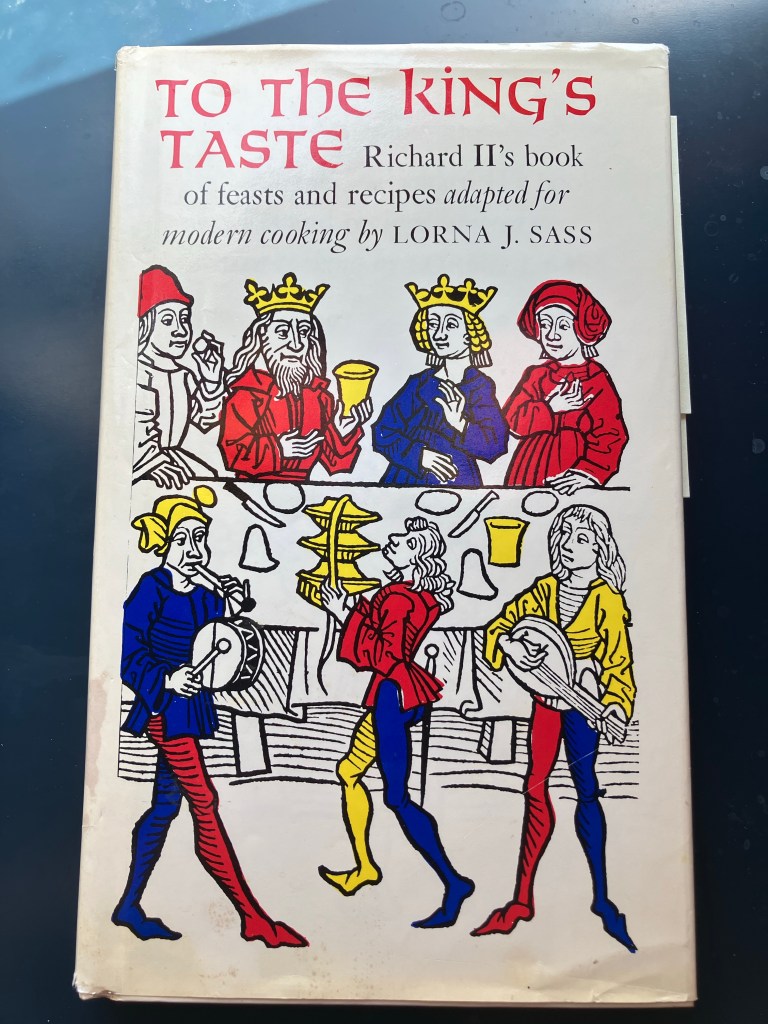
When I brought this up to him the last time I saw my parents, he initially was as baffled as I had been as to how this had happened. After my mom and I had a couple of snickers about a possible torrid affair with the author, I thought about the inscription date (NYC ‘88) and stumbled into the obvious answer. In 1988, while we were briefly living in New Jersey, my dad was working for American spice and condiment conglomerate Durkee (at the time, best known as owners of French’s brand mustard) and I’d bet dollars to donuts that my dad met Ms. Sass at one of the innumerable food trade shows he was sent to during this period. He also says that he had a lot of contact at this time with food and recipe reps working for major lifestyle magazines like Good Housekeeping, so it’s possible that he crossed paths with Ms. Sass while the latter was moonlighting with the food mags or flogging one of her cookbooks. According to TtKT, Sass has a postgraduate background in medieval studies—hence her interest in its culinary traditions—but according to her Goodreads page, her real claim to fame is one of the earliest advocates and recipe creators for pressure cookers in the US, back when the technology was new here in the 1980s, as well as an early advocate for vegetarian and vegan cooking. Truly a pioneer of food history and science.
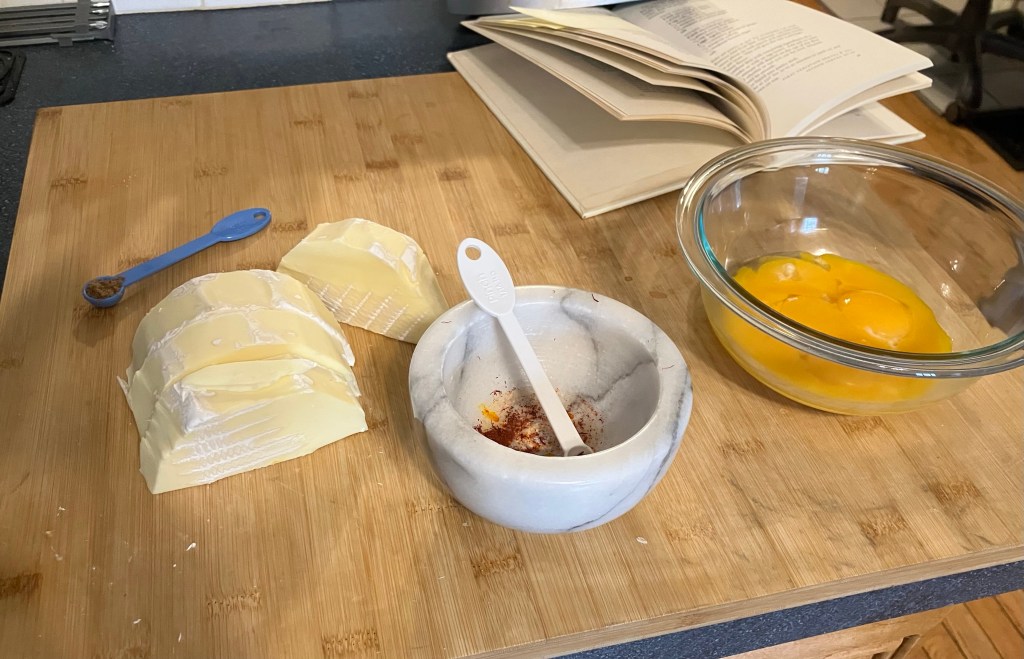
So what are we making today from To the King’s Taste? Well, taking into account my level of ability, and the fact that I wasn’t cooking for a large group and I wanted to be mindful of potential food waste, I landed on Sass’s interpretation of a Brie tart. In the Cury, the recipe runs as follows:
Tart de Bry: Take a crust ynche depe in a trape. Take yolkes of ayren rawe and chese ruayn and medle it and the yolkes together. And do thereto powdor gynger, sugar, safron, and salt. Do it in a trape, bake it, and serve it forth (TtKT, 48)
Like I always say with Middle English, much of the recipe becomes clear if you sound out the words aloud—with a few exceptions. Sass tells us that “ruayn” cheese is a “fine-quality fatty cheese made from the milk of cows that had grazed on the autumn grasses of hayfields after the harvest” (ibid). And by inference, a “trape” is a baking dish. Sass translates these barebones instructions modernly as follows:
8-inch uncooked pie pastry
1 pound young Brie cheese
6 egg yolks, beaten
1/8 teaspoon saffron
3/4 teaspoon light brown sugar
3/8 teaspoon powdered ginger
salt (to taste)
1. Bake pie pastry at 425° for 10 minutes. Let cool.
Remove rind from Brie. Optional: cut rind into pieces about an inch square and sprinkle evenly on pie crust. This will give the tart a stronger cheese flavor.
2. Combine Brie with remaining ingredients in a blender or with an egg beater. Add salt to taste: the amount will depend on the age of the Brie and whether or not you use the rind. Mixture should be smooth.
3. Pour liquid into pastry shell.
4. Bake at 350° for 30 to 40 minutes or until set and brown on top. Serves 8-10
(TtKT, 49)
There is some good news for Amateur Hours like me in this one. Firstly, since this was the go-go ‘70s/‘80s, there is a tacit permission by Sass (because she doesn’t offer up a recipe for a fresh one) to use a premade pie crust, which I happily took. If you’re more ambitious than me, you can use your favorite scratch pie crust recipe instead.

[Pretending I was in a large, specialized medieval kitchen like the one the Cury masters ran, I turned things over to our young pastry chef, Pépin Fraîche]
I like Brie as a cheese quite a bit, but since I’m not an especial lover of its rind, I didn’t add any of the optional rind back into the recipe. That said, I wasn’t surgical in its removal, so knowing that the rind could be added back in gave me permission to not worry too much about small edges left clinging to the cheese. Also, while I chose to use it for the novelty of it, know that the saffron in the recipe is—as it would have been for Richard’s court—mainly a coloring agent for the dish, as opposed to a major player in the flavor profile. So if you don’t feel like shelling out the big bucks for good saffron (particularly after buying a pound’s worth of Brie!), I think you can skip it. The egg yolks should be plenty to give the tart its desired deep yellow color. Annnnnd, voilà!
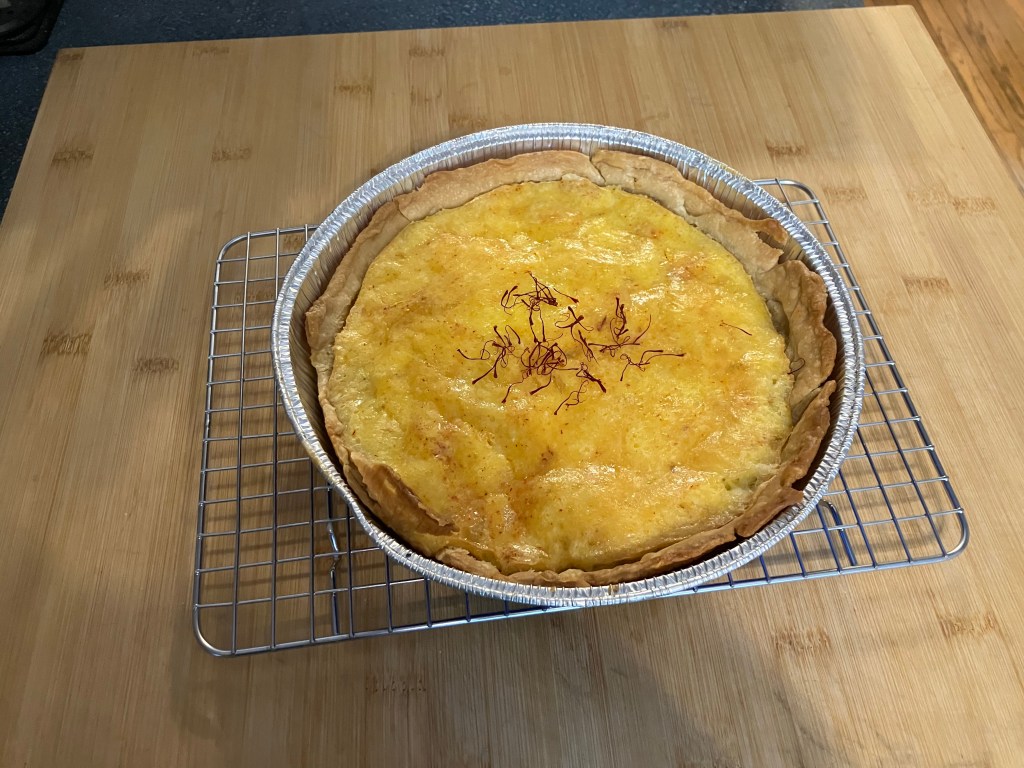
[Success!]
As you can see, I made up for my lackadaisical crust crimping by adding a few sprinkles of saffron on top for decoration, an extra extravagance I could easily imagine at Richard’s board. I chose to serve my tart with some fresh strawberries and a Cabernet Sauvignon (some sweet and mellow fruit flavors to cut the predicted saltiness of the tart). Medieval people tended to avoid fresh fruit as dodgy for the digestion, preferring their fruits to be stewed in sugar or honey. But because I don’t care for the sorts of syrupped fruits that Richard would have loved, I decided to risk my medieval physician’s disapproval, hoping that the positive humorous (as in the bodily humors) attributes of our soft ruayn cheese tart—the best for digestion—will preserve me. Wine, however, was almost always seen as health boon in medieval medicine (consumed within reason, of course). Like their fruits, medieval wine—particularly in non-cultivating kingdoms like England—tended to be juiced with honey and spices, though mainly to disguise the acidity of badly-preserved casks. Since my wine was properly canted, I’m drinking it straight. A Cab Sav is a bit on the dry side for a medieval wine, as like the Romans, people in Europe at this time still favored sweeter wines overall, but it’s not a terrible choice and pairs well with Brie in a basic sense.
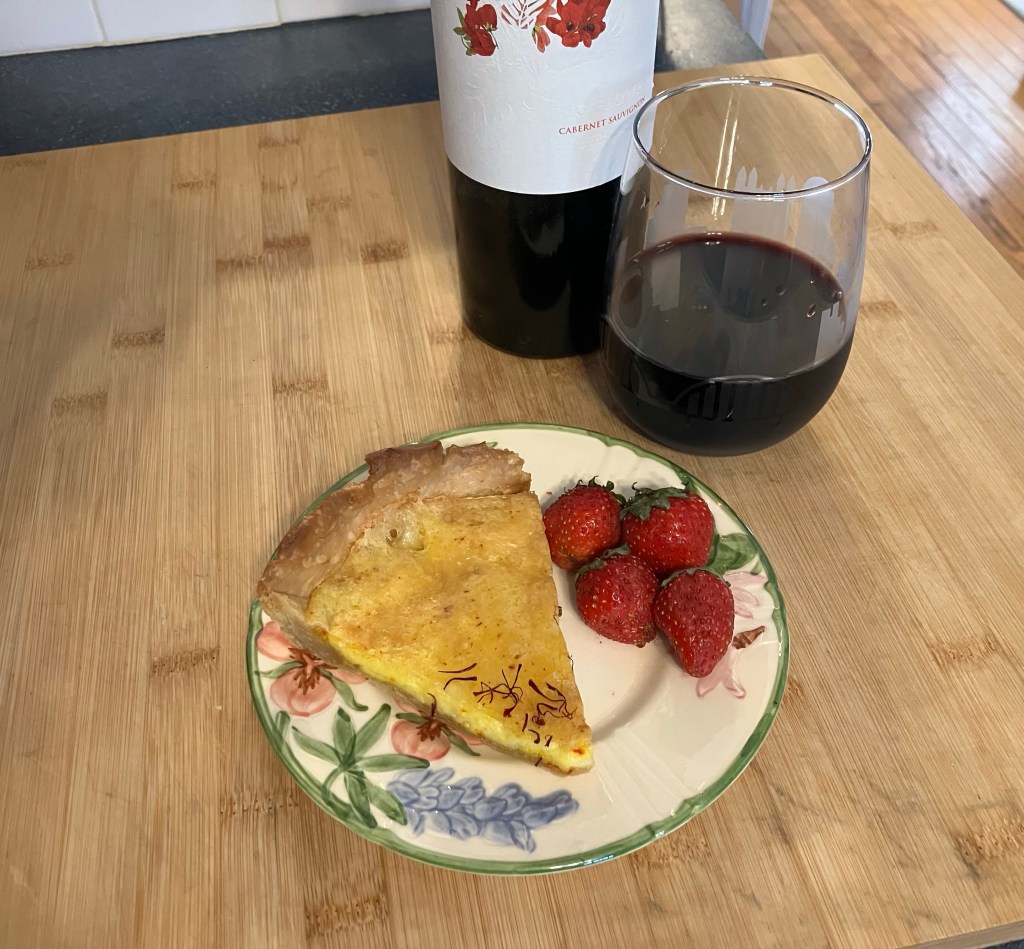
[I think cheese pairing aficionados tend to favor white wines (particularly Sauvignon Blancs) with Brie, but a lighter-bodied red is kosher. Cabernet Sauvignons are considered full-bodied, but I think a younger vintage (3-5 years old) like the one I used is just fine. Follow your heart!]
But how does it taste?? Honestly, pretty good! This was full experiment mode for me, so the fact that the tart was even edible was a real win for the whole endeavor. The dominant flavor is obviously Brie, so how much you like it will largely live or die on how much you enjoy the cheese. As you would expect with the addition of the egg yolks, the texture of the tart is very reminiscent of a firm quiche, frittata, or savory custard. For me, who likes those kinds of dishes, but doesn’t live for them, I still think on a texture level that on an average basis I’d prefer a simple baked Brie to this, but this was fun to try out. Neither the saffron nor the ginger are present in enough quantity to be a serious flavor in the dish, so if either of those spook you, I wouldn’t worry about—ditto for the brown sugar if you were concerned that there would be a weird sweet element on top of the sharp Brie taste. I think all of those are there mainly for stability and a bit of depth, nothing more.
For me, I found the biggest hurdle to be just how rich the tart is—as you would expect perhaps for a dish fit for a king. Sass includes a slightly-less-authentic second variation of the recipe that halves the eggs and adds half a cup of heavy cream. I chose the version I did mainly for the authenticity, but since Sass considers the second version even richer than the first, I’m glad I didn’t make it because I’d probably still be recovering. If you try this one out, I recommend cutting relatively small pieces—especially if you’re serving it with other food. That said, because cheese-and-egg-based dishes like this are so versatile, you could serve this at almost any kind of meal. I’m imagining it as a very unique brunch item, particularly since it pairs so nicely with alcohol. I think that a fancy lad like Richard would have adored a lazy Sunday brunch eating this tart with a cheeky pitcher of mimosas or sangria—Santé!🥧


Leave a Reply