
Time flies when you’re having fun(?), so it’s already been two years since we last revisited that endless well that is the Egyptian pantheon, and since the search engines and AI bots can’t get enough of this as a topic, we’re going to dive back in with ten more lesser-known gods and goddesses!
[Parts one and two can be found in the links. The bots love these and—for some reason recently—my entry on Julia Balbilla. It’s very early days yet, but that might bode well for a secret fifth God’s Wife WIP I have percolating in my back pocket…🤫]
10) Anukis
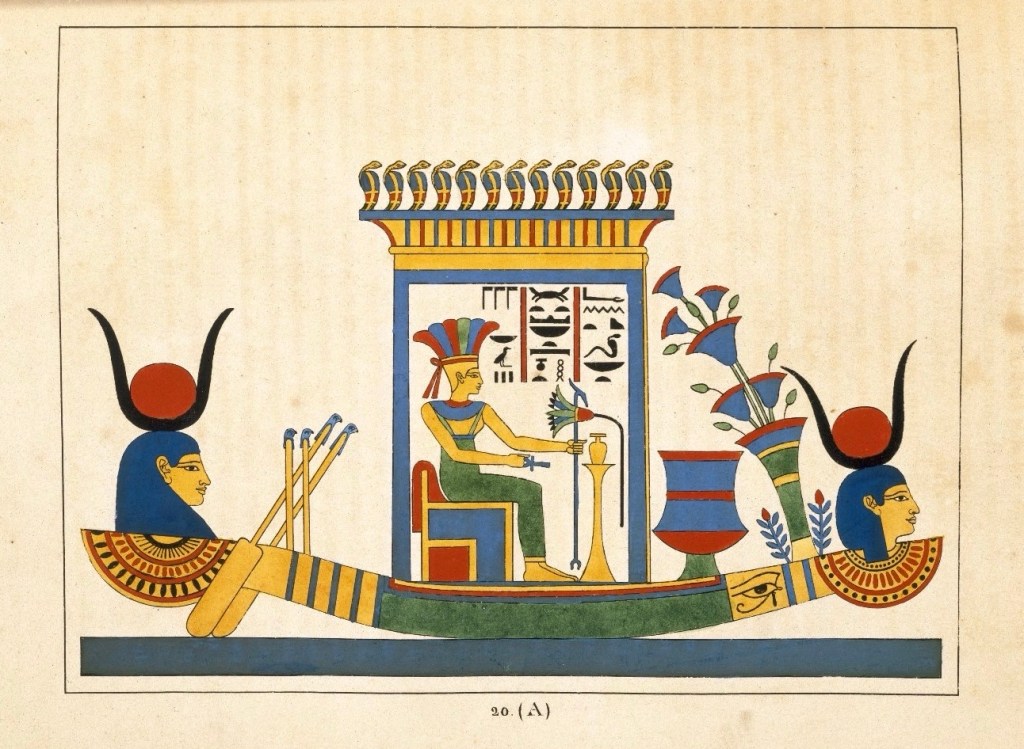
We’ll start off this time with a couple of less intimidatingly obscure gods by making sure that y’all know Anukis (sometimes known as Anuket), because as one of the major Nile deities, she was considered vitally important to the Egyptians. Anukis is the goddess of the Nile’s first cataract down at the very southern tip of ancient Egypt, and as such was seen as the patron goddess of the city founded at the cataract’s edge, Elephantine (3bw (Abu) in Middle Egyptian—the word for elephant). Although not an adopted Nubian goddess like many from this part of Egypt, she was also associated with Nubia based on her geographical location. Although she would often later be syncretized with Bastet and Hathor/Sekhmet, you can always recognize Anukis by her distinctive multi-plumed headdress with ribboned tails. The plumes are not usually specifically identified with anything, but Anukis is associated with both ostrich feathers and papyrus, so they may represent either or both of those items. Her name is usually translated as meaning “Embracer” or “Clasper,” and sometimes she is depicted with outstretched arms that seem to emphasize this, or possibly imitate the branching tributaries of the river. Despite the Elephantine connection, Anukis’ sacred animal was the gazelle, perhaps to connect her to the swiftness of the waters she presided over. She was seen as a daughter of Ra during the Old Kingdom; and later as a consort of the creator god Khnum and either the sister or daughter of Khnum’s other consort, Satis—which makes sense as both Anukis and Satis were associated with Nubia and seen as the guardians of the life-giving annual Nile floods.
9) Mafdet
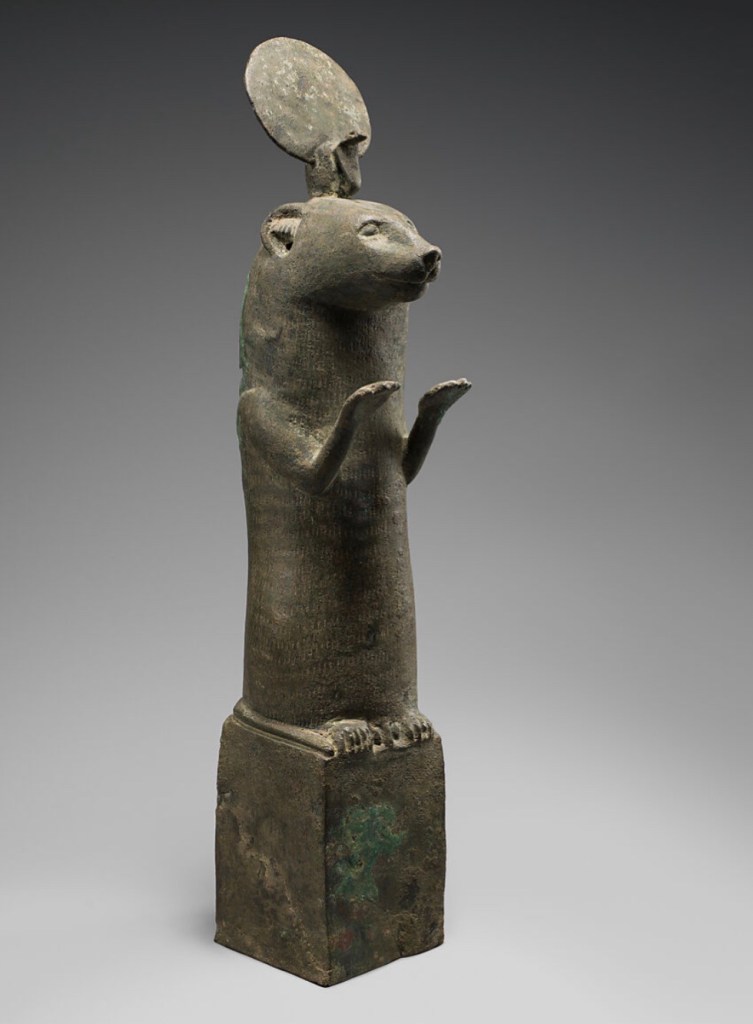
I’ve mentioned Mafdet here and there in other entries, but I thought she deserved a little spotlight since she’s not super obscure, but not exactly a household name, either. Mafdet is an incredibly old goddess, attested in the archeology as far back as Egypt’s First Dynasty (c. 3100 BCE). While her more famous sister Ma’at is the personification of Truth and cosmic balance, Mafdet was the personification of Justice and the rule of law. While I show her above in her (likely) mongoose form, the one associated with her protective aspect against snakes and scorpions, Mafdet’s other form is that of what is usually thought to be a cheetah or a serval. In that debate, I actually lean Team Serval because unlike cheetahs, servals are nocturnal hunters, and one of Mafdet’s duties to protect her father Ra alongside Set during his nightly journey through the underworld of the Duat. Indeed, one of her epithets is “Piercer of Darkness,” as she helps to bring the dawn each day. In her more retributive aspect, Mafdet is thought to rip out the hearts of evildoers, particularly those who oppose the divine will of the pharaoh, but since she can’t escape her feline nature, she was thought to lay those hearts at the king’s feet like any loving house cat.
8) Sah
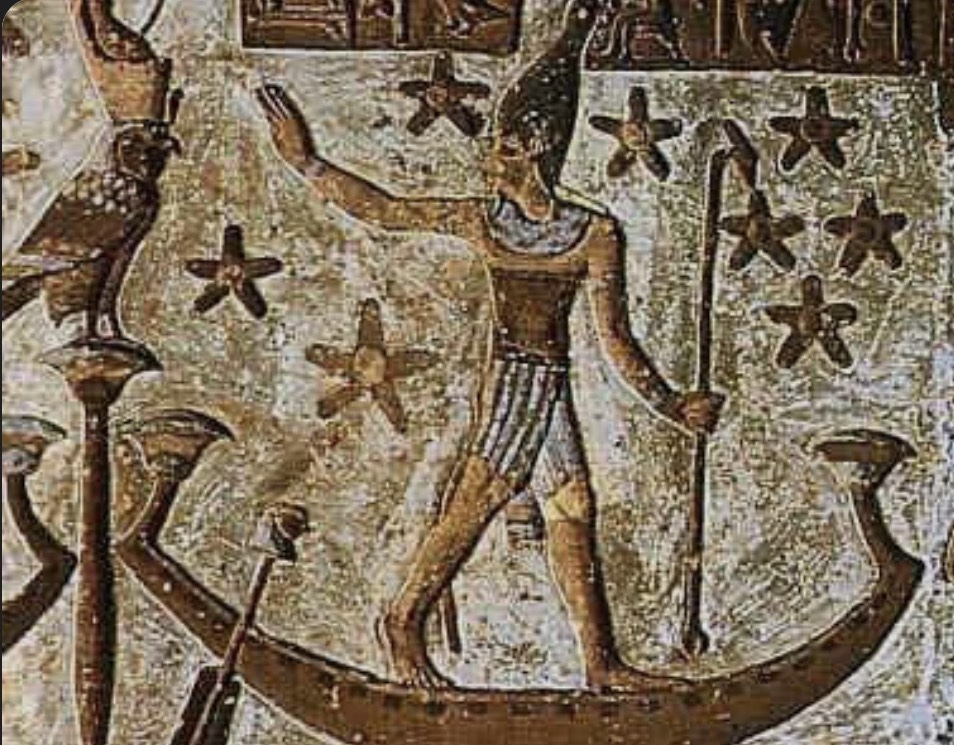
Sah is another very old god, one of many in the tangled web that is Egyptian cosmology who is called “the father of the gods.” He is a celestial deity and the personification of the constellation of Orion in Egyptian astronomy. His consort is the slightly better-known Sopdet, the goddess personification of the star Sirius, though both of them would largely be subsumed into their more popular later counterparts Osiris and Isis. This might feel a bit left-field for two sky gods, but one of the paradoxes of Egyptian cosmology is that the Duat was simultaneously seen as both an underworld and a sky-based “heaven.” Particularly in the oldest attested records from which old gods such as Sah first appear, like the Pyramid Texts, the ultimate goal of a person’s soul was to join the gods of the sky as a star-being. This is part of the reason that akh, the word that embodies a person’s spiritual “intellect,” the proper merging of one’s ka (“life force”) and ba (“essence” or “personality”), is also one of the Egyptian words for star; because the ideas were religiously linked to one another. In fact, Sah’s name is also the Egyptian word for the properly maintained spiritual body of a dead person, the form that would accompany a person through eternity.
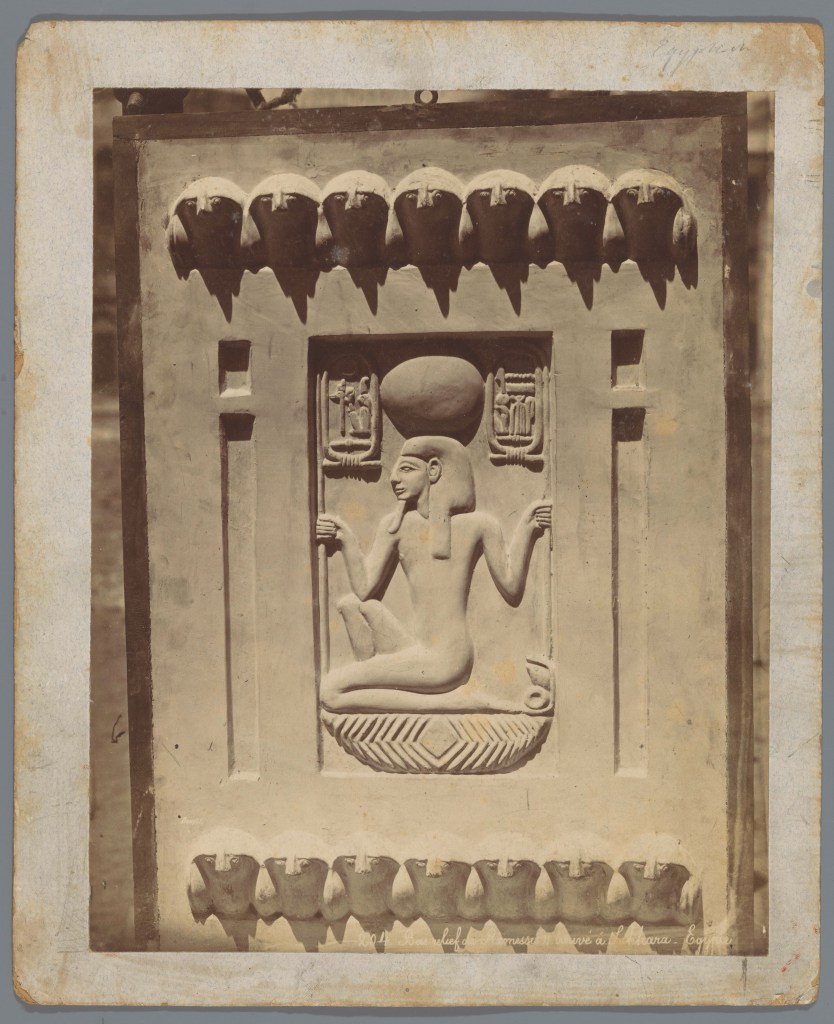
7) Heh
Heh’s name means “million(s),” and he is the personification of time and infinity. Like Nu, the god who is the watery chaos that birthed the universe, Heh—as Time Itself—is thought to have existed before existence was even a thing. Like the birth goddess Heqet, he is sometimes depicted with a frog’s head (a sign of birth and fertility), but generally I’ve always seen him shown as he is above: an anthropomorphic male deity kneeling in a basket (meant to represent the gathered “all-ness” of the universe), grasping two long palm fronds. The palm frond is the hieroglyph for “year,” the great length of Heh’s palm fronds is a visual symbol of the infinite time he represents. I know it’s a little hard to make out on this bas relief, but the right frond, as is often the case for Heh, is also shown sprouting from a frog sitting on a shen ring—the frog, as we mentioned, a fertility symbol, and the shen representing eternal protection (you’ve seen its stretched-out version forming the protective circle of a cartouche around a pharaoh’s name). Visually, this says that, protected by the infinite power of the shen, time will be endlessly renewed through the power of Heh’s hands.
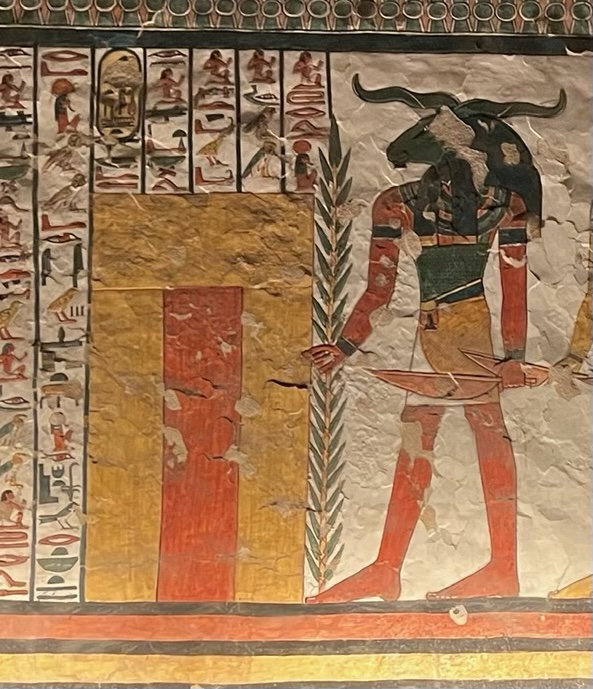
6) Ba-Pef
Okay, we had a little warm up with gods who are not crazy-unknown and whom we actually know some stuff about. Now it’s time to get wild and woolly…literally. We don’t know a ton about the knife-wielding, ram-headed Ba-Pef, but he is an underworld deity whose name literally means “that soul.” This would seem like a promising, if obscure name, but in his only attestation in the Pyramid Texts, his house is described as “wherein is woe,” and this, combined with his weapons, suggests he was not someone you wanted to meet in the Duat. This has led Egyptologists to hypothesize that “Ba-Pef” is actually a not-name designed to avoid calling the god by his real name (and risk bringing him to you). This was a common taboo among many ancient religions besides Egypt’s (think of the many euphemistic epithets given to the Greek god Hades), and given Ba-Pef’s chthonic qualities, it makes sense. There is evidence that Ba-Pef had a dedicated priesthood during the Old Kingdom, and some researchers have gone so far as to claim that it was a priestesshood entirely maintained by queens, but since this individual worship didn’t survive into later periods, hard facts are difficult to come by. But if this was a woman-based worship confined to the royal family, that might also explain why we don’t have more information.
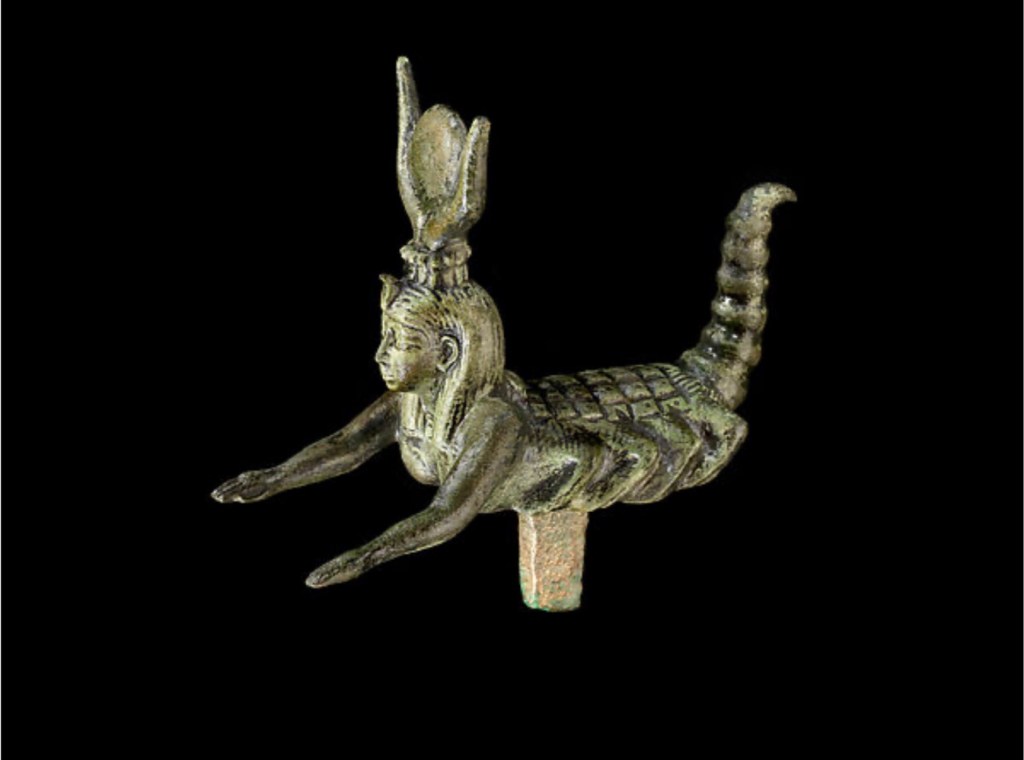
5) Ta-Bitjet
I had actually potentially seen Ta-Bitjet at the Divine Egypt exhibition in the fall, but was unaware as the exhibit called her (rightfully, commonly) a syncretism of Isis and the main scorpion goddess Selket/Serket (I called her an Isis-Selket Human Centipede in my write-up). But Ta-Bitjet, as the more likely to be shown as a human-headed scorpion, is also a distinct possibility. Like Selket, Ta-Bitjet was yet another protective goddess against the ubiquitous problem of scorpion stings in Egypt, and also another consort of the god Horus. Unlike Selket, though, we have a specific mythology from Ta-Bitjet that says her power over scorpion poison (and poisons more generally) comes from the blood of her ruptured hymen released by penetration from intercourse with Horus. Appetizing!
4) Duau
Duau was worshipped as a moon god in the Old Kingdom; one of the best attestations we have of this comes from the Fifth Dynasty pharaoh Unas’ step pyramid at Saqqara. But what helped him make this list is that he was also, delightfully, considered the patron deity of ophthalmologists in ancient Egypt. The study of eyes and eye disease was actually an advanced preoccupation of ancient Egyptians, as the climate of the kingdom created a pantheon of eye problems. Not only are desert and wet edge environments breeding grounds for all sorts of nasty eye parasites, but the sun glare in a world of sand dust and limestone often caused eye strain and partial or total blindness in many Egyptians. And I think it’s this last bit that led to Duau’s crossover domain, as sun glare damage was likely to cause more of the nyctalopia or night blindness Egyptians would have been noticed most by moonlight. It feels very natural that stumbling Egyptians would lift their heads to the moon and ask Duau for a little extra help (light).
3) Nebethetepet
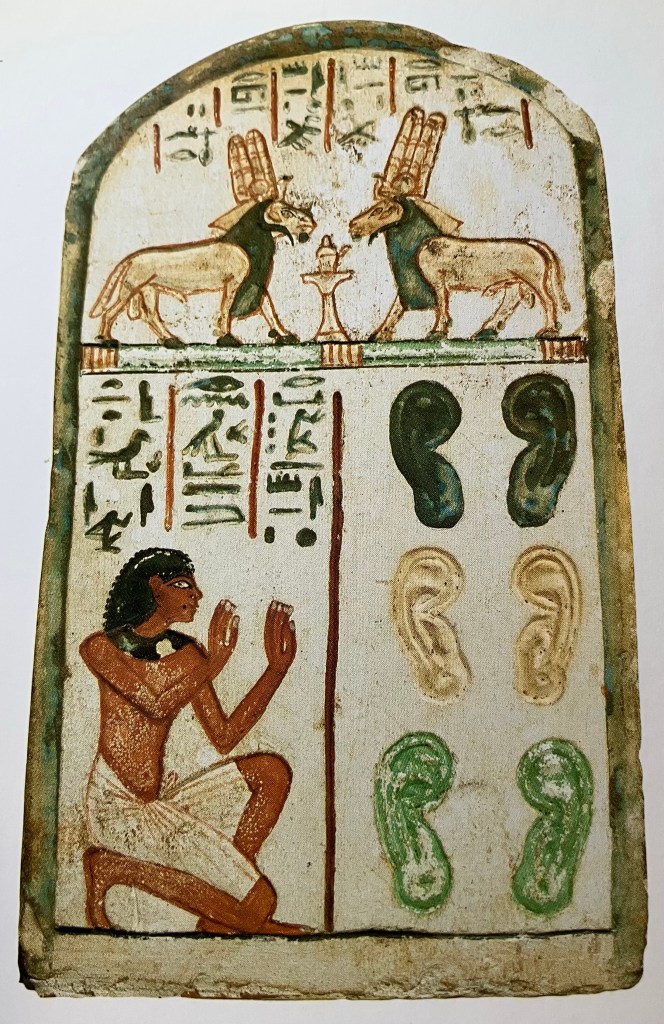
Nebethetepet is another goddess I met at Divine Egypt who I couldn’t quite work into that entry, so it felt like as good an opportunity as any to give her a moment in the sun. Pretty much literally, because Nebethetepet is yet another daughter of the sun god Ra. But her genealogy is (as typically for ancient gods) embroiled in a sort of doubled incest, as she is seen as the daughter of Ra—the sun in its noontime zenith form—but also usually paired as the consort of Atum, the nighttime sun below the horizon in the Duat. As a result, most of her best attestations have been found in Iuanu/Heliopolis, the sun’s largest cult center. But Nebethetepet’s name—“Lady of Offerings,” demonstrates her main function as a receiver of temple gifts and an intercessor to her father and husband on behalf of worshippers. The stela above was an offering tablet left for her by a supplicant, and the request both for her attention and the healing of the gods. Nebethetepet was also called the Hand of Ra/Atum, both for this intercession between mortals and the divine, and—less poetically—because she is sometimes literally identified as the personified hand of her father-husband. Specifically, er, the one he used to masturbate the world into existence. Look, like Ta-Bitjet’s hymen blood, let it never be said that Egyptian goddesses weren’t prepared to get their hands dirty in the line of duty.
2) Iat
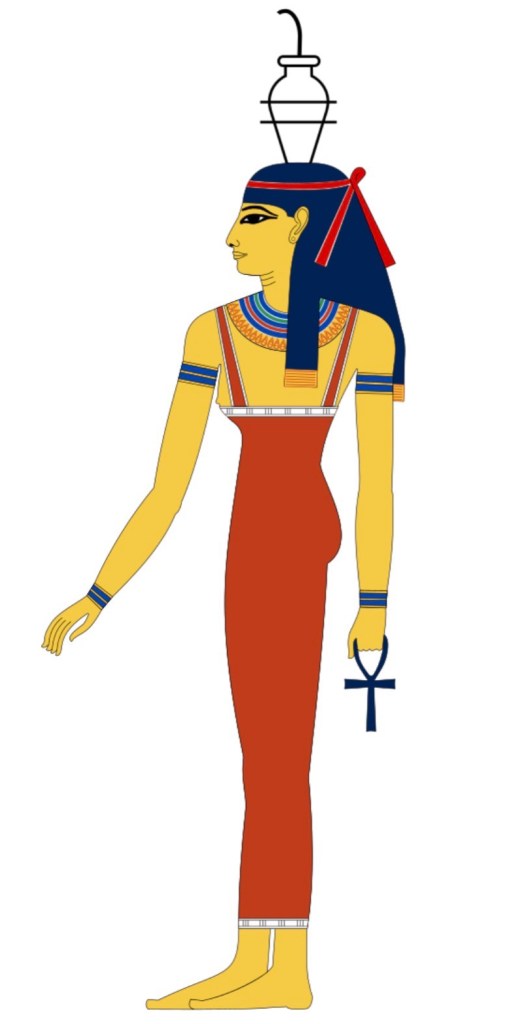
Oh, we’re not done with bodily fluids yet, folks. Luckily for all of you, though, Iat is the goddess of breast milk, which is at least perceptively cleaner. Her name likely comes from iatet, one of the Egyptian words for milk, and although we don’t know much about her, like the previously mentioned Heqet and Meskhenet, she made up part of the constellation of protective goddesses surrounding childbirth and childrearing. Most of her textual mentions come from the Pyramid Texts, where she is depicted as the wet nurse and foster-mother of the pharaoh, the giver of the divine sustenance that will allow the king to thrive in the afterlife. In the classic Wikipedia widget drawing above, it looks like her milk jug has a straw coming out of it. Though that would not be something unknown to the ancient Egyptians—they often drank their particulate-heavy beer through a filtering straw—I’m actually guessing that it is in fact a palm frond like the ones we saw with Heh. Indicating that Iat’s nourishment (or her ability to aid a mortal woman’s breast milk flow) is unending.
1) Abaset
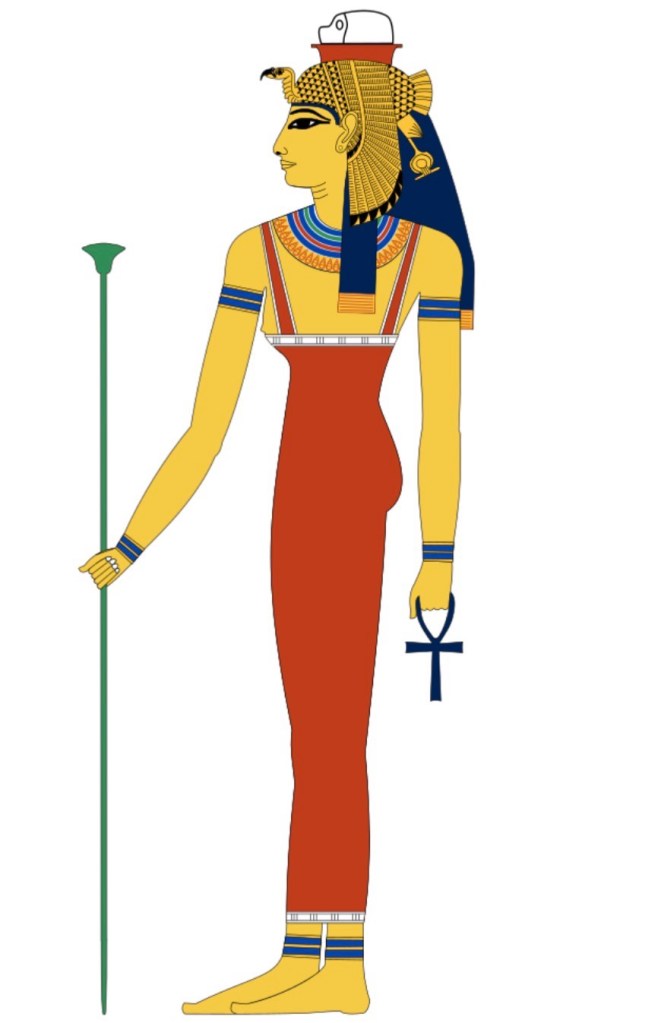
We’ve made it to number one, and a goddess so obscure that she isn’t even in the usually infallible Complete Gods and Goddesses of Ancient Egypt (Thames & Hudson, 2003). In the wonderful Richard H. Wilkinson’s defense, based on the literature, we’ve just discovered our first traces of this mystery goddess in the last five years or so. But she is also the goddess who inspired me to revive this Top Ten series because Abaset has a hedgehog on her head…!!! I’m obsessed. A depiction and short inscription with her name has been found in the tomb of Bannentiu in Qarat Qasr Salim, Bahariya Oasis, out in the Western Desert (roughly 370km or 230ish miles west of Cairo). Bannentiu’s necropolis dates from the Late Period and the 26th Dynasty, the last remotely native Egyptian ruling dynasty. That said, it was a dynasty with a lot of Assyrian and Nubian cultural influences, though it’s not clear if that is reflected in Abaset. As benefitting a late-arriving deity, aside from her adorable ride along, Abaset wears the basic Egyptian goddess attire of the tripartite wig and the vulture crown with a papyrus was-scepter, which don’t give us a lot of details that might tease out her domain or attributes. But let’s turn to the hedgehog: Hedgehogs are indigenous to much of the land surrounding Egypt, including Libya in the north and much of East Africa to the east and the south. Like certain other cultures around the world, hedgehogs were a food source in ancient Egypt, but also like Mafdet’s mongoose, hedgehogs are omnivores who eat a variety of snakes, insects, and likely even scorpions. So, if I had to venture an educated hypothesis, I would guess that at her heart Abaset is yet another protective mother (as evidenced by the solo mewet vulture crown) whose main role was to guard against venomous predators of the western Egyptian desert where she was found. If her presence in Late Period Egypt was due to influence from Bedouin or Nubian culture, she may have also been a healing deity, as the former consider hedgehog meat as medicinal against rheumatism and arthritis. Heck, Abaset is around for such a later period of Egyptian history that maybe she agreed with Aristotle that hedgehogs could be used to predict the weather. But any which way, we can only hope that future archaeologists will uncover more about perhaps the cutest of all Egyptian gods🦔

[Nobody tell Set I said that…]


Leave a comment