“So my first thought when I saw this murderous shape rushing toward me was: So it’s you. Here you are… This was my second thought: Why now? Really? It’s been so long. Why now, after all these years?” — Knife
“The history of life was not the bumbling progress—the very English, middle-class progress—Victorian thought had wanted it to be, but violent, a thing of dramatic, cumulative transformations: in the old formulation, more revolution than evolution.” — The Satanic Verses

I’ve already mentioned at least once about how my mother and I used to frequently trek up to Stratford, Ontario for their annual Shakespeare festival season to catch a few of that year’s plays. Even before mutual moves out of Buffalo made the trip too arduous a distance to attempt regularly anymore (maybe one summer soon the slate will be too good to resist…), some years when the lineup was less to our interests, we would explore alternate venues to scratch the same cultural itch and the corresponding desire to see one another. This led to at least one attempt at the Shaw Festival in Niagara on the Lake (not our jam, mostly for Shaw-adjacent reasons—don’t let us talk you out of visiting, it’s a beautiful area), and some years where we simply settled for Buffalo’s own Shakespeare in Delaware Park.
But another place we often considered was going down to Chautauqua, New York and its same-named institution just shy of the New York/Pennsylvania border (in what we call the Southern Tier where I’m from) and attending some performances or lectures. Situated on the lake also of the same name, Chautauqua is a bucolic little town much in the quaint vein of Stratford and Niagara on the Lake, and the Chautauqua Institution has been a going educational venture in one form or another since 1874, when it was founded as a sleep-away training camp for Methodist teachers. Over the next century, the religious classes expanded into a broad array of educational and artistic programs, which are now offered during the Institution’s nine-week summer season. The Institution and much of the surrounding community have been on the registry of national historic landmarks for nearly fifty years and the summer programs are the cultural highlight of the region.
In addition to theatrical productions, symphonic concerts, and visual art exhibitions, the Institution is renowned for its various lecture series, to which they pull big names in education, public affairs, and the arts. In the summer of 2022, arguably the biggest name on their slate was author Salman Rushdie, who was coming to the Institution in conjunction with Pittsburgh’s City of Asylum project, which looks to provide residencies to writers and artists who cannot produce their work or support themselves in their own countries for political reasons. I actually didn’t know that he was speaking in Chautauqua that August, but he was scheduled for a similar lecture in Stratford in October that I had spent most of the spring and summer that year trying to talk myself out of driving up for.
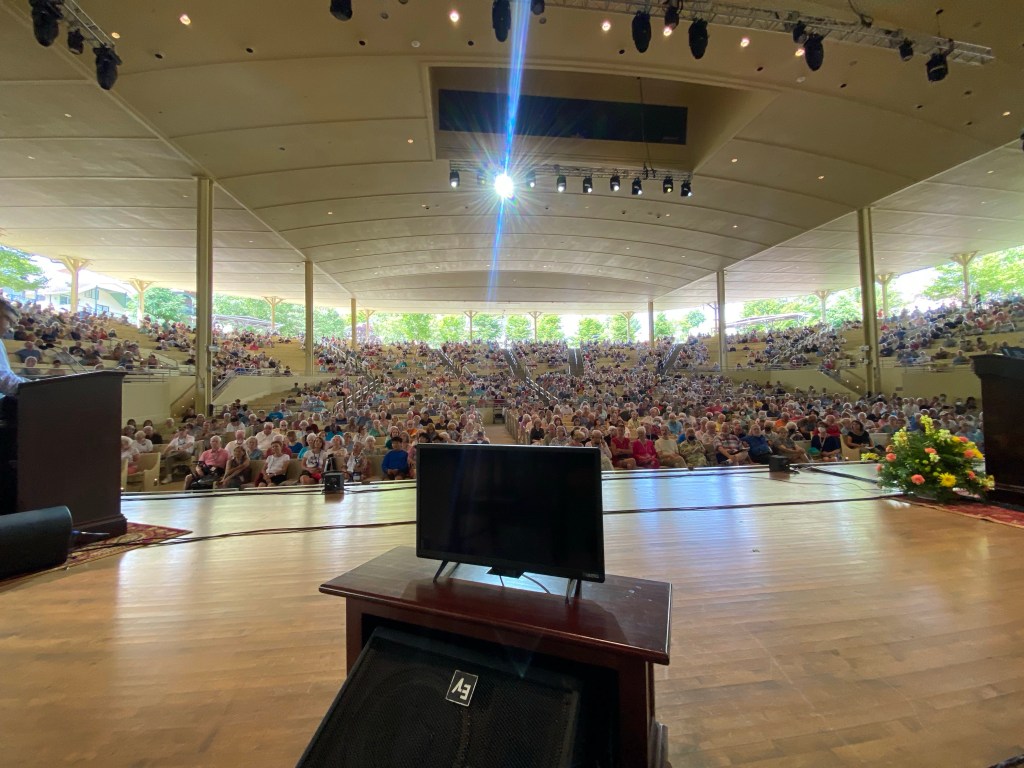
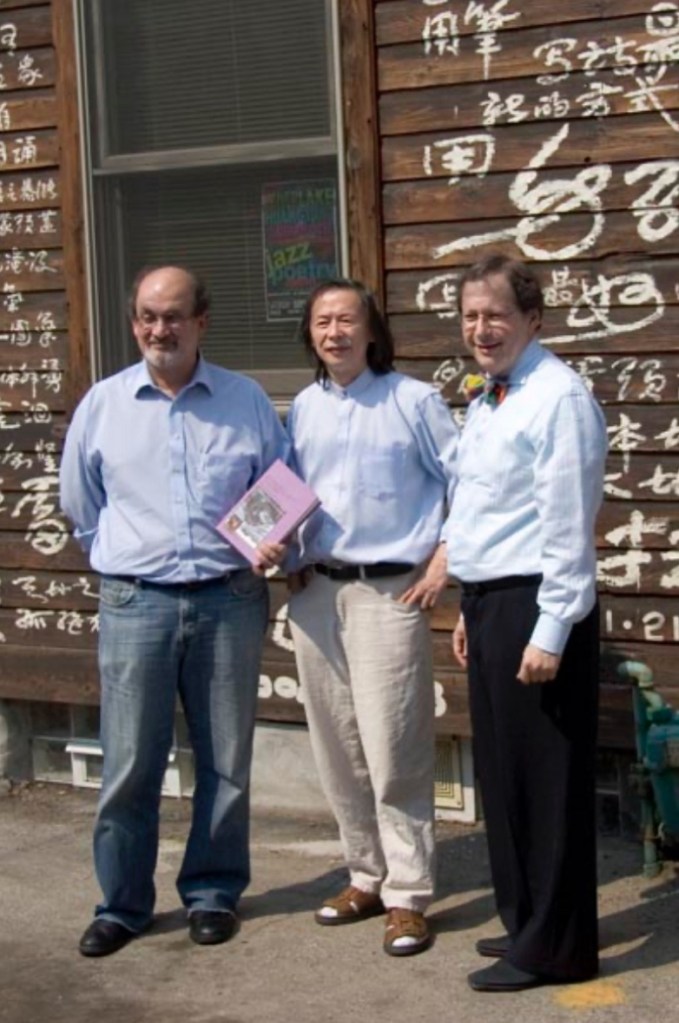
However, as it unfolded, it didn’t matter because Rushdie would never give that talk in Stratford. As he was introduced alongside City of Asylum Pittsburgh founder, Henry Reese, in Chautauqua’s renovated amphitheater on August 12, 2022, an armed assailant rushed the stage and began stabbing Rushdie, while Reese and members of the horrified audience tried to pull the man off the author. The attack only lasted twenty-seven seconds, but the assailant managed to inflict fifteen stab wounds in Rushdie before he was subdued, including ones to the author’s chest, neck, left hand, and right eye. Given these serious injuries, when he was emergency airlifted to the nearest trauma hospital in Erie, Pennsylvania, it was extremely uncertain whether or not the seventy-five year old Rushdie would survive.
I remember that when I heard the news, I, like Rushdie, had two immediate thoughts. The first was admittedly personal: that dragging my mom up to Chautauqua to hear Salman Rushdie speak sounds exactly like something I would have done had I known about it, especially since we were always talking about seeing something at the Institution, and experiencing a moment of sheer terror at the thought of her (us) witnessing something so awful. My second thought, ironically, was almost identical to Rushdie’s own quoted above: why now? Why was this (finally) happening now after so many years?
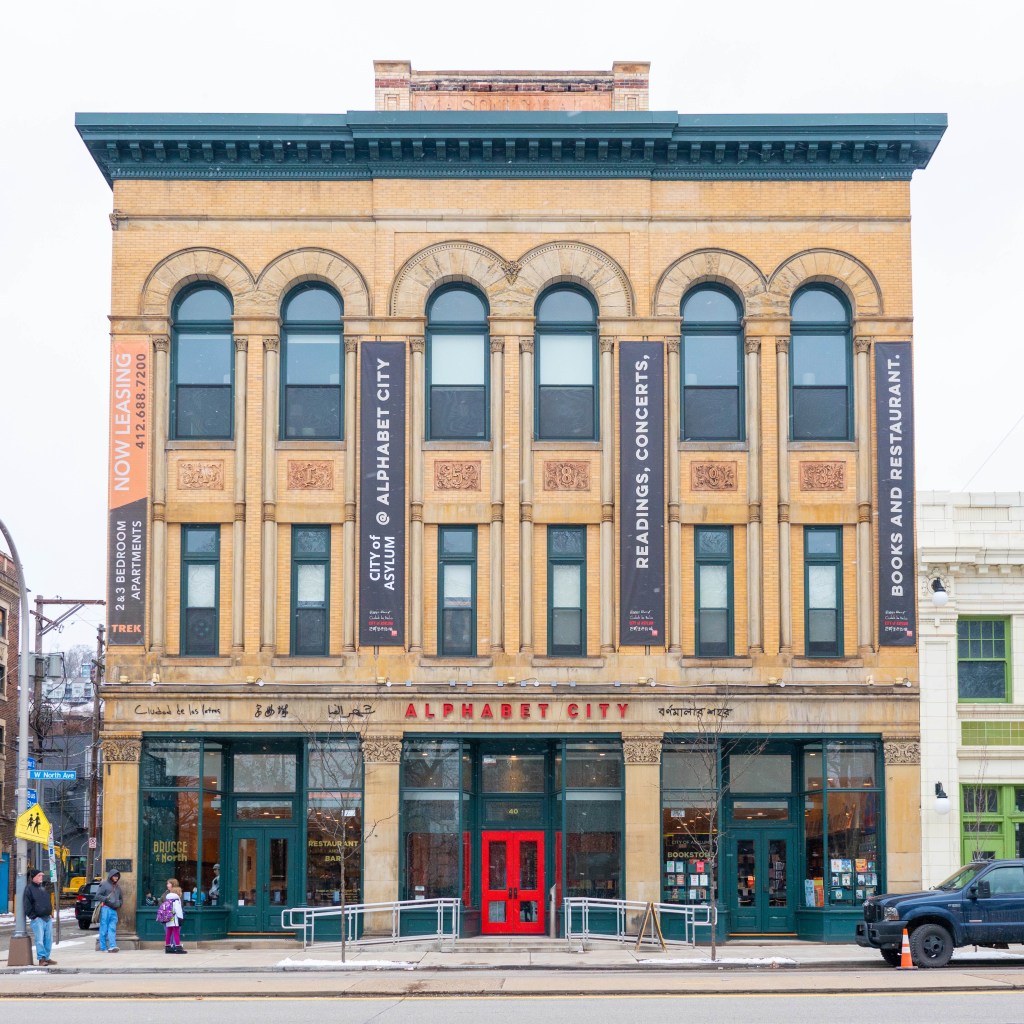
As his quoted first thought reveals, Rushdie has been in part expecting this proverbial appointment in Samarra for over thirty years now, even if the timing took him as much off guard as the rest of us. The Cities of Asylum project began in part as a response by the literary world to his experiences living largely underground off and on for nine years after Ayatollah Khomeini of Iran issued a fatwā, an Islamic legal ruling, that declared his 1988 novel, The Satanic Verses, as blasphemous against the Prophet Muhammad and Islam, and offered $2 million bounty for the author’s assassination. Despite Khomeini’s own death three months after its issuance, the fatwā has never been entirely withdrawn by the government of Iran. In 1998, the government eased its position back to not officially supporting an assassination attempt, but it also refused to repeal the fatwā or promise to prevent such an attempt in its name; and in 2005, it officially reinstated the active fatwā, while stating a year later that the ruling will remain permanent.
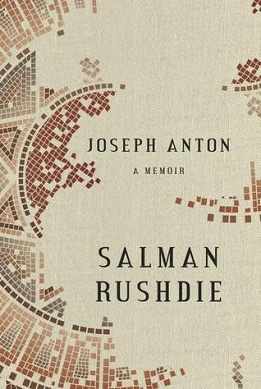
While this has been understood by everyone to be largely Iranian political rhetoric since the turn of the millennium, multiple conservative religious foundations within Iran have continued to add to the bounty on Rushdie’s head, with the latest reckoning close to $4 million (per The Guardian in 2016). Since returning to his “normal” life in 1998, particularly since moving to the United States in 2000, Rushdie hasn’t given the fatwā much shrift publicly—understandably wanting to move on with his life and his work, and not spend all of his time rehashing the fatwā decade and the novel he calls with fondness and exasperation “that book.” His 2012 memoir of that book and that decade, Joseph Anton, was meant to be his final word on both. Until the morning in Chautauqua and a young man steeped in Iran’s fatwā rhetoric intervened.

Despite all of the ominous and shallowly Alanis-esque ironic circumstances, Salman Rushdie did in fact survive the most serious attempt on his life, and after a year and a half of painful struggle to regain his health and his regular routine, he has gifted us Knife: Meditations After an Attempted Murder, his latest book and the unintended sequel to Joseph Anton. In a rarity for me, I got it on release day and read through its slim 200-odd pages in a couple of days, but they were a couple of days which gave me a lot to chew over. So rather than the entry I was planning (an exploration of the gender fluid medieval epic poems Silence and Aucassin and Nicolette—don’t breathe out just yet, it’s still coming…), I wanted to talk a little about Knife and my thoughts. I don’t know if I have anything particularly profound to contribute, but like Rushdie saying this was something he had to write in order to move past it, I feel like I have to talk about it to digest the experience of reading it.
In a review I wrote a decade ago for Joseph Anton, I called it an Important Book with caps for Emphasis beyond its individual literary merits or failings, and I stand by that. Recording the fatwā years and Rushdie’s experience as the most hated writer in the world is important as a testament to our notions and limitations of free speech and author expressionality. And Knife, is, I think, if anything, more important to both the author and his readers. Gone is Rushdie’s ability to retreat into the clinical third-person dissociation he employed to tell his story in Joseph Anton, and he is left only with the plaintive first-person “I” that was both changed and unchanged by the events of August 12, 2022. In his nonfiction and essays, Rushdie has never shied away from the directness of first person perspective, but here, it feels more imperative than before. It is in many ways a capitulation to his age and its accompanying frailties, and those of his literary friends as he ties his attack to the slow and often painful passing of his peer generation of writers.
And that’s the biggest strength of Knife. It’s not just an autopsy of the event itself for the morbidly curious. More than anything he’s ever written, fiction or nonfiction, Rushdie surrenders to the cruel exposure and indignities that his assailant’s actions caused him. He has always been open and outspoken, but this book might be the first time he allows any of us, the public, into his more private space—something that I recognize might be nearly as painful to him as the horrific physical wounds he suffered in Chautauqua. After several high-profile marriages (and divorces), even as someone who keeps tabs on him, I was surprised and delighted to discover that he had been largely able to keep his latest one, to American poet Rachel Eliza Griffiths, off my radar—and I grieved for them both that the Chautauqua attack and Knife will strip the last shred of that privacy away in the eyes of the general public.
But I also think that this literary exorcism will be a net good for Rushdie and us, as it shows both the humanity his critics so often try to take away from him and the love, both romantic and platonic, that sustains him in spite of his difficult career. There is minute detail about his injuries and the year of rehab to bring him back from the brink of death, but there is also loving descriptions of his wife and their bond—a bond that felt decadent in a pandemic and self-congratulatory in an increasingly broken world (something I’ve been fortunate enough to experience, too, and the ambivalence is real).
Obviously, Knife cuts deeper for those of us who have spent years beside Rushdie and his writing, but I think there is enough here for the casual reader too. How do you return to your life after something that tears down the life you knew before it? The events of Knife are specific, but Rushdie, as the consummate writer that he is, finds not only the universality buried within his experiences, but also the thing I wanted more than anything: signs that the seeming arrival of a death foretold didn’t break him. In a review that I wrote of his 2019 novel, Quichotte, I said that Rushdie is at heart an optimist, and while I think he’d agree with me on that (he essentially does so at one point in Knife), I would perhaps clarify my position to say that he is a realist who has great faith in hope. Even his darkest and most cynical writings are almost perversely hopeful, and as I read through Knife, I realized that I had been anticipating its release so keenly in part because I was afraid that his assailant might have cut away that part of him and left him bitter.
What a relief it was to find so much of the same old familiar Salman Rushdie in Knife: the one who loves to free-associate through the literary and pop culture catalogue in his brain, the one whom despite his place in the upper echelons of the modern world of letters isn’t too grand to make himself foolish or vulnerable. And frankly, the unapologetic atheist who believes fervently in love and the power of good, if not specifically a higher power. I’m devastated that he had to write this book, while being so grateful that he has. As always, I eagerly await his next fiction work (no matter whether I end up liking it or not), because a Salman Rushdie returning to fiction will be the final sign that his life has defeated his assailant’s misguided hate. The world at large often feels dark and hopeless, but if Rushdie isn’t willing to throw in the towel on free speech and free art yet, it feels cowardly not to follow him forward. The struggle for justice and equity is long, but the darkness can only win if we let it. To quote someone Rushdie clearly admires and who shares his sorrows, our dear rascal Ovid, “Tis hard, I admit, yet virtue aims at what is hard, and gratitude for such a service will be all the greater. [“Difficile est, fateor, sed tendit in ardua virtus et talis meriti gratia maior erit.”] (Epistulae ex Ponto, II, ii, 111-112; Wheeler trans.). It’s hard not to see Rushdie’s unlikely survival as a benevolent sign from the universe that he still has things to do.


Leave a Reply