
While the Egyptians were rightfully held by the ancient world as the possessors of the largest (western) pantheon, we know from our previous discussions about the snide remarks of the early Christian writers that the Greeks and Romans were hardly defined solely by the Olympians when it came to the breadth of their synthesized religious world.

[I love, though, that Herodotus claims that the Egyptians are “the most religious” people seemingly based on the idea that more gods = more religion. It’s a very Invader Zim approach to the question.]
So, as a kind of appetizer to my future Helikon Queens/Muses content, since my Greco-Roman lesser deity listicles are almost as popular as my Egyptian ones—and we’ve already revived that one twice—I thought this week we’d go back to the Greeks and see what other gods they have knocking around beneath the grandeur of Mount Olympus. I’m hoping to do a second Roman group sometime before the end of the year, but we’ll see what I can dig up. With the obscure gods of all stripes, I try to balance their oddness/obscurity with whether I can find any information about them beyond their names. Contrary to some of the results, I do try to make these posts actually interesting to read 🤪
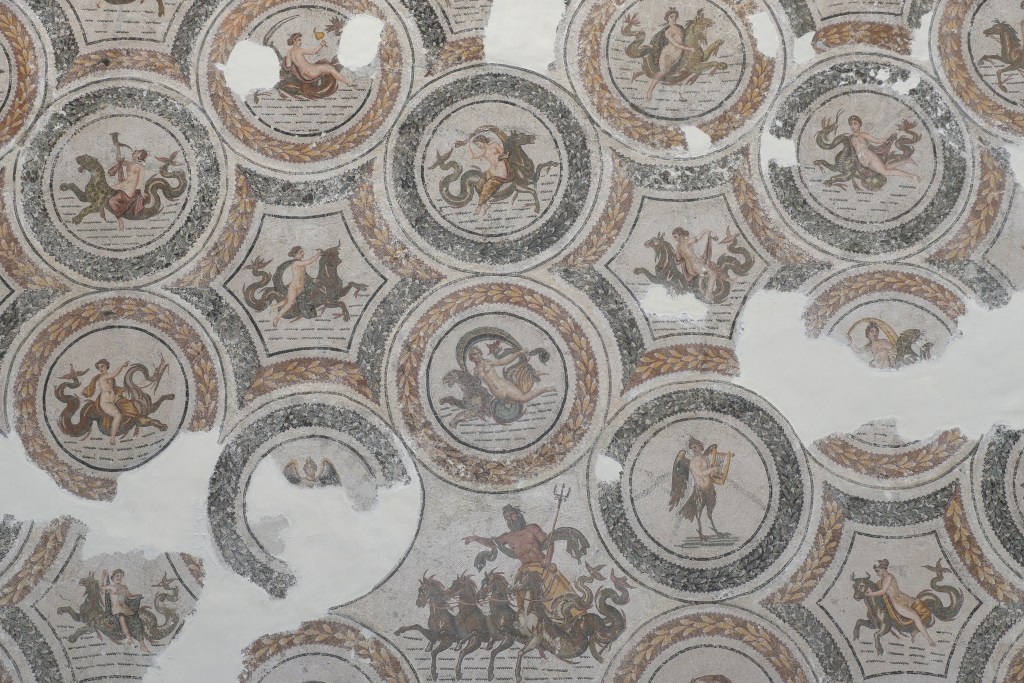
10) Thoosa
Sometimes described as the goddess of currents, particularly fast-moving ones, Thoosa was a sea nymph who was the daughter of the sea god, Phorcys (Nereus’ brother, which is why Thoosa is not specifically a Nereid, who are her cousins). In Homer’s epics, she is Polyphemus the cyclops’ mother by Poseidon. Although surrounded by the sea and more comfortable with it than, say, the Romans, the Greeks recognized the sea as an entity both powerful and liminal, and the number of strange offspring that come out of it, even through the ostensibly respectable Olympian Poseidon and the beautiful sea nymphs, reflect their knowledge that the sea is only ever negotiated with, never controlled.

9) Aergia
Aergia is the goddess of laziness—or sloth, if you want to get biblical about it. Like many personified deities, she is pre-Olympian in origins, being the daughter of the earth goddess, Gaia, and Aether, the god of the upper sky. However, rather than being torn between heaven and earth, Aergia is a semi-chthonic deity, one of the many companions of Hypnos, the god of sleep. Although writing in the mixed Greco-Roman milieu of the 1st century CE, the poet Statius describes Hypnos’ court as a group of torpid gods lounging around together like there’s a gas leak in the underworld: Aergia lying beside other mood gods like Silence, Forgetfulness, and Ease.
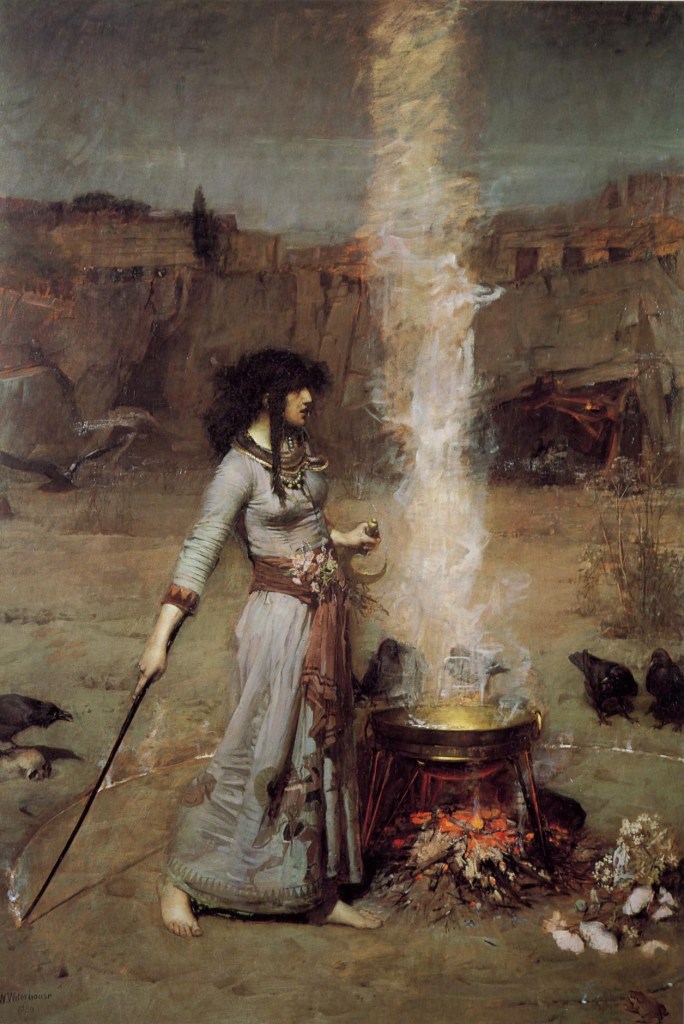
8) Achlys
Achlys is depicted as the personification of sorrow in the Shield of Herakles, an archaic poem attributed to Hesiod (c. 6th century BCE) in antiquity, but whose definitive authorship is unknown. Achlys’ literal name (Ἀχλὺς) means “mist,” but ancient poets tended to use ἀχλύς when they wanted to convey the fog of confusion that falls on a dying person that presages their demise. For example in the Odyssey, Homer describes the death of Eurymachos, one of Penelope’s suitors, at Odysseus’ hands as follows: “With his brow he beat the earth in agony of soul, and with both his feet he spurned and shook the chair, and a mist [ἀχλύς] was shed over his eyes.” (22.79-88) This fog of death upon the living was understandably seen as frightening, and Achlys’ description in the Shield of Herakles reflects this, as does the Hesiod poet’s appellation of her not just as Mist, but Death-Mist: “… Death-Mist [Ἀχλὺς], gloomy and dread, pallid, parched, cowering in hunger, thick-kneed; long claws were under her hands. From her nostrils flowed mucus, from her cheeks blood was dripping down onto the ground. She stood there, grinning dreadfully, and much dust, wet with tears, lay upon her shoulders.” (264-9)
By a millennium later in the 5th century CE, the Greeks poet Nonnus, in his compendium the Dionysiaca, an epic poem which attempts a sort of narrative synthesis of all of Dionysus’ various mythologies, takes this lurid description of Achlys and turns her into a full-on witch. She is identified with Thessaly (the traditional home of witchcraft in the ancient world, the way wizards were associated with Persia), and is shown making a poison for Hera that will turn the nymphs guarding Dionysus from her into hideous centaurs.
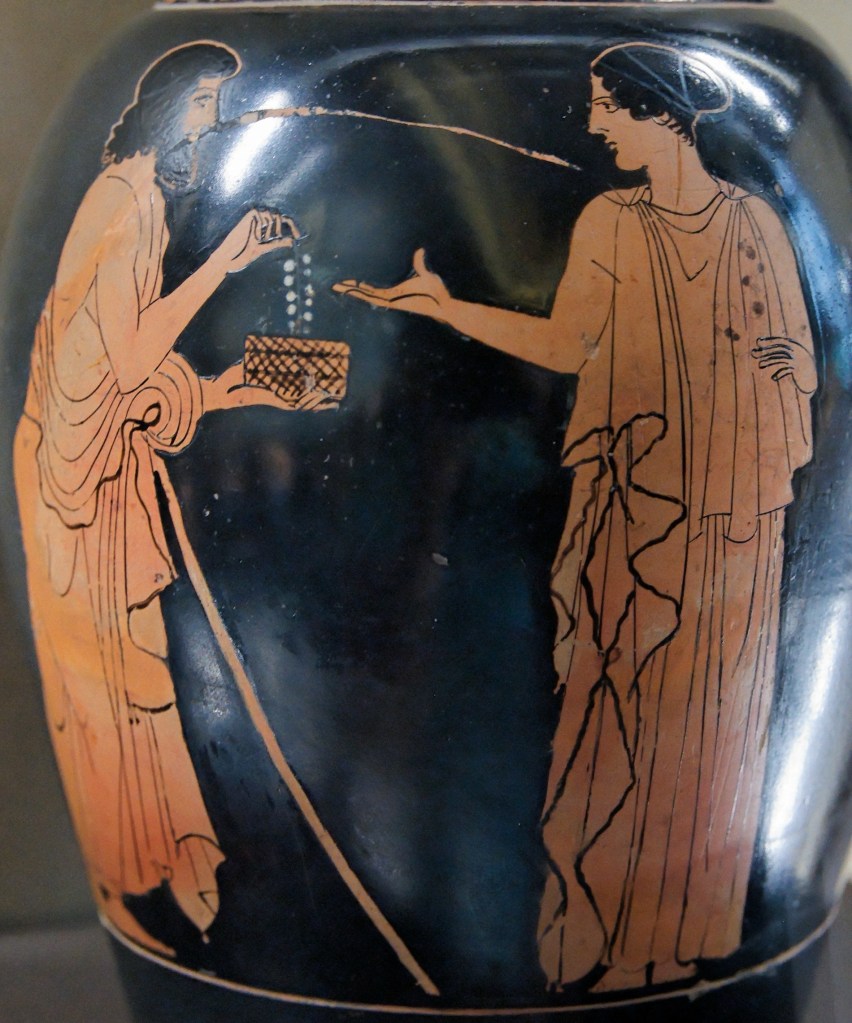
7) The Telchines
Speaking of wizards, the Telchines were primordial sorcerer-demons who the Greeks believed were the original inhabitants of the island of Rhodes. They have different parents among the ancient sources, but none of them are pleasant: they are either the product of incest between Gaia and her son, Pontus (the personification of the sea); the children of Tartarus (the worst realm of the underworld) and Nemesis (the goddess of retribution); or my favorite, yet another gross offshoot of Uranus’ castration, alongside Aphrodite and the Erinyes. Their monstrous, semi-aquatic forms—flipper hands and dog heads—suggest that the Gaia/Pontus parentage is the most likely, though. We also don’t know how many of them there were (we have at least twenty-one names across the various sources), nor do we have a definitive gender breakdown (sixteen of the names are male, five are female).
Like a lot of the pre-Olympian deities, however, the Telchines were complex and not wholly bad. They were seen as founders of several sacred locations throughout Greece besides Rhodes, and Rhea at least initially entrusted Poseidon’s upbringing to them, although they would eventually be on the losing side of the Titanomachy, supposedly killed by Zeus or Poseidon. The trace mythologies suggest that changeover happened when the Telchines began to dabble in poisons and more malignant forces. They were believed to be able to shapeshift and destroy crops through hail and snow, as well as blighting the soil with toxins. But at the same time, as wizards, they were thought to be exceptionally skilled metallurgists and therefore respected, if not worshipped, by various artisans and craftspeople. Various sources claim that they made several of the Olympians’ weapons, and may have helped Hephaestus forge Harmonia’s cursed necklace, which may explain part of its malignant subsequent history.
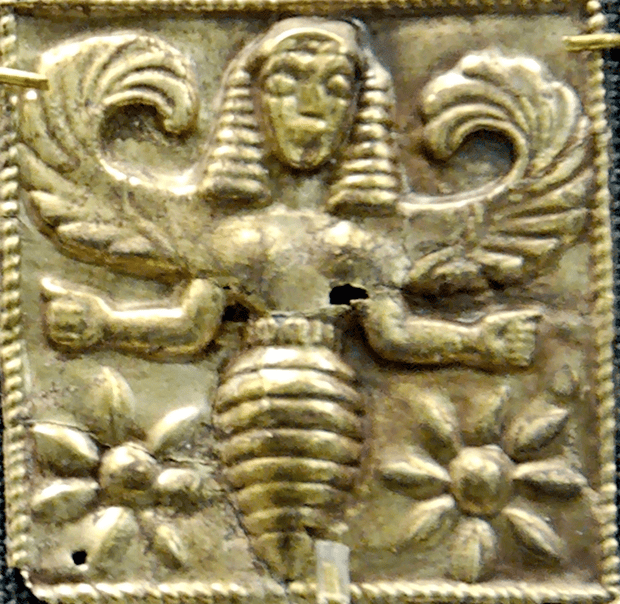
6) The Thriae
The Thriae are three nymphs from Mount Parnassus, the mountain overlooking Apollo’s great oracle seat at Delphi, and are thought to have been the goddesses who nursed this prophetic ability in him as he took over the Pythian throne from the goddess of divine law, Themis. Because they are associated with the sacred spring in the Corycian Cave, a natural rock formation held in cultic regard since Delphi’s prehistory, the Thriae are sometimes identified as Naiads (freshwater nymphs) specifically, despite having the unusual form of being young women from the waist up, with the lower abdomens and wings of bees. Bees and honey were a part of many Greek religious traditions, both being seen as sacred to the gods. Like many priestesses across the Greek world, the Pythia at Delphi was sometimes called Melissa (“bee”), in part because bees were believed to be able to transcend liminal boundaries between the gods and men, and life and death.
The 2nd century (CE) geographer Pausanias says that the names of the Thriae are Melaina, Cleodora, and Corycia (for whom the cave was named). They have several sons with Poseidon and Apollo, which reflect their dual watery/oracular nature, most of whom exist to provide mythological founders for Delphi and Parnassus. Unlike the later divine enthusiasm method of Apollo’s Pythia, the method of prophecy that the Thriae taught Apollo, according to the Homeric Hymn to Hermes, was a sort of divining that interpreted the appearances of stones. Because this divinatory type was so intertwined with the Thriae themselves, the Greeks literally called this “pebble divination” Thriai, after them, with practitioners referred to as Thriovolos (Θριοβόλος—“thria-thrower”).
5) Kyamites
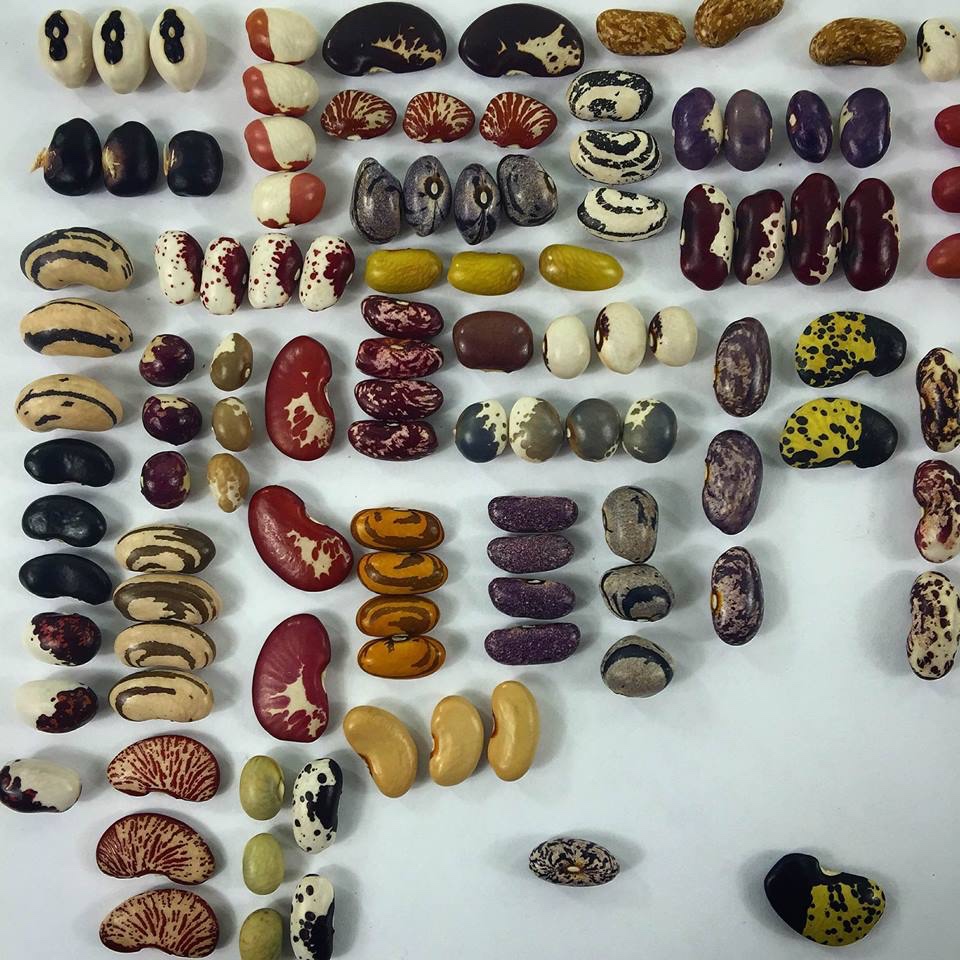
Like a few other god on this list, Kyamites was a local polis deity, whose worship, as a minor god, was confined to a relatively small geographical area. In this case, though, we’re talking about the city of Athens. According to Plutarch, because Kyamites’ shrine was situated near the Athenian bean market, he became associated with the market and its main commodity. Before his bean makeover, it’s unclear what exactly Kyamites’ claim to fame was; ancient Greek culture was full of these intensely local hero cults, most of whose original implications were obscure even to the people who ostensibly worshipped them. Kyamites may have been an ancient former resident who rendered Athens a service of one kind or another, or just a local boy who did something cool. For example, the playwright Sophocles was technically venerated in a version of this kind of god-hero cult because his plays were so good. And because “Kyamites” means “beans,” maybe his lost original name and what he’d actually done to get the shrine got subsumed by the connection to the market.
But another intriguing theory on both Kyamites’ obscurity and his weirdly legume-centric sphere of influence is that “Kyamites” wasn’t his name because he was the god of beans, but instead it was a not-name designed to avoid speaking his unlucky real name. The Hungarian philologist Károly Kerényi has suggested that Kyamites’ shrine is in fact a shrine to Hades, the god of the underworld, which isn’t quite as crazy as it sounds. Beans, particularly black beans, had chthonic implications across the ancient Mediterranean (think of their ritual usage in the Roman Lemuria); and Plutarch claims that some of the Egyptian priesthoods were forbidden from eating them, presumably for ritualistic reasons. Since beans were often held as a food of the dead, but one that living people (especially poor ones) also ate, if Kyamites was in fact Hades, his shrine may have been one of appeasement by those who made their livelihoods from something generally deemed to belong to the dark god the Greeks always had a somewhat ambivalent relationship with.
4) Pasithea
As with the Thriae, we in the modern age tend to think of the Graces (also called the Charities) as being strictly three in number, with most people following Hesiod’s account of them being Aglaia, Euphrosyne, and Thalia (not to be confused with the Muse of the same name), the daughters of Zeus and the Oceanid, Eurynome. But like many of the minor Greek goddess, particularly those who exist as a group of ideologically similar sisters, the names and numbers of the Graces were less fixed in the past, and Pasithea was one of the pinch hitters on their roster. There is no agreed upon scholarly consensus on what precisely her name means, with most trying to massage it into the kind of represenive names the other Graces have (Euphrosyne’s means “joy,” for example). Thea is Greek for “goddess,” and many have glossed pasi into a conjugate of pan (“all”), Panthea/Pandemos being epithets of Aphrodite, in whose entourage the Dionysiaca puts Pasithea.
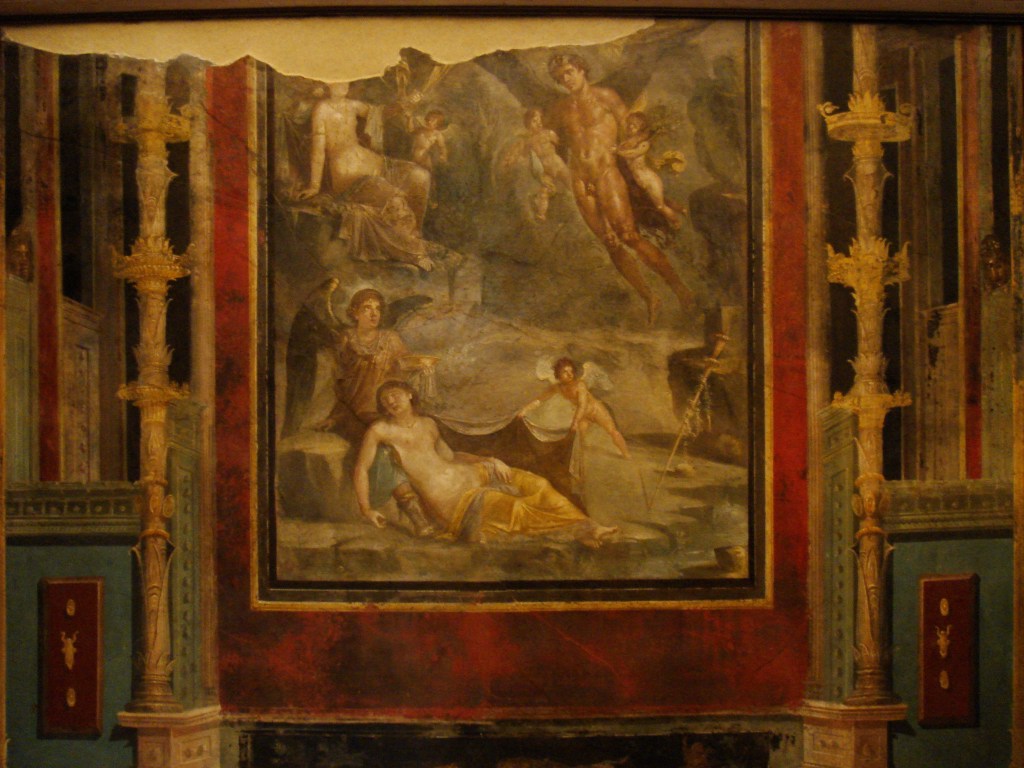
But Pasithea’s oldest attestation actually comes from the Iliad, where in Book 14 Hera gives her in marriage to Hypnos, the aforementioned god of sleep, in exchange for Hypnos putting Zeus to sleep for a while to take him out of the war’s action. As the goddess of marriage, this is kind of Hera’s domain to mess in to begin with, but the 4th century Posthomerica suggests she can offer Pasithea to Hypnos because she is the Grace’s mother. The Dionysiaca concurs, but adds that Dionysus is her father, which is awkward because Hera and the god are antagonists in the poem. But it gives her something to complain about to her mistress Aphrodite and gets the love goddess to come to Dionysus’ aid. The above Pompeiian fresco is possibly a painting of Pasithea (sleeping in the foreground) as her new husband Hypnos (the winged figure at center) is brought to her by Hera (the goddess seated in the top left corner). Once married to Hypnos, Pasithea was sometimes denoted as the goddess of meditation, a gentle presence between sleeping and waking; perhaps in a less salutary vein, she was also sometimes held out as the goddess of hallucinations, which might have been tapping into something latent on her Dionysian side.
Pasithea is also mentioned in a 10th century commentary on the Odyssey by Eustathius of Thessalonica on an otherwise obscure elegy by an unknown “Sostratus.” In a mythological variation on both the prophet Tiresias’ gender swap and the Judgment of Paris, Tiresias is called to the wedding of Peleus and Thetis to judge the beauty of Pasithea and her sister Graces (here named Kale and Euphrosyne) and Aphrodite. Sadly for our girl, Tiresias names Kale the most beautiful, for which Aphrodite turns him into an ugly old woman, although Kale will amend this to the prophet being a beautiful young woman because Graces gotta Grace.
3) Methe
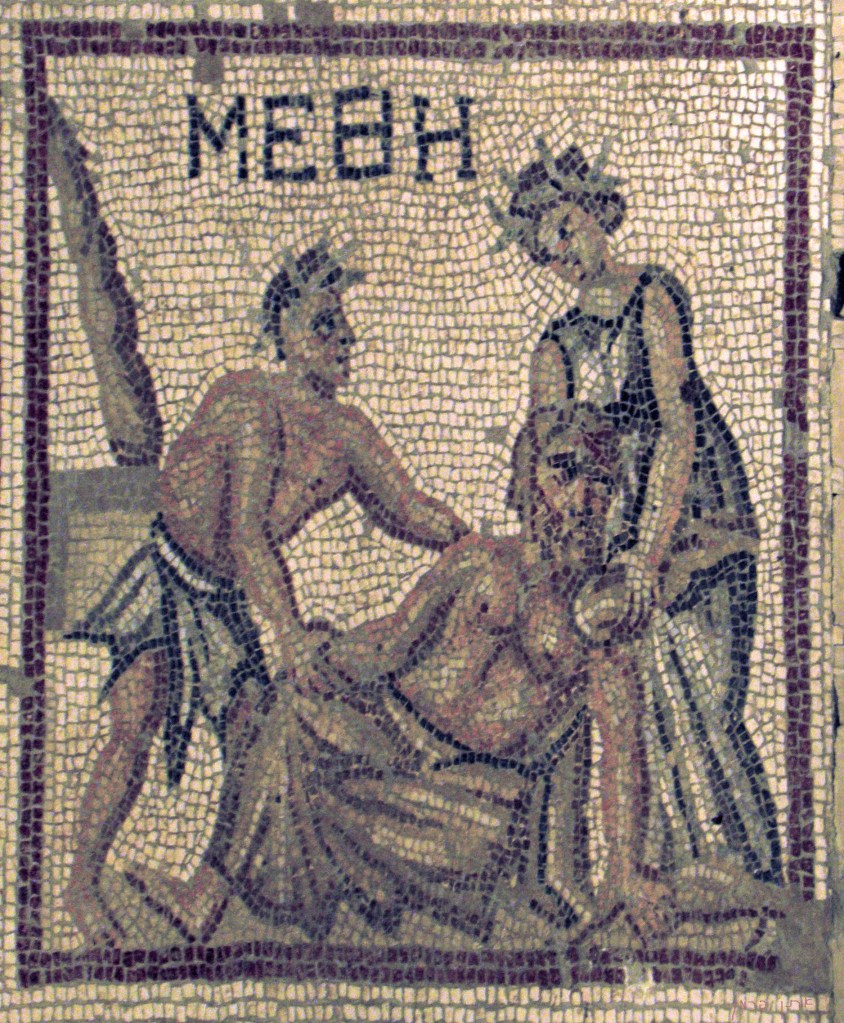
Methe’s name means “drunkenness,” so you’re probably not surprised to find out that she is part of Dionysus’ entourage, the way that the minor gods embodying the various stages of love (or the Graces like Pasithea) hang out with Aphrodite. You might also be as a result imaging her as a goddess whose hair you have to hold back for her while she throws up in the street, but actually Methe is portrayed in the handful of late antiquity sources we have as more of the personification of being pleasant inebriated (hence why she’s considered equivalent to the Roman goddess Ebrietas) rather than black-out drunk. The Anacreontea describes her as a companion of our Graces, under whose influence “Lype [Pain] takes rest and Ania [Trouble] goes to sleep.” (frag. 38). While Dionysus can be a god of excess and frenzy, Methe is a part of the god in his form as a benevolent friend of mankind, one who eases suffering and lightens the heart. Wine’s place in medicine and pharmacology in the ancient world attests to this as well: Dionysus threw a good party, but he was also seen as much a healer as Asclepius. All of this is reflected in the Roman-era mosaic above, where Methe is shown cradling a drunk man to keep him upright with the help of a young man who might be meant to represent her son according to the mythological tradition, Botrys.
Like with Pasithea, that mythological tradition is laid out in the Dionysiaca. According to Nonnus, Methe was originally married to a legendary Assyrian king, Staphylus, who along with their son, Botrys, hosted the god during his eastern travels. Unlike Dionysus’ sometimes mixed reception as a new god, the Assyrians welcome him with open arms. This is reflected in the royal family’s names, as alongside Methe (Drunkenness), Staphylus’ name means “Grape Cluster,” and Botrys’ simply means “Grapes.” When Staphylus dies suddenly during the god’s visit, Dionysus personally holds funeral games in his honor and takes Methe and Botrys into his protection, which is how Nonnus believes the queen-turned-goddess arrived in the god’s train.
2) Brizo
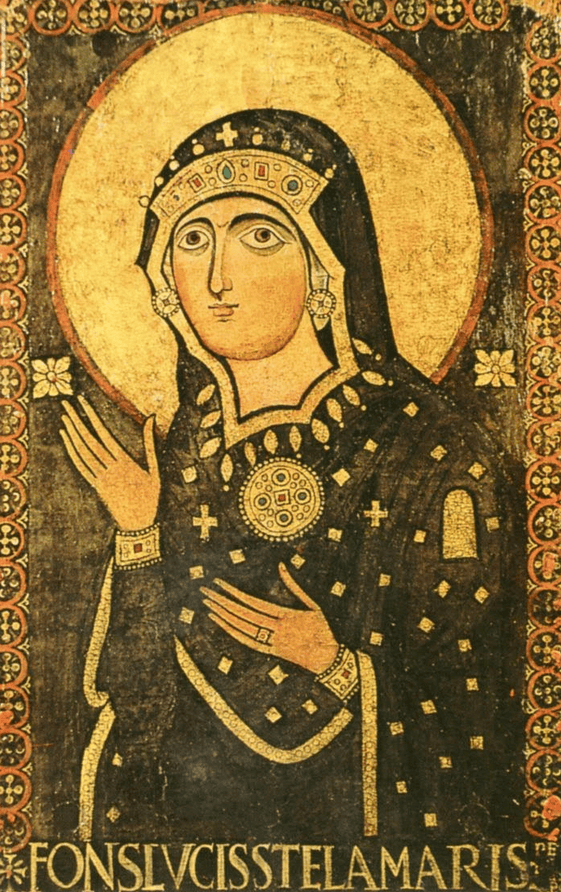
Brizo was a regional goddess specifically tied to the island of Delos in the large Cyclades archipelago that trails off the coast of mainland Greece. Delos is better known as the birthplace of Apollo and Artemis (and consequently the home of their mother, Leto), but Brizo may have had an even older connection to the island, given her apparent role as a protecting sea goddess, as such primordial deities tend to be first arrivals in religious rituals. Like much of ancient Greece, island and coastal mainland, many Delians made their livelihoods from the sea, and Brizo’s sphere of influence reflects that. While generally depicted as the protectoress of sailors and fishermen, it seems that Brizo may have been especially a confidant of the women of the island, as in later antiquity, the historian Semos of Delos writes of Delian women sending out their offerings to the goddess in little boats in order to beg Brizo to watch over their husbands and menfolk on the water. Much like how Osiris’ connection to the sacred fish of the Nile made offerings of fish verboten to his worship, though, Brizo also forbade fish offerings, and the worship offered by the Delians may have been aimed at gaining the goddess’ acquiescence to the fishing industry that fueled so much of the island’s economy. And to draw another Egyptian parallel, much as Coptic Christians would create the iconography of the Madonna Lactens from existing Egyptian art of Isis nursing Horus, part of me wonders if early Byzantine/Orthodox identifications of Mary as Stella Maris, the Star of the Sea, guardian of sailors, come from these older roots of local goddesses who once filled these roles for Greeks before the advent of Christ. This part is just my personal speculation, but it’s why I used a Byzantine icon of Madonna Stella Maris as my picture for Brizo, who I couldn’t find a depiction of.
Brizo’s other attribute to the Delians was as an oracular deity. That feels like it could be a later addition grafted on from Apollo’s skill set, as the most prophetic Greek god besides Zeus, but it is also possible that local Delian cults treated Brizo as Apollo’s instructor in prophecy, the way that the Delphi claimed that their famous oracle was originally the domain of the Thriae and the Titan Themis. This theory becomes more likely when one takes into account that Brizo’s very name, βρίζω, means “to slumber,” pointing to her oracular domain over her connection to the sea. Because Brizo’s particular form of prophecy was, rather than the sort of question and response oracle of the Pythia at Delphi used, was oneironancy, meaning she gave her oracles through prophetic dreams. Scholars are divided on whether worshippers had to receive her prophecies within her sanctuary or not, but given how common prophetic incubation (ritually spending the night in a temple in order to communicate with the patron god through one’s dreams) was throughout the ancient world, it certainly seems likely that Brizo’s shrine on Delos would offer this in some capacity.
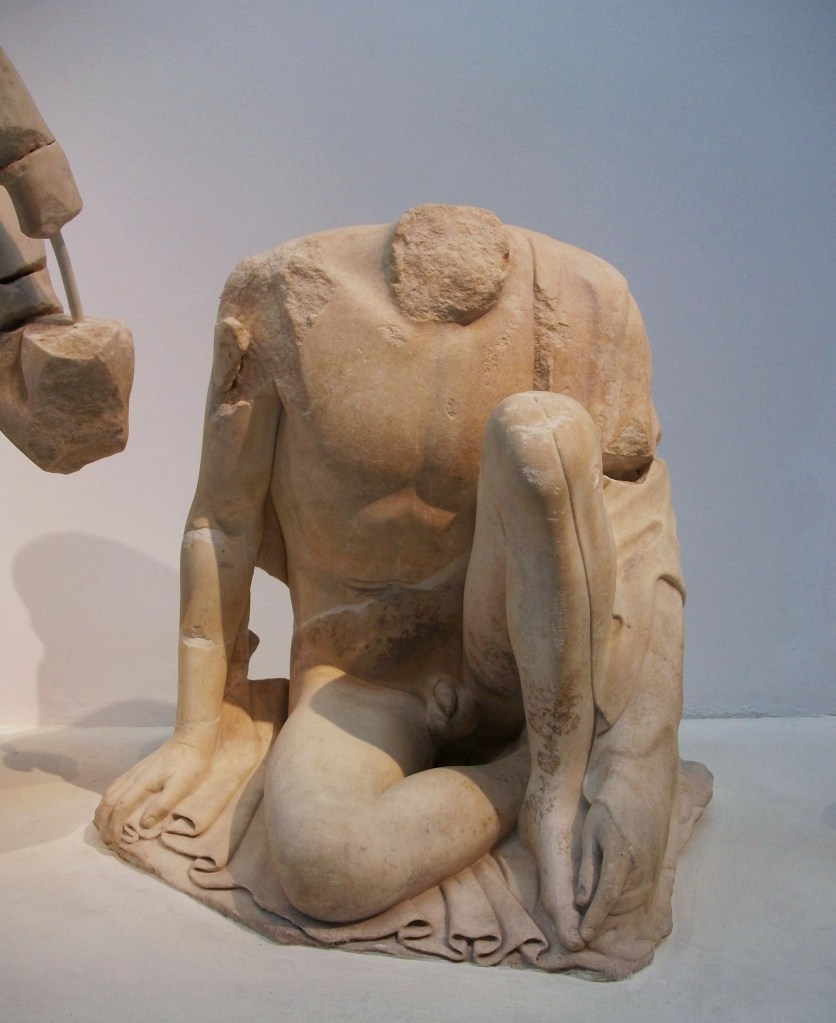
1) Sosipolis
Sosipolis was another local god, worshipped as the patron god of Elis (ancient Greek, Eleia), a territory on the far western coast of the Peloponnesian peninsula, and more specifically the city of Olympia. Our old friend Pausanias is our only source for the cult mythology behind Sosipolis’ connection to Elis, recounting a legend that the god had saved them from an invading force from neighboring Arcadia. Indeed, that is what his name means, Sosipolis translating literally as “Savior of the Polis.” According to Pausanias, as the Eleans were preparing to defend themselves from the Arcadians, an unknown woman appeared before the soldiers with a newborn baby boy at her breast (another Madonna Lactens) claiming to have been told in a dream to offer the infant up to the polis as its champion against the Arcadians. She must have been very convincing, because the Eleans took her at her word and placed the naked baby at the head of the army like some kind of live heraldic standard. When the Arcadians attacked their position, the child turned into a serpent, which was disconcerting enough to panic the Arcadians into a permanent retreat, after which, the snake-baby vanished.
Possibly because of the appearance of the woman who had brought Elis their unlikely champion—an unnamed recently delivered and nursing mother—the Eleans took her as an incarnation of Eileithyia, the Greek goddess of childbirth, and their savior Sosipolis, as her son (ironically the only named child of the goddess of childbirth). This might also be why the god’s specific name was given to him, as Sosipolis was also an epithet of Zeus, who would have been his grandfather as Eileithyia was seen as the daughter of Zeus and Hera, even though the goddess’ own name suggests that she is so old that her existence predates not only the Olympians, but even the earliest conception of Greek culture as we delineate it. The limited mythology of both her and her son posits no father for Sosipolis, which implies that he may have been parthogenetically born from the goddess of childbirth herself (though one can never wholly rule out Zeus as the father, either).
While he is attested at an Elean temple dedicated to Tyche, the goddess of good fortune, for somewhat obvious reasons, given the Eleans’ lucky escape from invasion, and possibly as a figure in Olympia’s Temple of Zeus (that’s where the headless statue above is from), again for reasons explained by his genealogy as we know it, Sosipolis’ main home was in Eileithyia’s temple in Olympia. There, he was tended in a non-public shrine within the inner sanctuary. He was afforded a dedicated priestess, whom according to Pausanias was either a virgin, or at least chaste during her service, as he claims the priestess was traditionally an old woman. Though he might be getting that from his information that the cult image of Sosipolis was supposedly of him as an infant in the arms of a crone: representing both his original form when he was named Elis’ champion, and Eileithyia, not as a newly-delivered mother, but in her more recognizable form as the trusted celestial midwife. Pausanias also reports that Sosipolis’ offerings were honeyed barley cakes, which might be because a version of Eileithyia’s name was etymologically linked to Eleusis, the home base of Demeter, whose Mysteries worshipped her with similar cakes. Or it is simply the kind of sweet treat one would offer a baby—even a super baby who saved your city.


Leave a Reply