“Writing may be a very pleasant pastime; but printing seems to have many disagreeable consequences attending every stage of the process” – Elinor Wyllys, author preface
“‘Yes,’ replied Mrs. Bernard; ‘but it is a pity her face should be so ugly; for she has rather a pretty figure—‘“ – Elinor Wyllys, chapter 2

Whew wee, folks, I know it’s been a while, but I thought we’d try to get back into some honest to God content here now that Daughter of Scorpions has finally been put to bed. I do have some adjacent entries lined up for that, but this week I wanted to tackle something I’ve been wanting to dig into a little since like April, before the relevant information gets any farther away from me in my brain. So instead of my more popular Egypto-Roman content, we’re going to spend a post with your second-least favorite topic: obscure 19th century women’s novels!

[Me forking my own search engine optimization]
But, I don’t know, I think today’s star, Susan Fenimore Cooper (1813-1894), is an interesting entrant in that category because—if you haven’t already guessed—she was the daughter of America’s first bestselling author, James Fenimore Cooper (1789-1851). While her father’s international fame brought Susan many atypical advantages for a woman of her time, it and the attendant limitations of any woman’s independence during this period also greatly impacted her life and literary output, and I want to explore that a bit, especially as it pertains to her only novel, Elinor Wyllys; Or the Young Folk of Longbridge (1845).
Susan was the second of seven children born to Cooper and his wife, Susan de Lancey, and she would be the eldest to survive to adulthood. The Coopers spent the first decade of the younger Susan’s life living in and around New York City, and when she was seven, her father would publish his first novel, Precaution, which only received lukewarm reviews, but would open his way into the United States’ infant literary world. His third novel, The Pioneers (1823), would be the first of his wildly successful Leatherstocking series, and turn Cooper into not only a sensation on his side of the Atlantic, but also in Europe, where the reading public couldn’t get enough of his tales about the American West.

To be honest, I’m not a huge Cooper fan (big surprise from someone so ambivalent about American literature generally, I know). I just can’t believe how weirdly dull his so-called adventure books like The Deerslayer are. But he was hugely influential on the generation of writers who followed him, particularly in the US and France. The American Transcendentalists like Henry David Thoreau were his direct literary progeny, and later French Romantics like Balzac, Maupassant, and Flaubert were deeply influenced by his style. Arguably my favorite novelist of the next generation, Victor Hugo, called him “the greatest novelist of the [19th] century outside of France,” and D.H. Lawrence went so far as to call the great Russian novelists of the era like (my other candidate for favorite next-gen novelist) Dostoevsky and Tolstoy “coarse” next to Cooper’s supposedly more “mature and sensitive art.”

[I know… I don’t really see it either. But Cooper did manage the incredible feat of getting generations of readers to take a hero named “Natty Bumppo” seriously, which is definitely something.]
Despite his successes, Cooper, like most writers throughout history, struggled to make his output as financially viable as it was popular. Fortunately for him, both he and his wife came from some means (though Cooper’s father, William’s, estate would spend many years in various probate litigations). That, combined with what money he was able to realize through his books, provided him the ability to relocate his entire family to Paris, where they would spend most of Susan’s teens as part of the first generation of artistic Americans living as expats in Paris. Post-Napoleonic Paris had begun its meteoric rise as the taste-making capital of Europe, and many American writers, painters, and other visual artists—who didn’t have much of a developed cultural outlet in young, republican America—had flocked to the city to learn from the European Old Masters instead.
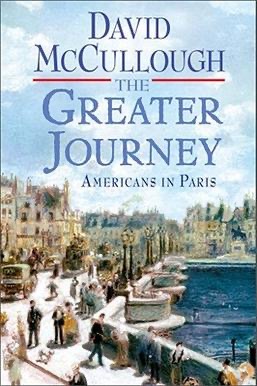
[For an excellent book on this topic, I can’t recommend the late David McCullough’s The Greater Journey: Americans in Paris (2011) enough.]
The Coopers join this initial expat wave in 1826, hoping that James could find larger, cheaper publishers for his work and that continental travel would be beneficial to his health, but also so that their children, as members of America’s rising upper middle/upper class, could access the wider educational opportunities of being “finished” in Europe. The true “European Tour” of one or two American generations later wasn’t really established as a ruling class rite of passage yet, but the Coopers were early adopters. As a result, Susan and her siblings received a classical European education, which for her likely meant the French convent schools, though I couldn’t find confirmation of this.
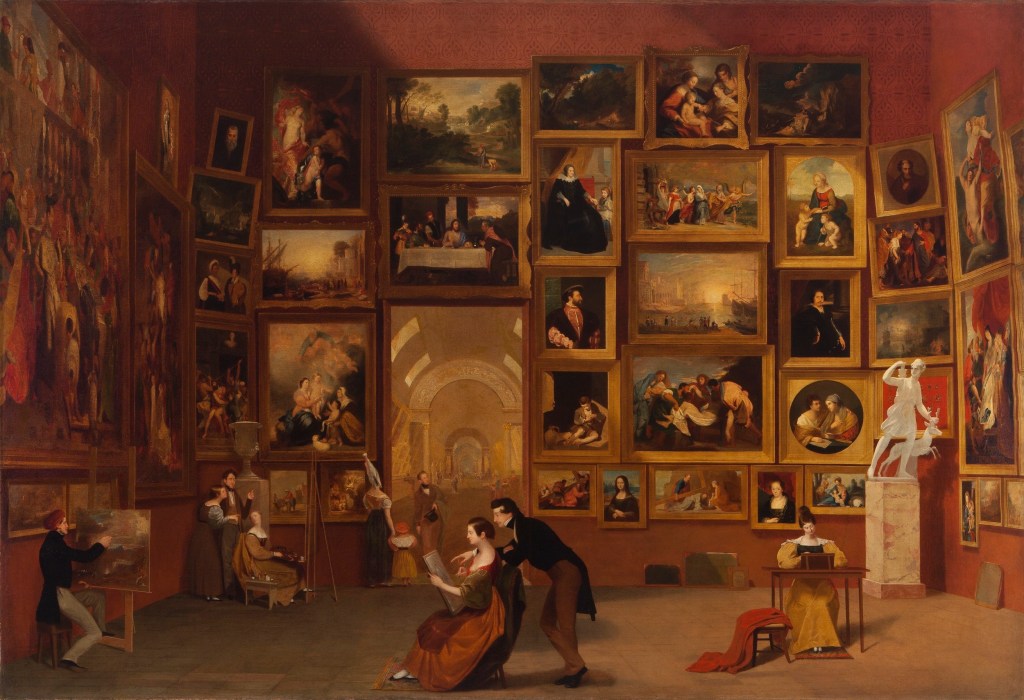
[James and Susan (center) at the Louvre, as painted by family friend and fellow expat Samuel Morse (who was still working as a painter and architect at this point in his life). Gallery of the Louvre, 1833.]
As the intimate posture of Morse’s painting suggests, Cooper and Susan were close. As she grew into adulthood, she would increasingly become his primary literary partner, serving as his secretary and amanuensis (the person tasked with transcribing a writer’s manuscripts—this was the old days where important literary men couldn’t be expected to write out their books themselves) until his death in 1851, as well as, alongside her sisters, his literary executor.
Susan, by all accounts, cherished this role in her father’s life and work, but it did come with costs. Having devoted her time to being available to Cooper, she never married, and his work clearly took precedence over her own writing, as the bulk of her published works date from after his death. And Cooper himself is a real double edged sword in the situation, as he, to his credit, enthusiastically encouraged Susan in her writing, but seems to have also potentially been the real spanner in the works of her personal life. There is a queasy passage in the introduction to the Syracuse University Press’s 1995 reprint of Susan’s most popular book, Rural Hours (1850), that implies Susan had opportunities to marry, but that Cooper refused to give his consent to any of these relationships and, dutiful as she was, Susan wouldn’t contradict his wishes.
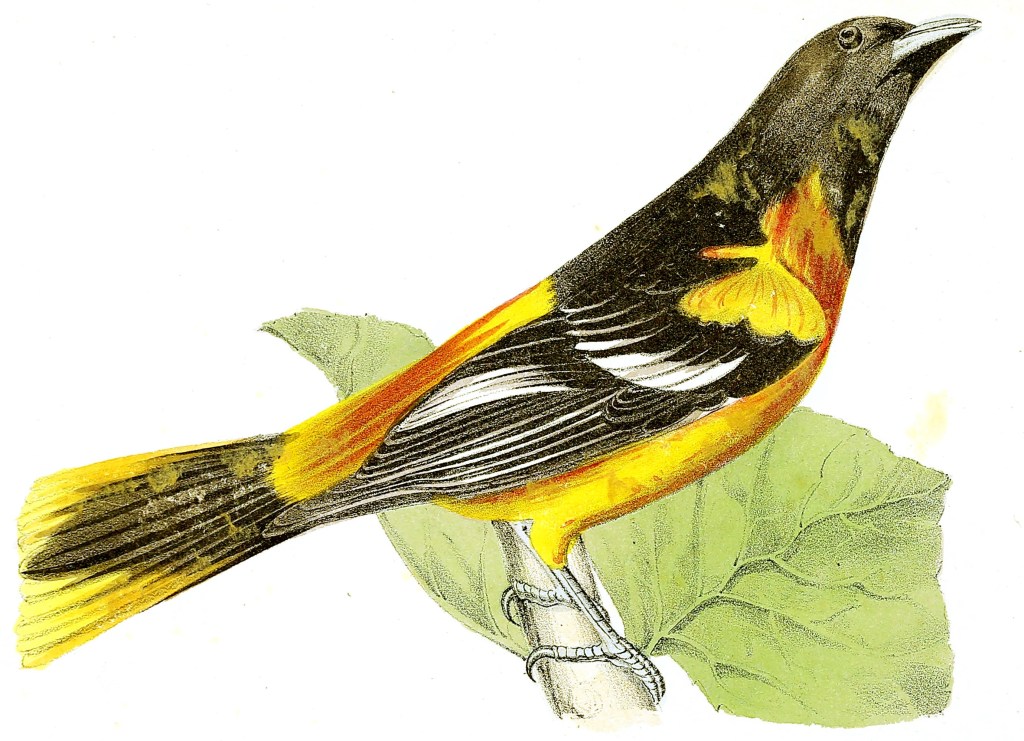
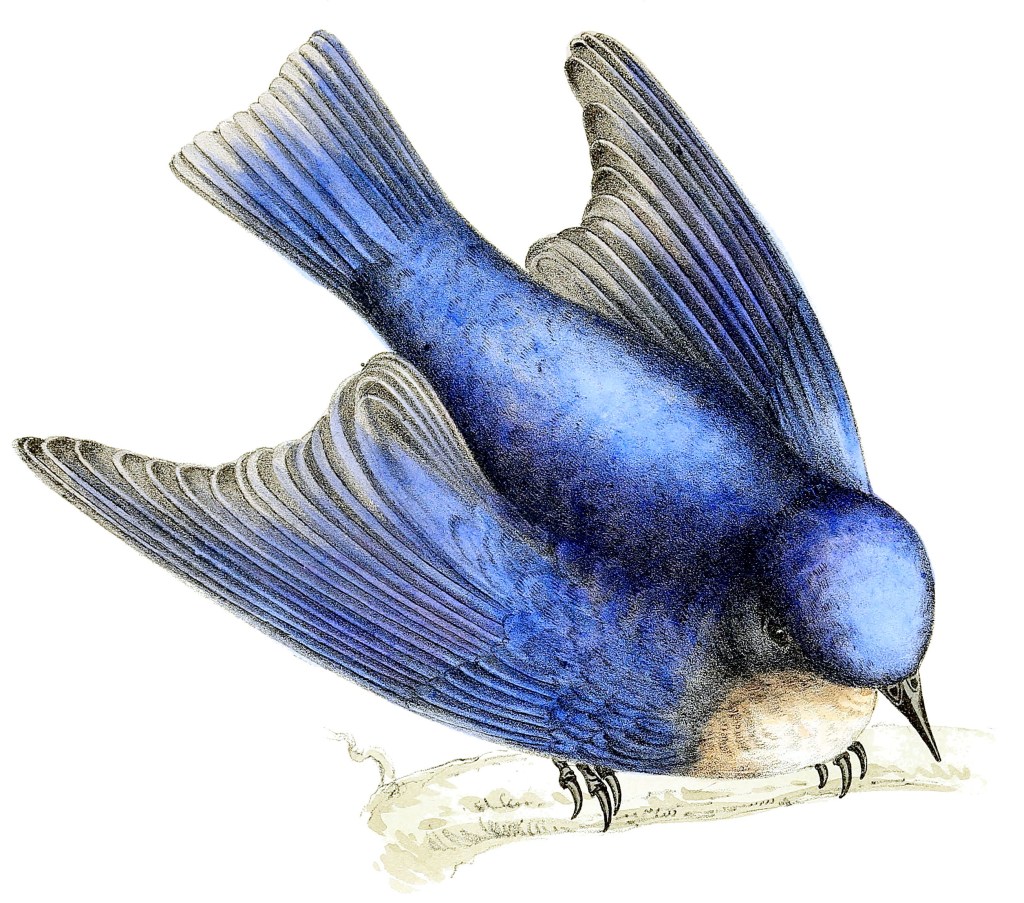
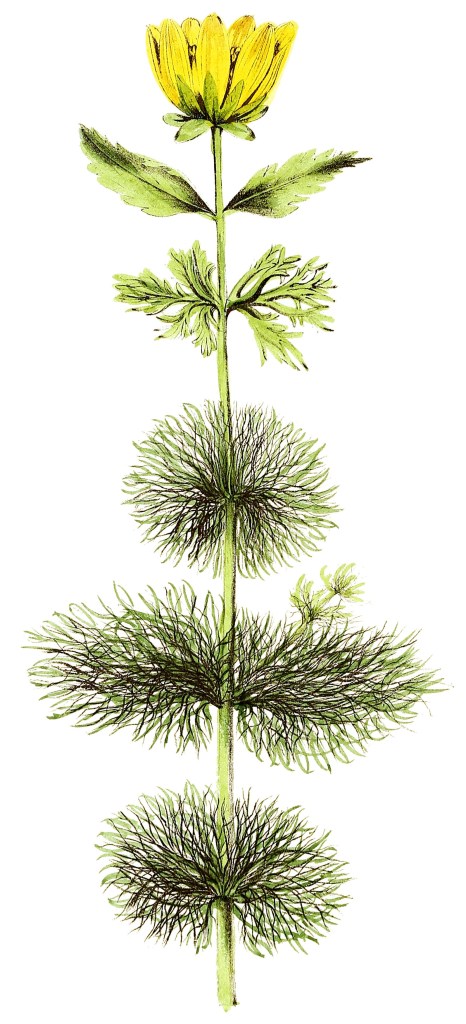
[This oriole, and the other bird and plant watercolors in this entry are from the original edition of Rural Hours. Although she is not credited as their artist, they are often thought to have been painted by Susan Fenimore Cooper herself. While this cannot be proven, Susan’s likely coursework in traditional feminine accomplishments like watercolor painting during her years in France, and her deep knowledge of the natural world of Upstate New York make this attribution as probable as it is tempting.]
Now, of course it is possible that Cooper did this with her best interests at heart (and we’ll explore what might have been his motives based on things Susan writes in Elinor Wyllys), but the fact remains that despite his apparently sincere belief in her intelligence, Cooper’s paternalistic attitude toward his daughter’s ability to make her own decisions at best proves him to be not particularly more enlightened than the general milieu of the time. At worst, it betrays the same earmarks of emotional incest and codependency that seems to haunt the gifted father-daughter relationships of this period, as we discussed in my entry about Theodosia Burr.
Rural Hours, a seasonal nature diary published shortly before her father’s death, has proven to be Susan’s most enduring literary work, as well as her most popular, placing her firmly in the company of North American women naturalist like Susanna Moodie and her sister. As we talked about in the Moodie entry, nature writing was one of the acceptable genres for women writers during the 19th century, but sentimental women’s fiction was another, and that’s where Susan Cooper’s first literary foray, Elinor Wyllys, lies. Although essentially forgotten today as just another 19th century novel of manners like Mary Jane Holmes’ Millbank, Elinor Wyllys, published on the earlier, pre-Victorian tide of women’s literature, was reasonably successful in its day. Though, admittedly, perhaps this was in part because it took a while to convince the reading public that “Amabel Penfeather,” Susan’s nom de plume for this book, wasn’t in fact her father’s pseudonym for a stealth novel project. But the fact that midcentury readers thought the writing was good enough to potentially be Cooper’s suggests that Susan’s successes with Elinor Wyllys weren’t entirely literary nepotism.

[Though, again, my god—Amabel Penfeather??? What is it with this family and coming up with, just, the most ridiculous names?]
It’s this sort of schismed pedigree, though, that makes Elinor Wyllys not quite fish or fowl. It has a lot of its predecessor Jane Austen’s flavor in its romantic misunderstandings and “people just visiting each other’s houses”-style plot, but there are also influences from both her father’s masculine literary arena and interests, as well as whispers of the more independently-minded, psychological women’s novels that will burst onto the scene two years later in Charlotte Brontë’s Jane Eyre. And I think these factors alone make Elinor Wyllys perhaps more than the sum of its somewhat pedestrian parts, and therefore worth examining.
The basic plot is relatively straightforward. Our titular protagonist, Elinor, is an orphan being raised by her doting grandfather and spinster aunt in the rural village of Longbridge, clearly modeled on Susan’s ancestral hometown of Cooperstown, New York, founded by her grandfather (the aforementioned William Cooper).

[Yes, that Cooperstown…]
Approaching adulthood at the start of the story, we follow Elinor and her various friends and cousins through their coming of age in a slice of life portrait of quasi-rural America during Susan’s own younger years, i.e., roughly the 1830s. The various titular “young people” travel, fall in love, and establish themselves over the course of close to a decade—all the while an equally young America takes root and decides what kind of country it wants to be.
Our heroine, Elinor, is intelligent and kind, and therefore widely loved by those who know her, but she is hopelessly unattractive. No, really— I don’t know if I can adequately explain to all of you who haven’t read this book how much time and space is devoted to reminding the reader what an uggo poor Elinor is. Characters are constantly remarking on it in her earshot and behind her back, she says it to herself a lot, and—I promise you that I am completely serious—Elinor’s dead mother left her a letter to be read on her seventeenth birthday telling her that she has likely grown up to be too plain to be likely of marrying and that she should reconcile herself to that. When Elinor’s beautiful cousin gets married, the guests have only two thoughts about the ceremony: 1) How gorgeous the bride looks, and 2) What a shame that the wedding party is marred by that one hideous bridesmaid. Most of Elinor’s specific plot is about getting jilted by her childhood sweetheart the minute he f*cks off to Europe for a season and sees some hotter women, and him subsequently growing enough as a person to be okay with an ugly wife. After any one of these frequent asides into Elinor’s appearance, Cooper is usually quick to walk it back a bit to make it clear that, like, Elinor doesn’t have a physical deformity; she’s just very, very plain.

Those of you who thought Charlotte Brontë was obsessed with Jane Eyre’s appearance are going to be in for a ride with Elinor Wyllys. And like Brontë’s hyper focus on her unpretty protagonist, it’s hard not to read into Cooper’s fixation as part of her author insert.
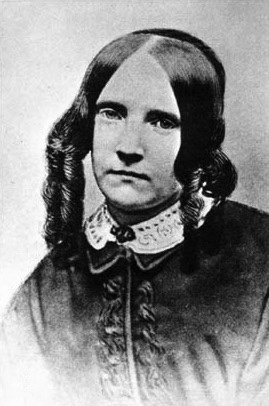
[Photograph of Susan Fenimore Cooper c. 1850, when she was in her late thirties]
Look, I’m not here to go in too hard on this photograph—God help me depending on which representational photo of me survives a century, particularly one from around my forties. But regardless of what you or I think of Susan, the writing around Elinor’s appearance feels intensely personal, honestly to an almost an uncomfortable degree. It feels like it’s coming from a lived experience. It feels too real to be simply fiction. In Morse’s painting of her with her father as a teenager, Susan looks perfectly nice, so like Elinor, I don’t think that she was grossly unattractive. But we do have to remember that her father was a literary rockstar moving in the most rarified circles of European society during her pivotal adolescent years—it’s not difficult to imagine people having ideas that an author of beautiful books should have an equally beautiful family, and them being perhaps unintentionally cruel to a girl who was merely average-looking.
Here, too, is where I circle back to James Fenimore Cooper’s interference in his daughter’s love life. The pages-long letter Elinor receives from her dead mother is full of kindly, but extremely frank discussions of Elinor’s homeliness and how she should bear her appearance with Christian fortitude and not go chasing waterfalls, essentially. This letter, too, feels way too real to be a complete invention, and I’m left to wonder whether these are things Susan’s father (or mother) said/suggested to her. Particularly in light of Susan, like her fictional doppelgänger, having some manner of fortune that might be suspected of attracting less than scrupulous suitors. Perhaps Cooper thought that his daughter wasn’t pretty enough to solicit genuine interest from men who weren’t just after his money/fame, and he was trying to protect her. But even if that were true, what a sad thing to believe about one’s own child. And what a burden for that child to know that you felt that way.
However, it’s not all low self-esteem and complicated family dynamics. Like all average girl writers, Susan gets to make all of her pretty characters dumb as rocks and teach them the perils of relying on mere appearances as her revenge. And even though I wanted Elinor’s fiancé, Charlie, to go pound sand, he does have to endure a lot of humbling before he gets to win her back. Susan also doesn’t have an entirely negative view on the spinsterhood that was hers in real life. Two of the most admirable women in the novel are Elinor’s maiden aunt Agnes and their neighbor, Patsey Hubbard. Patsey in particular is definitely written as a role model for Susan’s single readers: after the death of her clergyman father, she is the sole breadwinner and caretaker for her younger siblings and invalid stepmother (extra martyr points for that), which she does by running a respected school for the local community. The Hubbards’ situation is always precarious, but Patsey keeps them afloat through ingenuity and hard work. This was how Susan herself similarly filled the forty years of her life she had left to live after her father’s passing, dedicating a lot of her time and money to local orphans and the needy. Like the Brontës after her, Cooper recognized that there were only a few avenues open to women of their class outside of marriage, but she was committed to illustrating that those single lives were worthwhile, too.

[Though it must be said that a lot of the Brontës’ problems would have been ameliorated by having that sweet Cooper money sloshing around…]
In the end, aside from her sublimated worries about her appearance, Elinor Wyllys, like Susan’s nature writing and the western novels of her father, are mostly about building a uniquely American literary identity in a world where the European novel was supreme. The Leatherstocking tales and Elinor are a reaction to what the Coopers perceived as the aging, decadent society that they saw abroad and about promoting the supposed agrarian, egalitarian virtues of the United States. A democracy of small, practically autonomous villages inhabited by helpful neighbors and simple pleasures. Where sober hard work is rewarded, and a good girl can get the boy even if she has an unfortunate face card.
But just as the joint Cooper oeuvre is bound to its time by the more positive aspects of Jeffersonian republicanism, it is hindered by many of the same underlying fatal flaws that will erupt in the decade after James Fenimore Cooper’s death. Because the Coopers’ America was ultimately one where a white man could speak for a Native population he barely knew from the estate his family took from them, while his daughter wrote about their local flora and fauna as she passed a cemetery where resident Blacks were barred from burial with whites. This is not to shame them for being average people of their time, but rather to further show that all artists are products of the world they know, and why literary analysis is important. As I’m pretty sure I’ve said before, we can’t understand where we are if we don’t understand where we’ve been.


Leave a comment