AKHNATON: More lands, more subject peoples, bigger palaces, still greater temples to Amon, thousands of beautiful women where my father had hundreds? No, Horemheb, listen to my dream. A kingdom where men dwell in peace and brotherhood, foreign countries given back to rule themselves, fewer priests, fewer sacrifices. Instead of many women—one woman. A woman so beautiful that after thousands of years men shall still speak of her beauty… [A pause. Very softly] That is my dream … — Akhnaton, Act I.i

I almost can’t believe that this hasn’t come up before, but one of my first literary loves were the mystery stories of Agatha Christie (1890-1976). As I hit my preteens and roared right past traditional YA books, I spent the years between twelve and fourteen devouring nearly every available Christie novel and short story collection. My mom suggested Murder on the Orient Express during a trip to our local library, and I was young enough that I had the extreme pleasure of getting to read one of the most famous mystery novels of all time without knowing its equally famous denouement.
After that, I was completely hooked. I read through every Christie book my library owned—even the Tommy and Tuppence novels that I think kind of blow—and I have a distinct memory of sitting in my enforced weekly “reading period” (remember when those were a thing?) in my seventh grade science teacher’s classroom working my way through Evil Under the Sun (ahhh, some of you just got the reference in this entry’s title…). You’re looking at a thirteen-year-old who, rather than doing cool things, stayed up late on school nights to try to catch reruns of Poirot and Miss Marple on PBS and A&E. I have WAY TOO MANY opinions about the books and their tv/film adaptations. When my wife and I were in London about nine years ago, not only did I make her take me to a production of Christie’s play, The Mousetrap—at the time still running consecutively since 1952 at St. Martin’s Theatre—but I also made her tramp through Islington so I could take a selfie in front of Florin Court, the Art Deco apartment building that they used for exterior shots of Poirot’s flat, Whitehaven Mansions, in the tv show I dedicated my teens to watching.

[Proof!]
All of this is to say that I consider myself pretty well-versed in the oeuvre of the so-called “Queen of Crime.” I might have the memory of a goldfish for the denouements of all but the most famous of her books, but that allows me to have the pleasure of rereading/rewatching them and getting to be surprised again (probably also a hazard of reading so many of them nearly thirty years ago now). Even when it comes to some of her more obscure works, I thought I had a pretty good handle on at least what was out there, even if I haven’t read every last morsel in her extensive bibliography.

[All of those Johnny-come-lately ghostwritten Poirot books published in the last fifty years don’t count. I have yet to read one that wasn’t terminally mid. I told you that I had opinions…]
So imagine my surprise when I stumbled onto references to a play Christie had written about famous iconoclast pharaoh Akhenaten (r. 1351/3-1334/6) (which she spells Akhnaton) that I’d never heard of. Published near the end of both Christie’s career and life, the play has never been, to my knowledge, truly, professionally staged, and judging by its generally out of print status beyond sketchy print-on-demand editions that the National Trust isn’t doing a particularly good job of policing, it is about as obscure as my lack of knowledge seems to betray. But as it intersects with two of my major preoccupations, Agatha Christie and ancient Egypt—two preoccupations that, coincidentally, appeared in my life around the same time in my early teens, I got a hold of an authentic copy published by Bantam and wanted to hash it out with you all. Because while not The Mousetrap, Akhnaton is, I think, an interesting work from a surprisingly multifaceted writer.
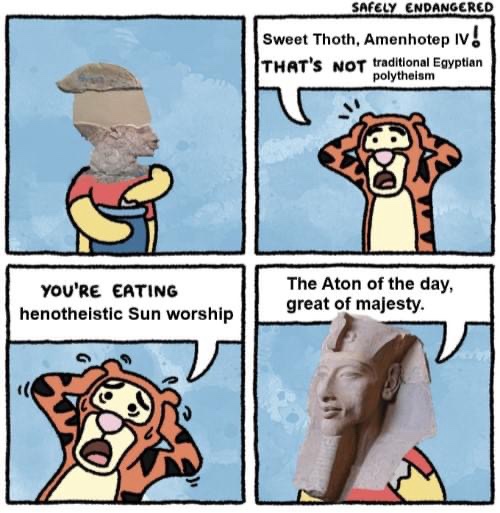
Those of you who only know Christie through her midcentury crime stories or merely by reputation might feel like her writing a play about an ancient Egyptian pharaoh is a left-field move, but it is actually well-trodden ground for her. Christie’s interest in ancient history appears to have really begun in 1928, when she became friends with British archeologist Sir Leonard Woolley and his wife, while she was on vacation in Baghdad and they were conducting a dig. This was a dark time in Christie’s personal life, as she was on her trip to recuperate from the mental anguish of her divorce from her husband of fourteen years, Archibald Christie, which had been precipitated by his infidelity and a likely breakdown on her part, leading to the infamous eleven days where she, one of the most famous authors in England, disappeared without a trace, only to finally turn up at a spa in Yorkshire. Anyway, Christie never elaborated on her “disappearance” in her lifetime or in her otherwise extensive autobiography, but her decision to spend much of the next several years out of England speaks for itself.

But it wasn’t all gloom for, as I said, she hit it off with the Woolleys in Iraq, and they invited her to join them on their next planned dig in February 1930. Leonard Woolley is seen as one of the first “modern” archaeologists—more of a scientist than the Edwardian treasure hunters that had largely come before him, and his extensive excavations at the site of the Sumerian city of Ur cemented much of our foundational knowledge of Sumer and ancient Mesopotamia. His wife, Katharine, wasn’t just with him for moral support, either, as she was an archaeologist in her own right, one of the earliest women with any training in the field. Though, their marriage was rather unusual, in that they mostly got married in 1924 because Woolley’s backers at U Penn were uneasy about an unmarried woman (albeit a widow—Katharine’s first husband dramatically took his own life at the foot of the Great Pyramid in 1919) working at their dig. Also, the Woolleys never seem to have actually consummated their marriage, as Katharine is thought to have had, in addition to MS, androgen insensitivity syndrome, which owing to an absent uterus, made sexual intercourse painful, if not impossible for her. Anyway, all of this likely meant that the unconventional Woolleys were more sympathetic to both working women and complicated interpersonal relationships than the average bourgeois Britons of the time, and Christie took them up on their offer to return to Iraq in two years. Which turned out to be a particularly fortuitous decision on her part, as returning to the Woolleys’ Ur dig would introduce her to Leonard Woolley’s other archeological partner, Max Mallowan, whom she would be marrying within eight months.

Christie’s second marriage would last the rest of her life, and she would accompany Max on all of his archeological expeditions. His digs, like Woolley’s, would center in Iraq, primarily in Nineveh and Nimrud, but so much time in this part of the world generally meant that outside of her husband’s work, Christie was also often in places like Istanbul and Cairo, and her writing would come to reflect this. It is in the later part of her career that we get her great travel mysteries like Death on the Nile (1937), Murder in Mesopotamia (1936), and of course, Murder on the Orient Express (1934). These novels were a chance to get her detectives out of the rut of English country house mysteries and into the best “exotic” locales the Empire had to offer. Christie had always been a master of writing her stories from lived, personal experience—she famously came by her extensive knowledge of poisons from her dispensary work during the first World War—and her new life gave her the opportunity to write about life in midcentury archeological camps with an unmatched authority, in addition to her natural flair for puzzle work that mystery writing requires.

[The original “beach episodes.” I posted this on social media and told my followers that you’re all lucky I can’t draw because the God’s Wife scene that flashed before my eyes when I read this post would scar us all for life. Let’s just leave it at Caesar in a quintessential Italian old man speedo and Virgil dressed like Marlon Brando in The Island of Doctor Moreau…]
But in addition to her beach episode mysteries, most interestingly from this time in her life comes what I believe is her only true historical mystery, that is, her only novel set outside the 20th century, Death Comes as the End (1945). Suggested by her Egyptologist friend, Stephen Glanville, Christie bases her murder mystery plot off of the Heqanakht Papyri, a set of letters and household accounts from Heqanakht, a ka-priest living during the Middle Kingdom (c. 1950s BCE). Among the various items dealt with by the absent Heqanakht in his letters home is his adult children’s apparent antagonism to his new concubine. Despite him specifically identifying her as “merely” his concubine (hesyt) rather than wife (hemet), Heqanakht demands of his eldest son, “Would one of you be patient when his hesyt was denounced to him? In what way can I be at the same table with you? Shall you not respect my new hesyt?”

[A part of the Heqanakht Papyri (on display at the Met)]
Christie takes this intergenerational conflict and weaves it into a story where the new concubine, who in classic form for a Christie victim is a stuck up bitch who has more than earned the family’s dislike, ends up dead and everyone in Heqanakht (renamed Imhotep)’s household is a suspect. Aside from its solid mystery, Christie paints the picture of a believable ancient family, with all of the same petty foibles as her modern characters, and it is legitimately one of my favorite books of hers, and by far my favorite non Poirot/Marple story. Our point of view character, Imhotep’s daughter, Renisenb, recently widowed and returned to her father’s house, is not one of Christie’s brighter protagonists, but she is one who has a genuine emotional arc, which is nice, since Poirot and Marple (like their inspiration, Sherlock Holmes) are designed to be relatively static across their stories.

[My favorite Poirot and Marple? When it comes to Poirot, I’d probably land on a traditional choice like Orient Express or The Murder of Roger Ackroyd; but for Miss Marple I’d probably pick what I suspect is an unorthodox choice in A Murder is Announced. If pressed, I’d add the more likely acceptable The Body in the Library. As a detective, I love Poirot more, but I adore Marple’s gaggle of policemen who can’t believe they’re stuck working with this old bag. Japp in Poirot is god-tier, of course, but it’s hard to beat Marple’s thoroughly exasperated Slack and incredulous Craddock (the original Hot Cop).]
Although it wouldn’t be published until 1973, only three years before Christie’s death in 1976, the first manuscript of Akhnaton was also written at the same time as the height of the author’s travel mysteries—Christie dating the original pass to 1937. She tended to write 2-3 books a year, and Akhnaton was written presumably while she was working on either Death on the Nile or Dumb Witness (for obvious reasons, likely the former), and by Christie’s own admission in her autobiography, Akhnaton was meant more as a writing exercise than a play with publication/production in mind like The Mousetrap. Hence why it spent the next thirty-six years in her desk drawer.
What sparked Christie’s memory of the draft, and her publisher’s interest in it was the enormous buzz in 1972 around Treasures of Tutankhamun, the first major exhibition of Akhenaten’s son’s grave effects in the UK since their discovery by Howard Carter’s team in 1922. Aside from its significance in the world of Egyptology, the exhibition itself was a huge diplomatic victory for Britain in mending its fraught relationship with the post-colonial Egyptian government, and was symbolically a mark of a supposed new chapter between the countries. The British Museum saw nearly two million visitors to the exhibition, and as a mark of goodwill, all of the proceeds from it were donated to Egypt to help fund the upkeep of the temple ruins at Philae. In the midst of the new Tut Mania, Christie dusted off the old Akhnaton manuscript, made some minor edits, and passed it off to her publishers in 1973 before the zeitgeist moved on.
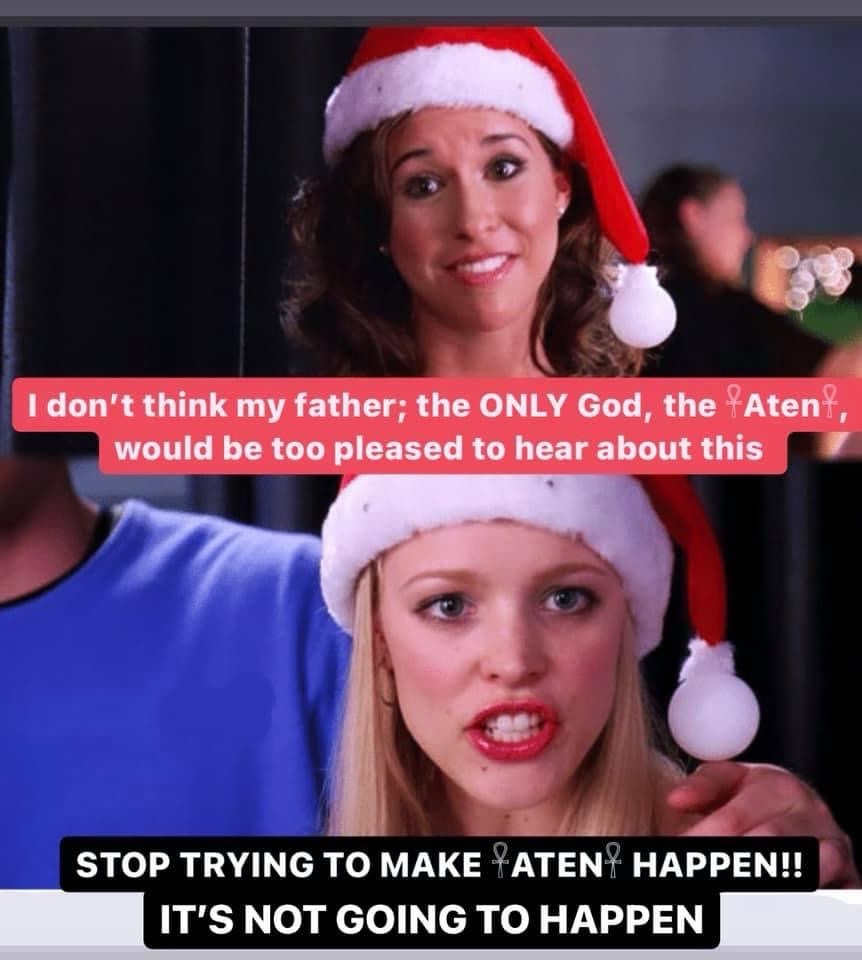
Because of its arguable lack of serious intention; the long delay between its drafting and publishing; and the now fairly credible belief that its author was likely suffering from Alzheimer’s or other age-related dementia when she was making her publication editing pass, Akhnaton is a rather strange artistic artifact from a prolific author. That is not to imply that it is somehow messy or incoherent, but rather that it is a play oddly out of time. It is detailed and correct about many aspects of Akhenaten’s life and reign… but as we knew them in the 1930s, not the ‘70s, right down to her unconventional spelling of the pharaoh’s name, calcified in an earlier transliteration spelling. The biggest example of this is the place of Tutankhamun (for obvious reasons, still going by Tutankhaton) in the play, where he is presented as the son of a noble family, rather than of Akhenaten himself. In the first decades after Tutankhamun’s tomb was discovered, it was believed that Akhenaten had no direct male heirs and that Tut had been named pharaoh merely on the strength of his marriage to Akhenaten’s daughter, Ankhesenamun. Speaking of hesyts and hemets, it was only later when Egyptologists discovered the existence of Akhenaten’s secondary wife/concubine, Kiya, that Tut’s parentage was more fully sussed out, and he was identified as the pharaoh’s (probable) son by another consort (either Kiya, or the so-called Younger Lady) under his great queen, Nefertiti. But as Christie and her husband had largely returned to England after World War II, and Max after all was an archeologist, not an Egyptologist, it was a given that Christie would have necessarily kept up with the various twists and emerging theories in the Tutverse.

[Are we going with “Tutverse”? Yes, we are.]
And I know that I’m constantly bringing it up in relation to Egyptian fiction, but a lot of the rest of Akhnaton follows in the same vein as the non-Sinuhe parts of Mika Waltari’s The Egyptian (1945), especially the characterization of Horemheb as the normal dude in a sea of crazy people, and Nefertiti’s sister Mutnedjmet (in Akhnaton named Nezzemut) being bad news. But aside from its dated Egyptology, what I found most intriguing about Christie’s take on what is now some very well-tread fictional ground was her surprisingly nuanced interpretation of her title character. Akhenaten is usually portrayed in fiction as Waltari does: a born holy fool with the sun permanently in his eyes both figuratively and literally. And with Egypt crumbling around him at the end of his reign, you do need to end up there, but what Christie does in the course of her play is show us an Akhenaten who arrives at that desperate point only after a long slide from an initially much more grounded idealism (illustrated by my flavor text at the start of this entry). The Akhenaten of Act I is capable of being wry and unusually perceptive in way he rarely gets to be, and only devolves to the recognizable sunstruck lunatic in Act III when all of his attempts to change the world have backfired on him. This reminded me of a play I enjoyed reading last year, Albert Camus’ Caligula (ironically, written around the same time as Akhnaton), where instead of a protagonist driven into destructive utopianism by the world’s cruelty, you have the young emperor driven into destructive nihilism by the same. It’s really two sides of the same coin, and you can draw some really interesting parallels between the two works.
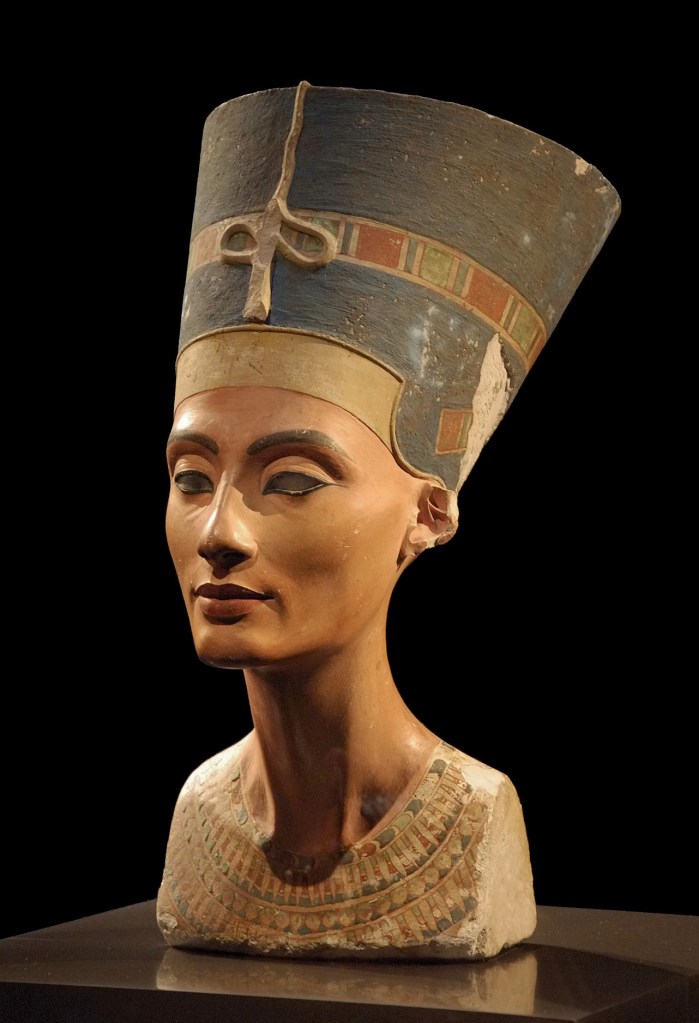
[The famous Berlin bust of Nefertiti. One of the little details that Christie adds that I love is the idea that the artistic revolution of Akhenaten’s reign is driven by him as an artist, and that he is the sculptor of this bust. It isn’t factual, but it’s a great example of how fiction can sometimes speak to the feeling of truth even more than the raw historical facts.]
A criticism that could be made of Death Comes as the End—that there’s still an undercurrent of Englishness in her ostensibly ancient Egyptian characters—could be equally applicable to Akhnaton, perhaps even more so. An introductory stage direction about Horemheb in Act I literally describes him as a “pukka sahib,” for god’s sake. But the deeper one gets into the play, the more one is forced to consider if Christie is actually using a vague, out-of-place Englishness in her historical Egyptian play to make broader comparisons to the eclipsed British Empire that largely died during her lifetime. Akhenaten is a tragic figure whose fatal flaw is that he is too trusting in an evil world, but one to whom his playwright is sympathetic. You could certainly read the ultimate downfall of Akhenaten’s religio-political revolution as an argument for the status quo of a fallen Rule Britannia, but I think the more compelling—and more subversive—reading of Akhnaton’s text is to doubt the possibly of utopia, but to view a nostalgic return to a previous order as just as potentially poisonous. In the end, Horemheb betrays Akhenaten to save Egypt, but his choice is depicted as desperate and he is ashamed of it, even if it is the “right” thing to do; just as murdering the pharaoh to stop the destruction that his ideals have brought down on their heads is still portrayed as a bad act by those who commit it. Christie’s Egypt has less in common with the White Man’s Burden of her youth than it does with the great Greek dramas, where Fate lies somewhere outside the mortal and divine, beyond strict morality and just deserts. And that’s why, while it’s not The Mousetrap, I think Akhnaton deserves far wider acclaim than it has been heretofore afforded, and I’d go see a staging of it in a heartbeat.

[A beautiful dream in of itself. Even if it were more popular, the staging is so complex (something like 11 scene locations and over twenty different speaking roles as written) that tickets would probably cost a zillion dollars in order to recoup production expenses…]

 Sarah Holz
Leave a comment