
Listen, dear readers, my book-buying problem is no secret. I buy a lot of books every year, and apparently I’m not able to curb this addiction in any meaningful way—even as I fight an increasingly lost battle with where I’m going to put all of those books. That said, I’m not one to entirely throw caution to the wind. Most of the books I buy are used in one fashion or another, and I’ve said for many years that I actually enjoy acquiring used books of some quality over new ones. In part because they literally don’t make books like they used to, and particularly older hardback books are hardier than ones you’ve bought far more recently. But also, to tie back to my previous post where I talked about how nebby I am about what other people (real and fictional) are reading, I like having books with a past, so to say. My absolute favorites are ex-library books—I love all of their catalog markers and stamps, not to mention they often come in those wonderful protective Mylar covers gratis—but old books with traces of their previous owners are a close second, especially if they left some reading notes behind.
For the sake of sanity, I try not buy a lot of different editions of books I already own, but there are a few exceptions to this. The most egregious offender on this front is Dream of the Red Chamber (Honglou meng [紅樓夢]), where I own two different translations of the unabridged text, and way too many books of redology criticism. Despite this, I had been trolling about for a reasonably priced copy of the original 1929 Doubleday abridged translation in English, in part because the cover is considered a classic of midcentury publishing design.


However, a copy with this dust jacket in almost any condition will run you at least a couple hundred dollars, and my general advice to (regular) people looking to get into book collecting is to be cautious once an old book goes over $100, particularly if there isn’t a specific reason for that (deceased author signed it, near-pristine condition, extremely rare, etc). In my experience, once books hit a price point over that, especially once you reach $200 or higher, it gets harder to tell if the book is actually worth that much or you’re dealing with a seller just probing where the ceiling on a title is. Anyway, I ended up seeing a seller on AbeBooks offering a first edition of the Doubleday printing. This copy didn’t have the iconic dust jacket, but it was also much cheaper as a result. I wavered on it for over a year, but what actually helped sway me was that the other reason the price was so comparably low was that the listing warned that the book’s previous owner had done a fair amount of writing and underlining in it. It’s unusual for me to meet a potential fellow Red lover in the wild, so I pulled the trigger, thinking maybe my unwitting book club buddy might have had interesting insights on one of my favorite books that we could explore here together.
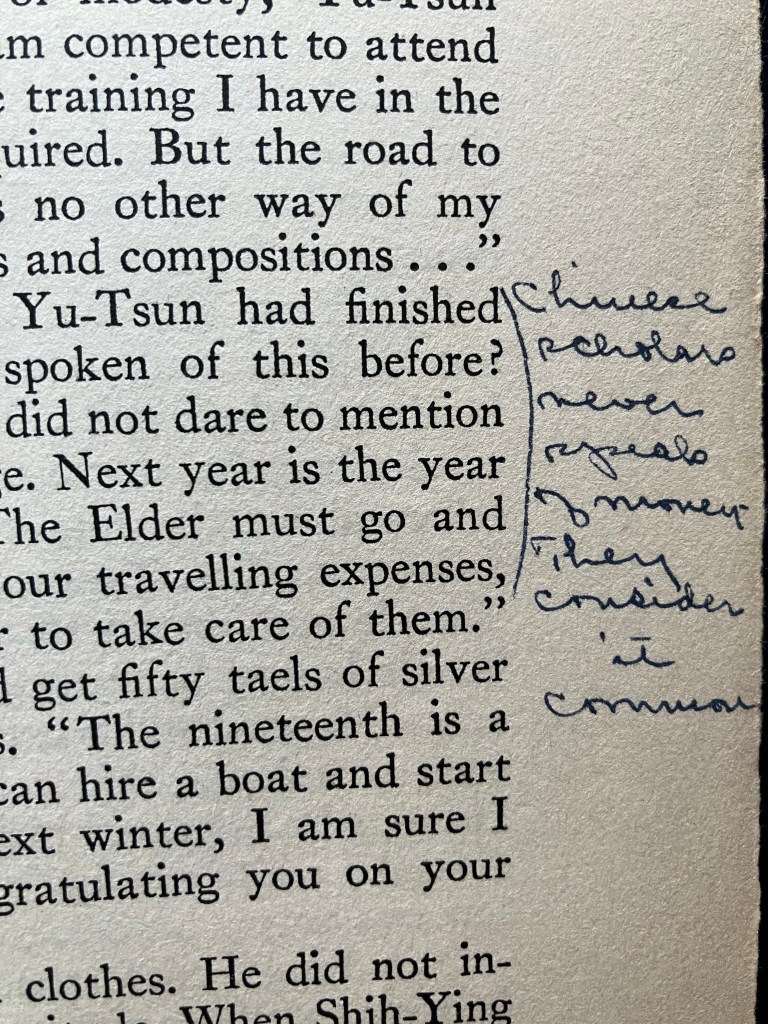
To cut the suspense short, in this I was largely to be disappointed. Not that the previous owner was a philistine or anything—far from that. It was rather that their scattered notes were more focused commenting on the socio-cultural aspects of Red’s story, rather than the literary, which would have been more my personal speed. But I was intrigued that these few observations were made with a certain tone of familiarity and authority in regard to Chinese customs, which made me curious as to the background of the previous owner. And it was that mild curiosity that sent me headlong down a truly wild rabbit hole—a rabbit hole that I want to share with all of you.

Unlike some used books, I did have a name to begin my search on, as my mystery reader had helpfully written it on the decorative fly leaf:

Now, most of that is very legible, though the first letter of the last name was a bit of a toss up. But fortunately, I had a loving grandmother with a similarly archaic cursive style, which left me fairly certain that the letter was supposed to be a G, which would make her name Mrs. B. S. Guyton. She also included (presumably) her town, Oxford—unfortunately an extremely common town name in the English-adjacent world. Like most of you, I started with the assumption that it could be the Oxford, in part because Dream of the Red Chamber remains a fairly obscure novel in the English-speaking world. Maybe the previous owner was a Chinese-subject scholar at the university, or her husband was. However, from the start, I wasn’t convinced by this theory; in part because, unlike many of my books, I had not bought this book from an English seller, but rather a stateside shop in Frederick, Maryland. So it seemed more likely that the previous owner was an American.
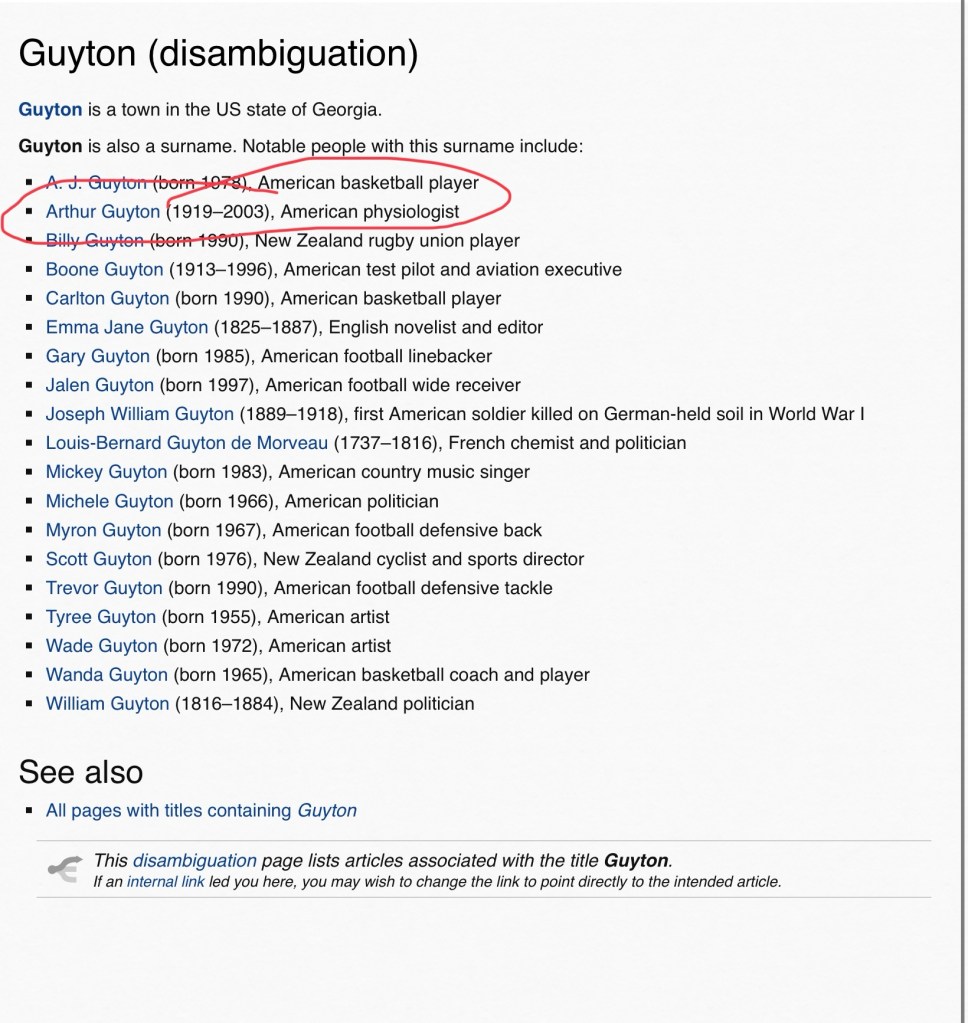
Puzzling on this, as a total shot in the dark, I stuck the last name “Guyton” into Wikipedia, just to see what came up:

As I didn’t know Mrs. Guyton’s own given name, and all of the women on this list were either born too early or too late to jive with the 1932 fly leaf date, I decided to focus on her husband, Mr. B.S. That left the New Zealander rugby player Billy and the pioneering American test pilot, Boone. I got hopeful again, because obviously the thirty-four year old Kiwi athlete was a probably no-go both by nationality and age, but Boone Guyton potentially fit the target time period. A quick perusal of his page, though, didn’t mention his wife by name, nor any clues that would point to her ownership of my book. Not to mention that Boone’s middle name, Tarleton, seemed to contradict my guy’s presumptive S middle name.
After this, I honestly just shrugged and went back to thumbing through the book for Mrs. Guyton’s margin notes, with no intention of pursuing the matter any further. I mean, as unusual as Red is, its owner was likely just an anonymous woman and probably didn’t leave much of a trace behind her—like most of the other used books I own. At least, that’s what I told myself until a shower of paper strips fell out of the back of the book. Most of them were blanks ripped from a writing pad… except two of the strips contained parts of a personal header!

Firstly, it is was gratifying to receive confirmation that I had in fact interpreted Mrs. Guyton’s cursive G correctly. But this paper also gave me the crucial information that Mr. Guyton was a doctor, and that the Oxford in question was Oxford, Mississippi. At first this wasn’t particularly revelatory—Dr. Guyton might be just a local country doctor, after all. But then I remembered that while not the Oxford, Oxford, Mississippi was named that because it is also a college town. Specifically, it is Ole Miss—the University of Mississippi—’s college town.
One of my lesser talents is that I’ve always been a pretty savvy Googler. That used to be fairly standard in my eyes, but as the general search quality continues to decline on the engine, having some skills is sometimes the only way it’s still useable. That said, in this case, I didn’t do anything special to start, just typed in “B.S. Guyton MD Oxford Mississippi” to see if anything came up. To my disappointment, the top result was a familiar name, but not my B.S. Instead, it was Dr. Arthur Guyton, a world-renowned physiologist whose name I remembered from my Wikipedia search results.
I’m assuming anyone reading this who has knowledge of Ole Miss’s medical school and/or the field of physiology is screaming at me right now, because Arthur Guyton is a HUGE deal in both. For many years the sole author of perhaps the most influential physiology textbook in the world, he was a leading researcher and instructor in this field largely because a bout of adult-onset polio in 1946 left him too disabled to pursue a surgical career. In spite of this physical challenge, he is credited with the discovery that tissue oxygenation requirements regulate cardiac output, rather than the heart itself, and his “Guyton Curves,” the relationship between right atrial pressure and that output, revolutionized our understanding of circulatory physiology. While he was doing all of this, and serving as the chair of the University of Mississippi’s Department of Physiology and Biophysics, he and his wife, Ruth, were also raising ten children in a real Cheaper By the Dozen-style environment—all of whom would also eventually become doctors and turn the Oxford Guytons into a veritable medical dynasty. But as interesting as all that is, what really caught my attention is the line my search pulled from this article written by Gary Pettus after Arthur’s passing for the medical school’s alumni magazine:
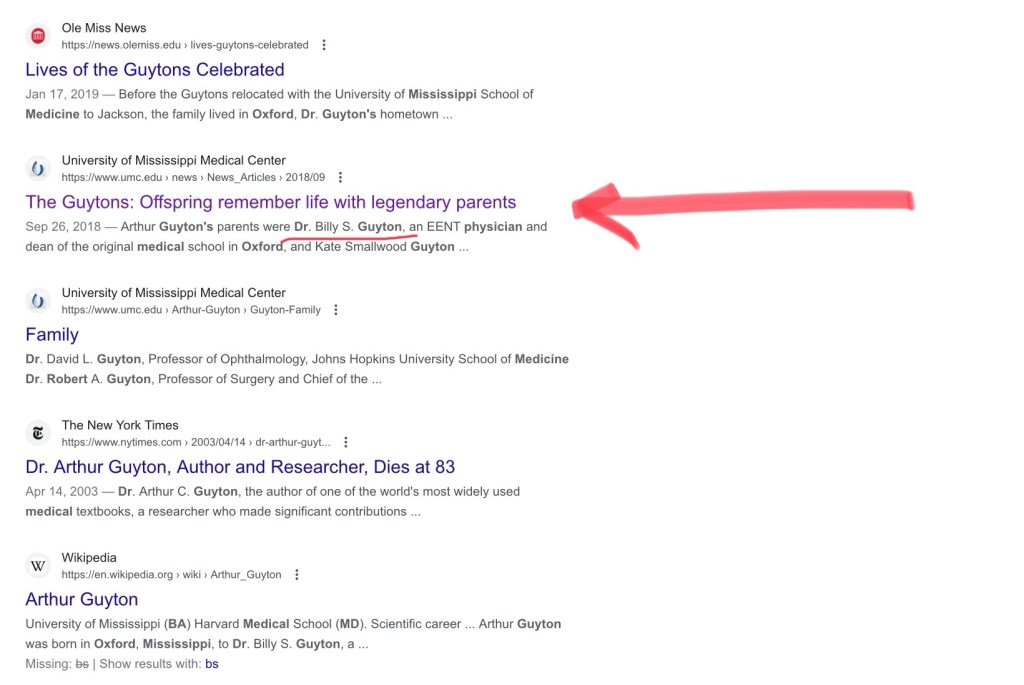
But finding that pull quote in the article itself gave me more than just Arthur’s dad, Dr. Billy S. Guyton, an ear-nose-and-throat specialist who served as the first dean of the medical school. As you can see above in my screenshot, it gave me the person I’d been really after the whole time: Mary Katharine Smallwood Guyton—wife, mother, teacher, and former missionary in China.

Everything immediately clicked into place and all at once my mystery reading buddy became a real person. And my hunch that she was more than just a casual reader of Dream of the Red Chamber was confirmed, too. Katharine Guyton likely picked up the new Doubleday translation because it reminded her of years in China.
As I said, the Guytons were and are a medical dynasty, but some of this obscures Katharine’s own talents, which I discovered on a blog kept by Arthur’s son and Katharine’s grandson, Dr. John Guyton. I’ll include a link to his page below, because the whole story is fascinating and I don’t simply want to plagiarize the work he and his family have done archiving all this information. But the short version is that Kate, as she was called by the family, born in 1887, was a graduate of the Mississippi Industrial Institute and College for the Education of White Girls, usually abbreviated as the Industrial Institute and College, the oldest public university for women in the United States. Despite her aptitude for the sciences and her interest in studying medicine, when Kate graduated in 1906, there still weren’t many opportunities for women in the medical field, which is why she became a math and physics teacher—even though she clearly had the same intellectual qualifications as the rest of her gifted family.
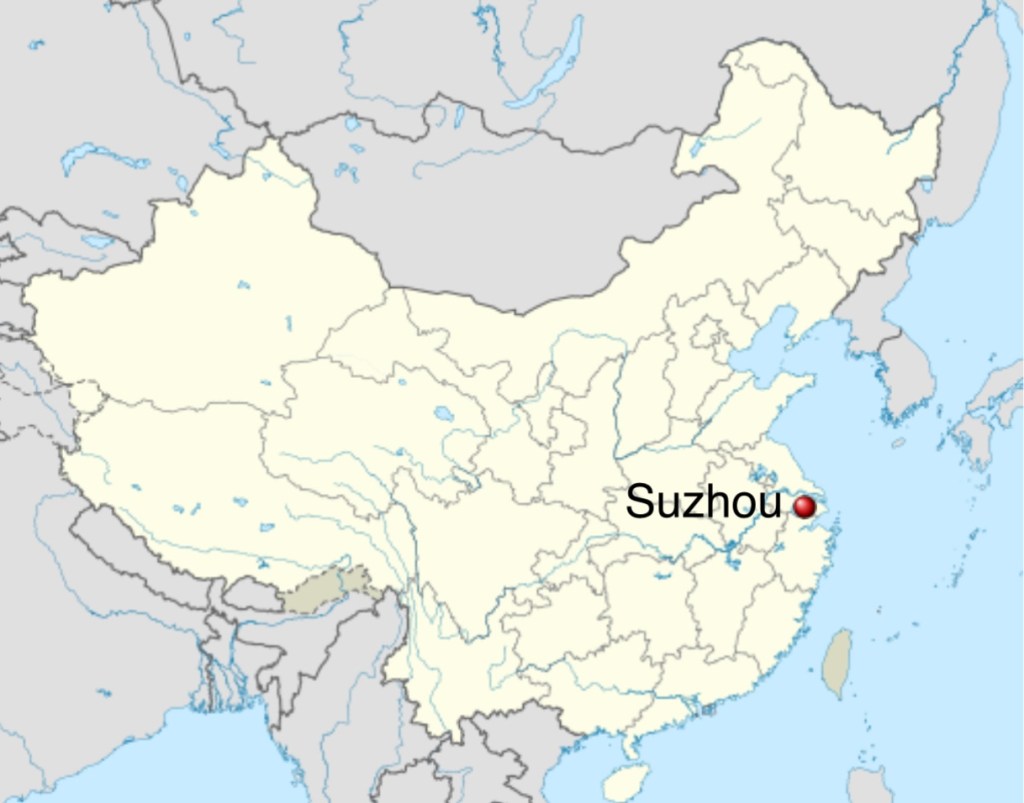
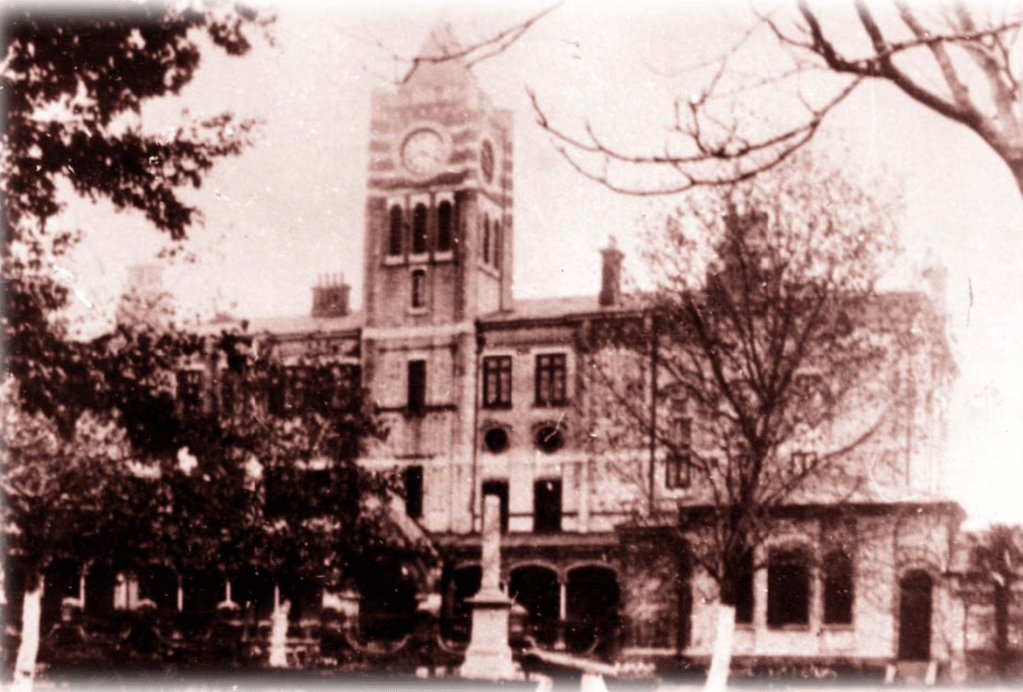
She had already met Billy Guyton by this point, but rather than immediately getting married, Kate encourage Billy to complete a medical degree while, at only twenty-one, she accepted a five-year teaching position in Suzhou (then Soochow), China with a Methodist mission. There, she taught female pupils at what eventually became Suzhou/Soochow University. Again, I encourage you to check out Dr. Guyton’s blog to see some of the wonderful photographs Kate took while in Suzhou—they offer some great glimpses of late Qing China shortly before the communist revolution. Even though the extreme political instability of the period made this an often precarious time to be a foreigner in the country, Kate by all accounts deeply enjoyed her years in China and even after she returned home and married Billy, there was a time where she almost convinced him that they should take another mission posting there. That didn’t end up being in the cards, but again, her copy of Dream of the Red Chamber, purchased nearly twenty years later, demonstrates her continued interest in China and its people; as did the way she stayed in touch with many of her Chinese students throughout her life.
Anyway, this was my little odyssey, and I was just dead chuffed that it turned out that I could find so much information on an unknown former owner of one of my old books. Not to mention that she and her family turned out to be so interesting—hopefully all of you found this neat, too. Though apologies if I’ve accidentally outed Dr. David Guyton or his family, the only Maryland-residing relatives of Kate, as the one who gave away this book to my Frederick-based bookseller. Know that it found a good home, Guytons 😊

REFERENCES
Dr. Guyton’s blog about his family and Kate Guyton’s time in Suzhou
Gary Pettus’ memorial article for the University of Mississippi’s medical alumni magazine
Arthur Guyton’s Wikipedia page
This LA Times article is emblematic of many similar obituary articles written after Arthur Guyton’s passing. Check the cited references on the Wikipedia page for others, but they all have much of the same information as this one or the Ole Miss article.


 Sarah Holz
Leave a reply to sarahlholz Cancel reply