As previously promised, I want to take this week to talk a little about my next book, The Gourd and the Stars, as I’ve entered the last pre-formatting editing phase and my artist at SelfPubBookCovers is beginning work on a cover. I thought I still might be jumping the gun a bit, but seeing how I found that I did the preview for The Flight of Virtue two weeks earlier last year, I’m apparently running late.

I’ve alluded to this a couple of times this year, but G&S will be divorced from both of my prior novels’ times—though somehow I keep ending up in France and the Middle East. The main difference other than this is that, unlike the worlds of The God’s Wife and FoV, where I’m largely a semi-obsessively self-taught dilettante, I’ve finally found a way to put any of my seven years of higher education to use in my writing. Because G&S is a novel set in the medieval period, and as those of you who’ve read my profile blurb know, I actually took enough college courses on the history and literature of this era that Pitt had to acknowledge it in some way.

Anyway, despite this background, for many years, I didn’t have much specific writing interest in the Middle Ages, especially the Crusading era, because I hadn’t found the crucial hook for my brain: a compelling historical person to anchor a story behind. As you all saw in my post about Richard Coer de Lyon, I don’t have much patience for Richard I, Ivanhoe, and most of the violent blowhards of the Crusades—not to mention that some of you know I’m not particularly interested in writing endless, unavoidably repetitive battle scenes. But one of the most important things I’ve learned in my writing journey is to keep yourself open to all sorts of art and media because you never know when something will plant a seed. For what would eventually become this novel, I had a very similar experience to how I started with The God’s Wife, where I was watching something focused on one historical person, but I was hopelessly distracted by someone else flitting about in the background. For GW, it was a tv program about Cleopatra that mentioned Arsinoë in passing that had me dumbstruck that no one was talking about this younger sister who almost outfoxed Julius Caesar at the height of his military career. For G&S, it was Ridley Scott’s 2005 film, Kingdom of Heaven.

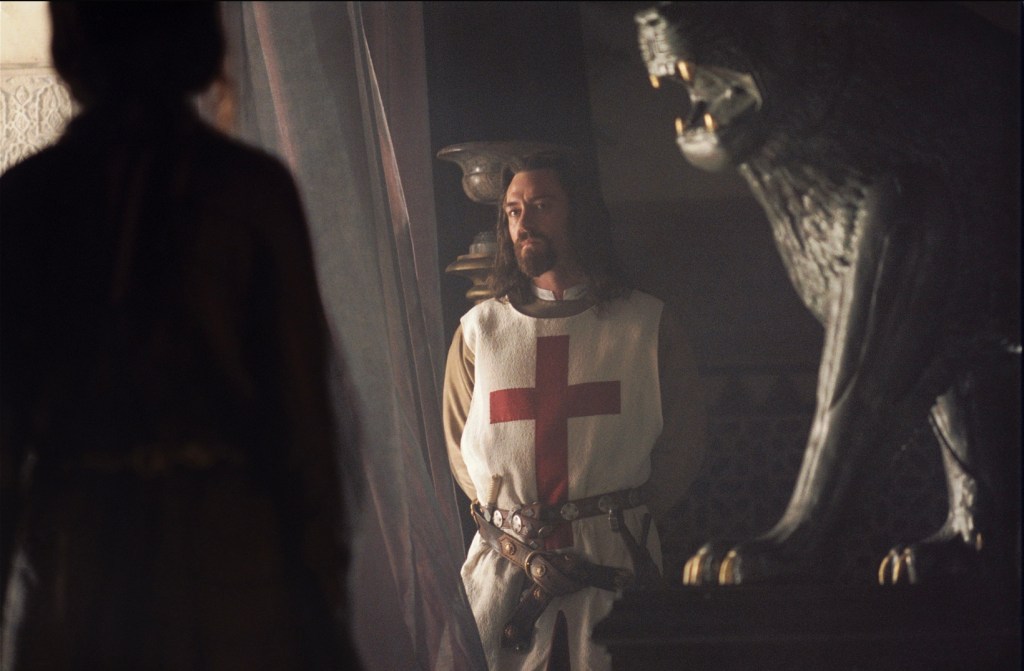
For those of you who haven’t seen it (or only saw the almost nonsensical theatrical cut and therefore couldn’t figure out what was going on), William Monahan’s screenplay appears to be (very) loosely based on the so-called Continuation of William of Tyre, which was a later addendum to William of Tyre’s Deeds Done Beyond the Sea, a history of the Latin kingdom of Jerusalem. Kingdom of Heaven is a basic hero’s journey story centered on Balian of Ibelin (Orlando Bloom), a historical baron of the kingdom of Jerusalem, who is rewritten for the movie as the peasant bastard of Jerusalem baron Godfrey of Ibelin (Liam Neeson, playing a character who seems to be a mashup of Balian’s father, Barisan, and his older brother, Baldwin). The legitimately-born childless Godfrey comes back to France to bring Balian to the Holy Land as his heir, where Balian is quickly embroiled in the politics of a Jerusalem on the verge of being conquered by its Muslim neighbors, led by Salah al-Din (Ghassan Massoud). Adventure and romance with Princess Sibylla of Jerusalem (an incandescent Eva Green) ensue.
But the show-stopping moment for me in this movie was the scene where Balian first meets Baldwin IV, the king of Jerusalem (an originally uncredited Edward Norton). Balian approaches the king, who is never named in the film, from behind, and Scott slowly introduces him to us through a series of shots on his gloved hands and his profile half-hidden by a hood. I don’t know if other people caught on to this visual language as quickly as I did watching this for the first time on tv some random afternoon, but I actually gasped aloud here and started talking at the movie—“Oh my God, does he have leprosy? Is that historical? They still let him remain king? What’s happening with that? Why are we talking about milquetoast Balian when this guy is around????”

Outside of having him serve as an avatar of nobility and patient suffering, Scott and Monahan weren’t particularly interested in Baldwin (something I found to be a recurring theme in academia as well), but I have never let the disinterest of others stop me when I get a bee (foreshadowing!) in my bonnet. Dear readers, Baldwin IV’s leprosy is historical, and his life and reign led me down a years’-deep rabbit hole into the history of Latin Jerusalem, medieval medicine and disability, interfaith politics in the crusading Middle East, French courtly literature, pre-modern beekeeping—and the result of all of this is The Gourd and the Stars.
So, after all of that disjointed explanatory flailing, what’s the actual story? While endeavoring to bring Baldwin into the center of his own life—a place often denied to him by ableist assumptions not infallibly supported by the historical record, IMO—you all know me well enough by now to know that it’s usually underrepresented women’s history I’m most interested in exploring in my novels. So Baldwin’s story was a jumping off point that led me to my point-of-view protagonist, and my first original character protagonist since Aetia: my girl Zénaïde d’Auterives, an unusual orphan who becomes an extraordinary physician in a time not designed for her to be either.
Zénaïde is born with albinism, and she is also congenitally mute—though not deaf—which is represented in the narrative by her speaking in italics, to show that she is either writing out her dialogue on a slate or communicating through her personal sign language. These disabilities are the reason she is discarded by her birth family, but she is instead raised by her adoptive father, an unconventional French monk who is also a physician, and he trains her in medicine to give her a way to make herself self-sufficient in a potentially hostile world. The novel follows her journey from an infant abandoned because of superstition toward becoming a trusted physician and friend to three very different kingdoms: France, Jerusalem, and the sultanate of Damascus.
Armed with her empathy and ingenuity, Zénaïde leaves the sheltered world of her monastic childhood and learns to navigate first the sophisticated world of courtly love and chivalry in the medieval Paris ruled by Eleanor of Aquitaine’s ex-husband, Louis VII, before a dramatic and possibly divine command sends her halfway across the world to the chaotic Holy Land of the Crusades. She’s sent as a physician for Jerusalem’s young king, Baudouin (Baldwin’s name in medieval French), who has suffered from leprosy since childhood, but she’s soon drawn into the region’s fractious politics, both within the court and without, where the kingdom’s Muslim neighbors are rallying under the banner of the charismatic Salah al-Din. As the noose tightens and draws her and Baudouin closer together, Zénaïde will have to learn to fight his external enemies as much as the internal threat of his disease. But at the end of the 12th century, a lady physician is nearly as radical as a leper king, so Zénaïde might have to risk everything to save herself as much as her beloved lord—even rely on the man who could destroy everything she’s built in the land that the medieval world called Outremer, “beyond the sea.”

I started this novel because I really wanted to write a story in this time period, especially about the changing social and political landscape of Palestine during these years. But the more I read and researched, the more my focus became on how institutional ableism has for so long twisted the official narrative on Baldwin IV’s reign. Up until very recently, the academic consensus was that Baldwin was too sickly to rule effectively, and his unwillingness to abdicate sooner was the reason the kingdom fell to Salah al-Din’s coalition army. Yet, my research time and again pointed to a young man who was courageous and resourceful despite the significant challenges his increasing disabilities presented him with. Not to mention he was consistently the only thing approaching a consensus candidate for the throne during his reign, meaning even the notoriously difficult barons of Latin Jerusalem thought he wasn’t the main problem.
So, it became more imperative (and way more interesting) to find something like the holistic Baldwin for my story—a living, human, person beyond the pejorative labels of his illness, or even the quasi-saintly figure of Ridley Scott’s film. Giving him someone who understood something about social stigma produced Zénaïde, but I really see this novel as a celebration of difference rather than merely a polemic against prejudice. Discovering how the treatment of disease and disability in the so-called “Dark Ages” was complex and often anything but barbaric was truly wonderful, and I wanted to create a story that gave voice to this lesser-known aspect of medieval studies. That I could unintentionally—at least initially—push back against two of the worst derogatory literary tropes (the “evil albino” and the “unclean leper”) at the same time was just a delightful bonus. As has been the schedule for the past couple of years, I’m aiming for an early 2024 release, and I’m just giddy for you all to fall in love with Zénaïde, Baudouin, and the rest!
Stay tuned!

 Sarah Holz
Leave a comment