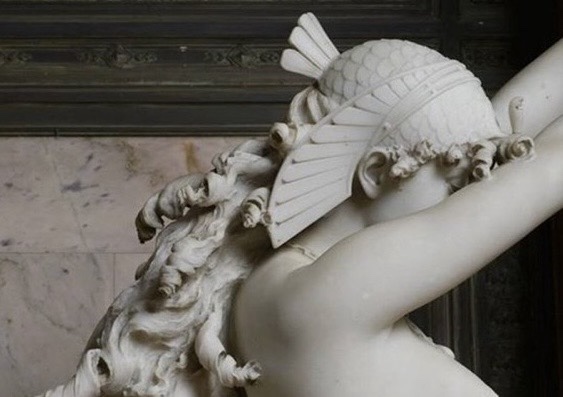
Okay, folks, this week we are back with my girl Arsinoë and her insane family for Round Two of their shenanigans! When we last let our Ptolemies, they were standing over the headless remains of Pompey Magnus and awaiting the arrival of his rival/martial antagonist/ex-father-in-law/frenemy—namely, one Gaius Julius Caesar.

[I’m assuming Julius stepped off his ship in Alexandria to Kesha’s ‘Joyride,’ but feel free to insert your own soundtrack.]
Now, by this point, roughly 48 hours post-Pompey decapitation, Ptolemy and his clique had pretty much regained their equilibrium. They were there to greet Caesar as the People In Charge, and both Cleopatra and Arsinoë were barred from participating or being at the palace (presumably, given their rightful concerns about Cleopatra’s persuasiveness). Indeed, when Caesar rocked up to them with a legion at his back, they were so confident of their position in his good graces, that they presented him with a truly one-of-kind welcoming present. Namely, Pompey’s head.

This was Ptolemy’s (and his people’s) first major miscalculation. Ancient historians (and the poet Lucan) are divided about his true feelings and motivations when he was given this unhinged gift, but Caesar was at least smart enough to know that looking excited about it would probably play very badly back in Rome. And that’s really going to be a recurring theme as we try to make educated conjectures about Julius’ motives moving forward: his ultimate objective is always his position back in Italy, and he will pick his own needs over those of anyone else. Which, in his defense, will also be how our other players move around the board—so this is not a criticism. When you play the game of thrones, etc, etc.
Anyway, whether he truly felt this, or was putting on a good show, Caesar showed open disgust for his Pompey kebab and vowed revenge on those who had advised the teenaged pharaoh to do this, while promising his dead rival a burial befitting his status as a valiant, patrician Roman. He then settled him in the royal palace, ready to try to sort out the kingdom’s whole Deal while regrouping his forces to take out the rest of Pompey’s legions still making trouble for him in North Africa, Spain, and Asia. Despite their disgrace in Caesar’s eyes, Ptolemy, his tutor Pothinus, and the others attempted to bar Cleopatra from getting an audience with their Roman “guest” and generally urging their case for a sole Ptolemy rule of Egypt. None of this worked.
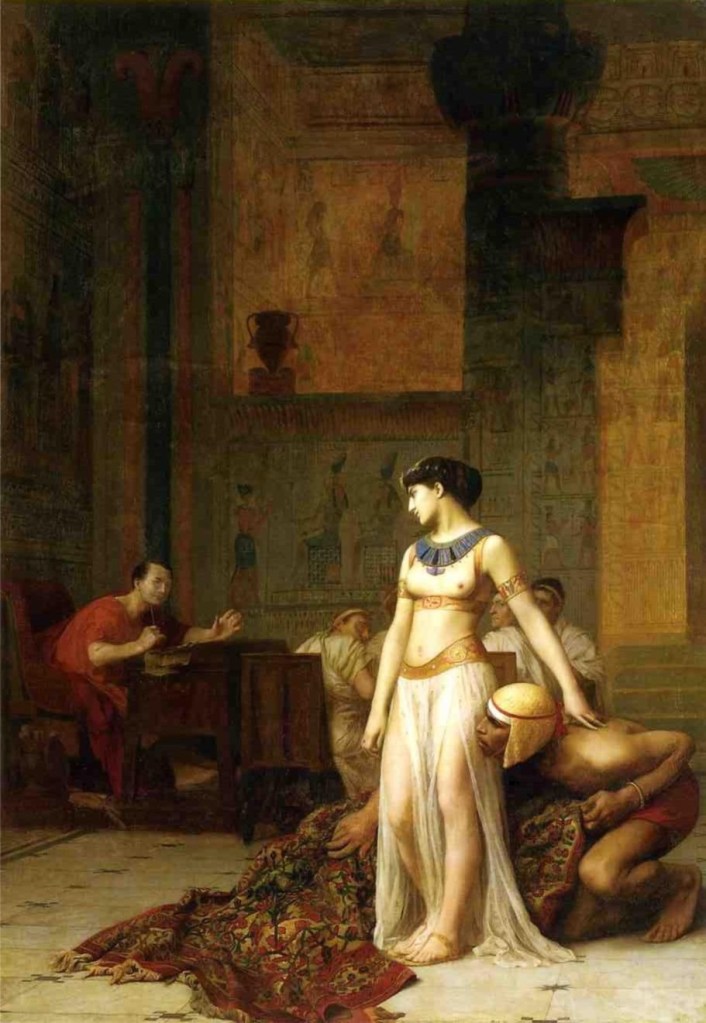
The legend about Cleopatra being rolled up naked in a carpet to be secreted into Caesar’s presence is probably untrue. I once watched a program where a bunch of researchers tried to recreate this with a very game Egyptian model, and since temperatures in Alexandria in September/October can still reach over a hundred degrees, Cleopatra would have at least been a hot, sweaty mess when she popped out of the carpet—if not unconscious from heat stroke. Suffice to say that she got an audience with Julius one way or another, and as her brother and his people had feared, she made a compelling enough argument for at least being reinstated as Ptolemy’s co-ruler. While I would never suggest that Caesar was a feminist, he (unlike many—most??—Roman men) seems to have genuinely enjoyed the company of beautiful and intelligent women, and given the choice between a charming, erudite young woman (Cleopatra was twenty-two-ish at this point) and her bratty, sixteen year old brother, it isn’t hard to see why Caesar drifted into her camp. And if we are to believe the queen of Egypt that her firstborn son, the future Ptolemy XV Caesarion, was in fact Caesar’s son, it would appear that she and her first baby daddy moved past the “just coworkers” phase pretty quickly.
So Ptolemy is back on the outs, and Cleopatra is the new hotness again (and possibly pregnant)—but where does this leave Arsinoë? Well, she, and by extension their youngest brother, Ptolemy XIV, have become kind of inconvenient for Cleopatra. She has no personal use for Arsinoë anymore, but even if the queen isn’t worried about Caesar’s notoriously roving eye settling on her sister, Arsinoë is potentially a huge asset for Ptolemy XIII to capture, as she is another princess of the blood who could serve as her brother’s queen in Cleopatra’s place, should he manage to gain the upper hand again. And if Cleopatra and Ptolemy XIII just become too annoying for Rome to deal with, they could be easily swapped out for a younger and theoretically more compliant pair in Arsinoë and Ptolemy XIV. So what to do? Cleopatra gets Caesar to allow, as it is now a Roman territory, for her sister and youngest brother to be installed as a new client queen and king in the old Ptolemaic kingdom of Cyprus.

Cleopatra’s solution at first seems like a good one, and one that is good for her siblings. But this ignores the crucial context of the recent history of Ptolemaic Cyprus. As we discussed last time, our kids’ father, Ptolemy XII Auletes lost Cyprus to Rome because he refused to help his brother, the last king of Cyprus, keep Rome at bay, and his brother’s suicide in the face of annexation of the island was a major contributing force in both Ptolemy’s unpopularity in his own kingdom and the coup that ousted him from his throne. In other words, sending Arsinoë to Cyprus could be interpreted as more of a stick (“Tow our line, Sister, or I’ll have Rome take care of you like they did our uncle…”) than a carrot. And even if a shrewd operator like Cleopatra had somehow been sincere in her offer, it appears that Arsinoë (and her tutor Ganymede) took this as the threat it was likely meant to be.
So Arsinoë finds herself in the same precarious position that her brother Ptolemy XIII finds himself in—not in favor with Cleopatra or Caesar, and increasingly superfluous to them. A recipe for death in their family. Luckily, Ptolemy XIII and Pothinus know this, too, and see an opportunity. Because while Cleopatra sees the threat her sister could become, it appears that Caesar is much less worried about one sixteen year old princess. As a result, she was, as Cassius Dio later notes in his Roman History, “not very well guarded” in the royal palace (Book XLII). Meanwhile, Alexandria is not super thrilled about their suddenly very openly Roman government. Ptolemy’s lead troublemaker, Achillas, has been trying to gather up the remaining Gabiniani and any Egyptian soldiers he can lay his hands on to fight Caesar’s occupying legion, but they need the presence of their Ptolemies to give them the extra push into more than nominal revolt. Ptolemy can’t get away from Julius’ surveillance to raise any kind of opposition to Cleopatra and Caesar—but Arsinoë can. Short on options herself, Arsinoë strikes a deal with her brother: she’ll get to Achillas and raise an opposition army, and in return, she’ll be crowned his queen when they drive the Romans (and their sister) out.
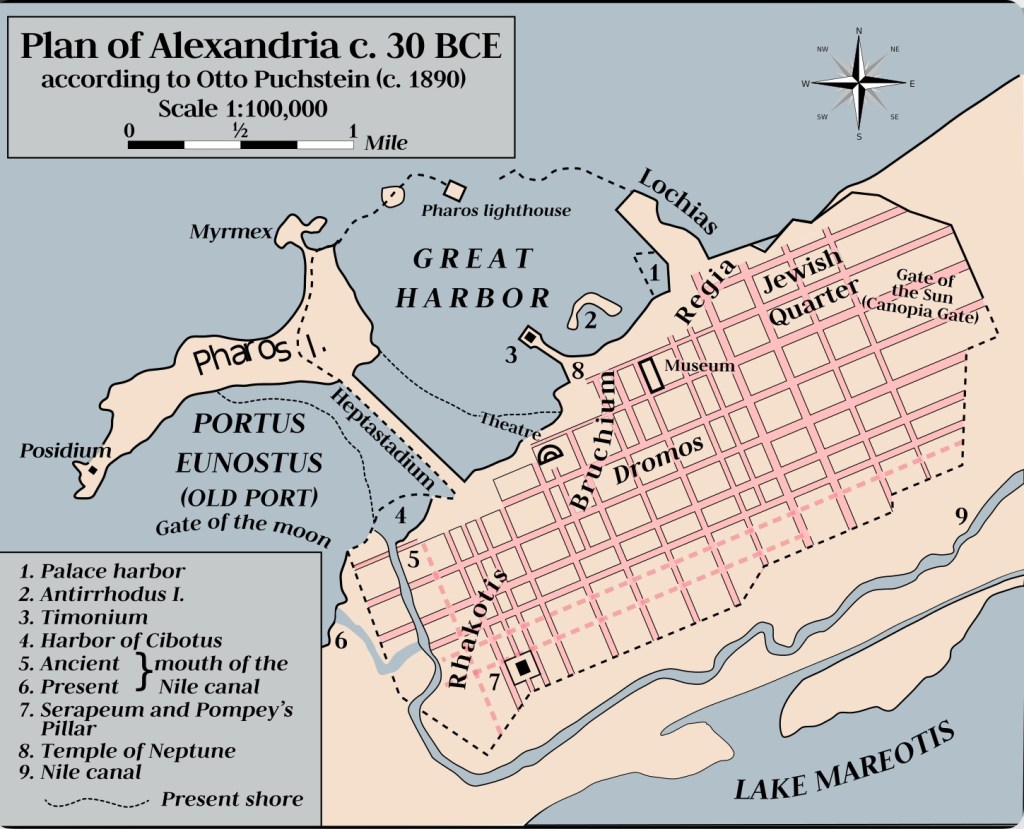
Whether Arsinoë really wanted to marry her brother or be queen is really immaterial. Her only potential protection was the throne of Egypt, and she made the choice that was most likely to keep her alive in that moment. We don’t exactly know how she and Ganymede snuck out of the palace, but they did, and made it to Achillas’ camp on the opposite side of the harbor near the lighthouse of Pharos. She was hailed as queen, and her presence invigorated the anti-Roman forces exactly as Ptolemy had hoped, as the city erupted into open rebellion against Caesar and his apparent puppet, Cleopatra. The Alexandrian War had begun.
Arsinoë and Achillas’ first moves against the smaller but better-trained Roman forces were actually very canny. Arsinoë’s troops drew the legion into protracted, urban guerrilla-style battles against local street barricades where the Romans were at a geographical disadvantage, and that kept them from wanting to penetrate deeper into the hostile city. But Arsinoë’s master stroke, one that almost won them the war, was cutting off the legion’s access to fresh water. Alexandria’s potable water came from an intricate maze of freshwater canals channeled from Lake Mareotis and other sources south of the city; i.e., Arsinoë’s forces sat between those sources and the largely harbor-bound legion. Her army proceeded to dam what canals they could that supplied the palace and harbor, and salt those they couldn’t. Within days, they had dried out Caesar’s soldiers, and the legion was threatening to storm the palace, trying to get their commander to cut a deal with Arsinoë. Caesar’s god-like status with his men is the only thing here that probably saved his ass long enough for his engineers to start digging new wells through Alexandria’s porous limestone that could filter the salt out of their water, but this bought Arsinoë what she needed most in her defensive war: time. Something that was becoming even more critical as she had a growing problem that was almost as bad as Caesar: her brother’s lieutenant, Achillas.

The exact nature of the disagreement between Arsinoë and Achillas isn’t known, but ancient writers were under the impression that it was essentially about who was really in charge of their forces. Their views probably largely stem from Caesar himself, who I’ll quote in full in the only paragraph in his Commentarii de Bello Civili that mentions (passively, anonymously) Arsinoë: “Meanwhile the younger daughter of Ptolemy, hoping to take possession of the throne while it was untenanted, left the palace, joined Achillas, and began to wage war jointly with him. However, a quarrel soon arose between them about the leadership; this increased the bounties to the troops, for each tried separately to win their support by lavish largesse.” (III.112.8)
No one in the ancient sources seems to have liked Achillas very much (probably because of the dishonorable way he killed Pompey), so it’s very possible that he, seeing how his forces weren’t doing a terribly bad job going toe to toe with a legion of Julius Caesar, thought that, hey, maybe he didn’t need the Ptolemies at all. And maybe once “his” troops won, he was the one who should be pharaoh. It’s also possible (I’ll get into why I think this is possible in a bit) that Arsinoë was far more popular with their soldiers and civilian supporters than Ptolemy XIII and his allies had expected. And they were afraid that if she was seen as the one who beat Caesar, that she’d have enough clout to rule by herself and kick her do-nothing brother (and his posse) to the curb. So whether he was acting for himself or as an agent for his absent boss, Achillas was starting to fight with Arsinoë almost as much as he was with Caesar.
Arsinoë by this point had proven that, despite her young age, that she was no one’s fool. After outwitting her brilliant sister and her genius lover, she wasn’t about to get taken out by the guys who thought a severed head was better than, like, some wine and a fruit basket. So in a move that showed exactly what family she came from, she simply had her tutor Ganymede kill Achillas before he could do the same to her. It was a potentially risky move, but it paid off, as it turned out no one in her army cared enough about Achillas to kick up much of a fuss about his murder. And with Achillas out of the way, she and Ganymede could stop taking pseudo-orders from Ptolemy and instead focus on taking the fight to Caesar.

[My favorite answer to Caesar’s perspective on this situation is Lucan, who doesn’t like Julius and is thrilled that he’s getting his ass kicked by a teenaged princess who also avenged Pompey through what he sees as a totally justified murder: “Moreover, Arsinoë was carried off secretly by a trick of Ganymede, her chamberlain, and conveyed to Caesar’s enemies. There, as a daughter of Lagus [another name of her ancestor, Ptolemy I], she ruled the army in the absence of the king and pierced with righteous sword Achillas, the dreadful instrument of Ptolemy.” (de Pharsalia, Book X)]
It was another risky choice for Arsinoë at this point to change their military strategy from a defensive approach to an offensive one, but she may have had little choice (and maybe this is what she and Achillas had disagreed about). Once their water trick had been circumvented, it was probably clear that what basically amounted to a long term siege of the city by Caesar’s legion was becoming increasingly untenable. She was losing her grip on her main advantage, Alexandria itself, so she switched to her, in my opinion, next-best one: Egypt’s superior naval power. Beating Roman in a ground war was grueling, but Rome had never been much of a naval power, and Julius himself did Arsinoë a favor by burning most of his ships shortly after her escape from the palace (probably to keep them from her). His second regional legion, and his best admiral, Euphranor, were rushing to meet their (surprisingly, increasingly) beleaguered commander in Alexandria, so Arsinoë moved what ships she had to try to take Caesar’s forces out in one, decisive battle. And she almost did it.
The first naval clash between Arsinoë and Julius technically ended in a stalemate, but anything short of a win for the Egyptians was effectively a loss. Arsinoë’s navy did manage to sink several of the ships her sister had been able to rustle up for the Romans including, hilariously, the one Julius was using as his flagship. And while I’m sure that it was gratifying to watch the greatest military mind of the age swimming back to shore like a bedraggled cat, even the stalemate had cost Arsinoë a number of her ships (and their crews), and she would now have to spend precious time refitting her forces before they could attack Caesar again. That gave Euphranor time to arrive, which meant that her next battle would be against an additional fresh legion and a better-equipped naval force. A true do or die situation—or was it? The second naval battle was a much more flat-out loss for the Egyptians, but Arsinoë’s land forces in the city managed to hold both of Caesar’s legions to their position at the edge of Alexandria’s harbor with an aerial bombardment (arrows/javelin spears) that once again left both sides in a stalemate. This was starting to get embarrassing—but not for Arsinoë.

Now, Cassius Dio, a Roman man reporting from almost three hundred years in the future, claims that at this point, the Egyptians had had enough: “…they were irritated at the rule of the eunuch and of the woman and thought that if they could put Ptolemy at their head they would be superior to the Romans.” (Book XLII). That’s also the vibe one gets from whoever authored the Alexandrian War continuation of Caesar’s Commentarii de Bello Civili (Julius’ own writing ends roughly around that aforementioned paragraph he wrote pretending he barely knew who Arsinoë is). But it’s that last notion, that Caesar tries to downplay Arsinoë’s presence, that I think is the thing that shakes this version wide open. It is certainly possible after several hard-fought months of stalemate that the Egyptians wanted to try changing tacks by seeing if they could switch out Arsinoë for Ptolemy, but why? Sure, they’d suffered losses, but they were ostensibly holding their own against Julius Caesar. And had done so for months, with Arsinoë at their head—something even the continuation acknowledges (“…she herself, with no colleague and no guardian, held the supreme command…” (I.4)). Stalemate was a loss for Arsinoë, but it was also emphatically a loss for Caesar. Here he was, attempting to show the world that he should be running the show in Rome, and he couldn’t even manage to steal a march on some no-name, foreign, teenaged girl and her ragtag army of Egyptians and Romans who’d gone native. Mortifying.
Also, just as Arsinoë was no fool, Julius certainly wasn’t. Even if Cleopatra wasn’t on his case demanding her sister’s troublemaking head at this point (again, given history—and things still to come—very unlikely), events had proven that Arsinoë was much more of a threat to him and Rome’s grip on Egypt than Ptolemy had ever been. So it would have been in his interest to spin his narrative on events that Arsinoë was gladly betrayed and surrendered by her own side rather than the truth: that he had so much difficulty outmaneuvering this girl that the only way to stop her was to turn her brother with a history of backstabbing loose and gamble (correctly) that he’d happily turn her over to their enemies to get “his” army back. So betrayed by either Ptolemy, her army, or some combination of the two, Arsinoë is captured and handed over to Caesar. And within a handful of weeks, Ptolemy squanders everything in a disastrous battle on the Nile that kills him and ends Egypt’s revolt against Cleopatra and her Roman alliance. But in a move that again seems to be a truer measure of what Arsinoë had accomplished, the now undisputed queen of Egypt has something much worse in mind for her renegade sister than a simple death in battle.
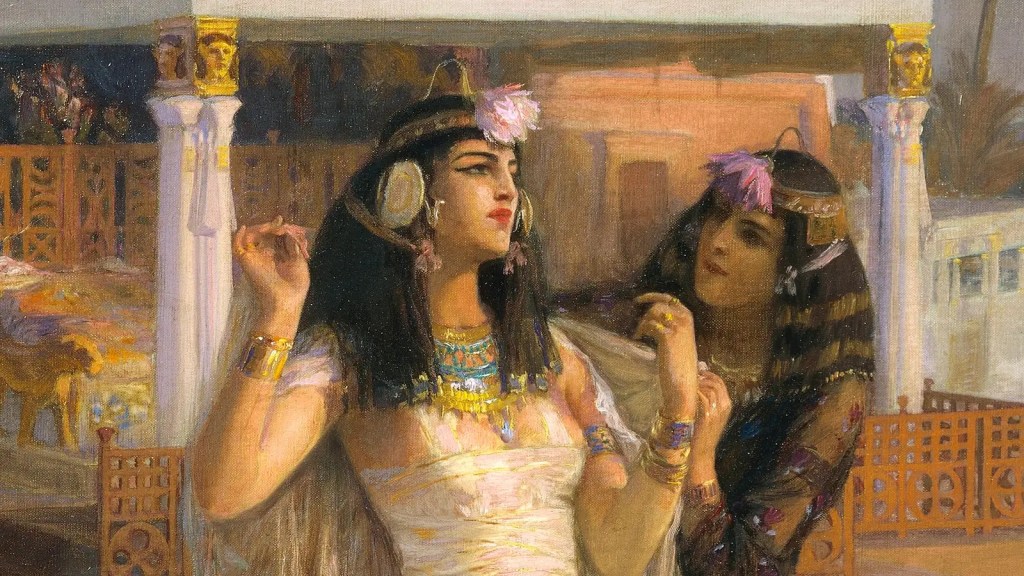
I’m sure that Cleopatra would have loved to give Arsinoë the Pompey Special and be done with her, but she doesn’t, which I also think subtly reveals that all of the victors’ posturing about Arsinoë being just a silly little girl playing queen and soldier is a cover for them. Because like she did with the episode between the Gabiniani and the sons of Marcus Bibulus, she hands Arsinoë over for Rome to deal with. Namely, for her lover Julius to lead in a triumph commemorating his victory in the Alexandrian War. Leading conquered opponents in triumphs was a time-honored tradition in Rome—one with a grisly, predictable end where the defeated leaders were straggled to death after the fun parade. This would give Caesar someone to show off to the home crowd (since Ptolemy was somewhere at the bottom of the Nile), and give Cleopatra the plausible deniability in her sister’s death that her father would have (heh) killed for when dealing with his siblings. Which in turn suggests that Cleopatra may have been afraid that Arsinoë still had enough popularity in Alexandria that a straightforward execution may have threatened her newly stable regime.
Julius has some matters to attend to in Pontus and Mauretania first, but by the next summer the whole gang is in Rome: Julius is being adored and/or hated, Cleopatra and her little bundle of joy Caesarion are mostly being shunned by polite Roman society, and Arsinoë is in prison, awaiting the worst parade ever. Well, the parades were set to be spectacular (hers would have a flaming replica of the lighthouse of Alexandria!), but they’re not great for her or her fellow defeated monarchs being displayed in Caesar’s unprecedented four triumphs, one for each of his victorious wars: Gaul, Egypt, Asia (Pontus), and Africa (Mauretania). Pharnaces of Pontus is MIA for this, having already been killed in battle, as has Juba I of Mauretania; though in the latter instance, Julius does have Juba’s son and namesake, Juba II, as a stand-in. But as sources of the time identify the younger Juba as a brefos, i.e., a child under the age of two, and they (probably) weren’t planning to execute a baby, that really only left the Romans with two viable red meat options for this crushing invocation of Roman excellence and might: the Gallic chieftain Vercingetorix, and Arsinoë. Vercingetorix walked his Green Mile, and was promptly and ceremoniously strangled as promised, but then Arsinoë took the floor before the entirety of Rome in the Egyptian triumph, and the last thing anyone seems to have suspected happened. She made her walk of shame her own, and changed her fate.

[Juba II being displayed in Rome during Caesar’s African triumph]
We don’t know exactly how Arsinoë won the Roman crowds over, but she did. It is possible that she played up her youth, but Dio seems to suggest that it was specifically her status as a queen, as well as her gender, which swayed the onlookers, suggesting that rather than a display of weakness, Arsinoë showed herself as the child of pharaohs and an heir of Alexander the Great: “Most of it [the triumph], of course, delighted the spectators, but the sight of Arsinoë of Egypt, whom he [Caesar] led among the captives…displeased them exceedingly…and the sight of Arsinoë, a woman and once considered a queen, in chains—a spectacle which had never yet been seen, at least in Rome—aroused very great pity” (Roman History, Book XLIII). It seems that it became quickly and embarrassingly clear that Rome would not think well of Caesar executing Arsinoë, a situation likely compounded by the general dislike Cleopatra had been attracting since her arrival and the (rightful) sense that the queen of Egypt was trying to get Rome to off a teenager to keep her own hands clean. As we remarked on earlier, Julius was not going to cross Roman opinion to humor his girlfriend, and he swiftly commuted Arsinoë’s death sentence into exile in the Greco-Turkish city of Ephesus in Anatolia. And there was apparently nothing Cleopatra could do about it.
Perhaps picking up on Cleopatra’s less-than-thrilled vibes about her sister escaping her appointed death sentence and wanting to avoid typical Ptolemy drama, Caesar appears to have put Arsinoë into the care of the powerful priestly college that served the great Temple of Artemis in Ephesus. These megabyzoi, by all available accounts, took to Arsinoë with the same immediacy that the Egyptians and the Romans had before them, and they even specifically hailed her as a queen, something that would get them into hot water with Cleopatra later. In spite of that, Arsinoë seems to have settled into her reprieved life with grace, and Caesar’s scheme for her probably would have worked long term… if he hadn’t gone and gotten himself assassinated two years later.
Caesar’s death in 44 BCE threw everybody’s calculations out the window, but fortunately for Arsinoë, Cleopatra was largely too busy with more immediate concerns to worry overly much about her exiled sister (though not too busy to poison their younger brother Ptolemy XIV to clear the way for Caesarion and his political prospects). For another two years, until the last of Caesar’s major opponents are defeated at the Battle Of Philippi, Cleopatra is focused on both securing Roman support and her own rule at home. Once it is clear that no one in Rome will officially recognize Caesarion as Julius’ legitimate son or political heir, she sizes up the Second Triumvirate (Mark Antony, Octavius Caesar, and Marcus Lepidus), and decides the one who has the most clout in the east, Antony, is her horse. She goes on one of her by-now legendary charm offenses by arranging a meet-cute with Antony in Tarsus, and the rest became history.

[Then myth, then something entirely beyond either history or myth…]
Cleopatra and Antony probably bonded over all sorts of things: their ambitions; their love of a good time; their dislike of that little weasel, Octavius. That last one would probably have been enough to keep them together, even if you’re like historian Ronald Syme and think that the story of their grand love affair is completely fictitious. More to the point, they knew that the little weasel didn’t like either of them very much, either, and would probably love to find a way to get rid of both of them. And whether Octavius himself had realized it yet or not, he had a perfect solution for his Cleopatra/Caesarion problem twiddling her thumbs in Ephesus. This might not be exactly how things went down, but it would certainly explain why Antony was willing to jet off to murder Arsinoë within two months of meeting her sister. Which he duly did on the steps of the Temple of Artemis in 41 BCE, leaving Cleopatra, at long last, the last of her father’s children. Arsinoë had been at most in her early twenties and her almost equally young older sister would live another eleven years before joining her siblings with one more violent, Ptolemy death. The irony being that Cleopatra would take her own life to keep herself from the humiliation and death she had once thrown at her younger sister.
Arsinoë’s death, carried out against someone in protective exile on temple grounds—and at as important a temple as that of Ephesian Artemis—was controversial even at the time, and no one thought well of Antony for acquiescing to it. The problem for our rebel queen was, of course, that by the time she met the death that had stalked her for most of her short life, anyone who would have gone to war for the sacrilege committed against her was already dead. The only posthumous mercy available to the last of her partisans was that Cleopatra was unable to retaliate against the Ephesian megabyzoi who had treated her sister as royalty in her last days.
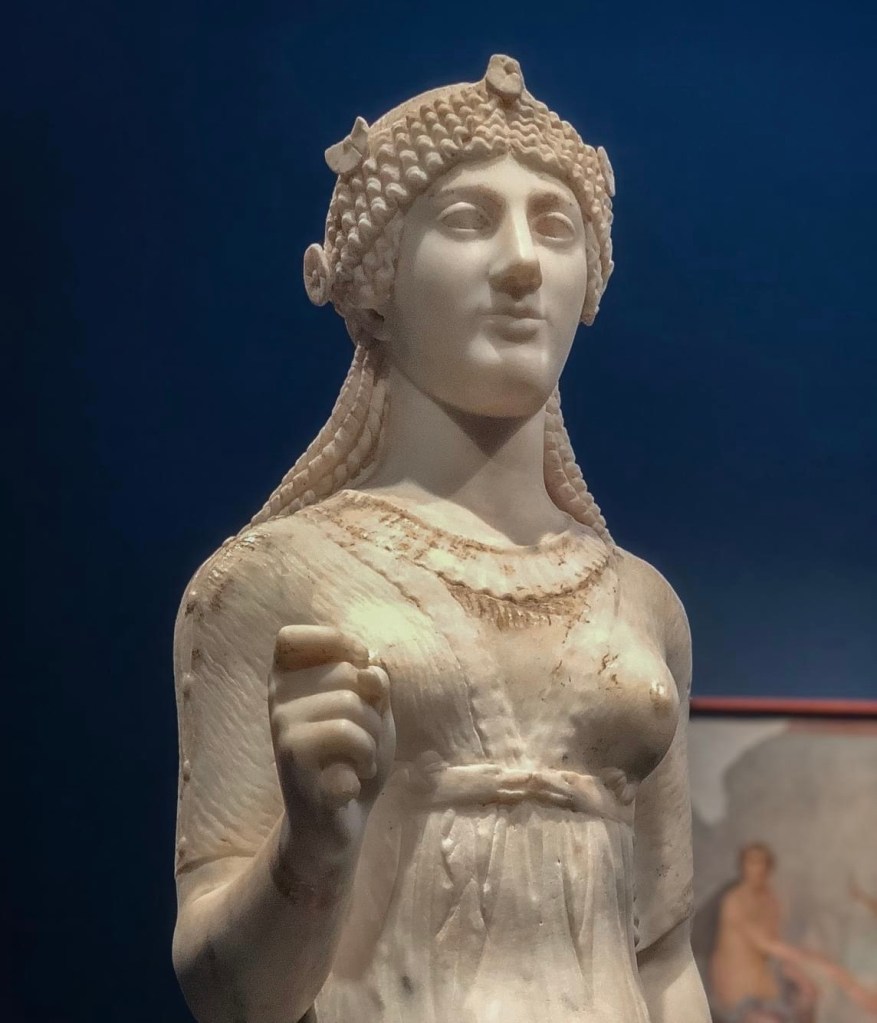
In 1904, an octagonal tomb shrine with a single skeleton inside was found among the ruins of the Temple of Artemis. It has no inscriptions, but its architectural features placed it firmly in the right time period, so since its discovery, many archeologists have yearned to identify the relatively youthful skeleton within as Arsinoë’s. But—despite what many biology absolutists will tell you—it is actually incredibly difficult to make firm pronouncements about almost anything regarding skeletal remains, including sex, or even age, especially in the absence of funerary inscriptions or grave goods. Some of the arguments about Arsinoë’s birth year and exact parentage that we discussed last entry are sometimes only Trojan horse positions and identifications based solely on how badly (or not) the scholar making them wants the Ephesian skeleton to be her. The truth is that it probably isn’t her, but either way, a definitive conclusion is unlikely to be forthcoming. As my readers know, I personally choose to revel in the mystery of that, and if you’d like to join us and my first darling, my once and future queen, in a fictional retelling of her wondrous, courageous life (with a touch of Egyptian magic), you can find her story as told by me here.
 Sarah Holz
Leave a comment