“The earlier Bankim was only a poet and stylist, the later Bankim was a seer and nation-builder.” – Sri Aurobindo
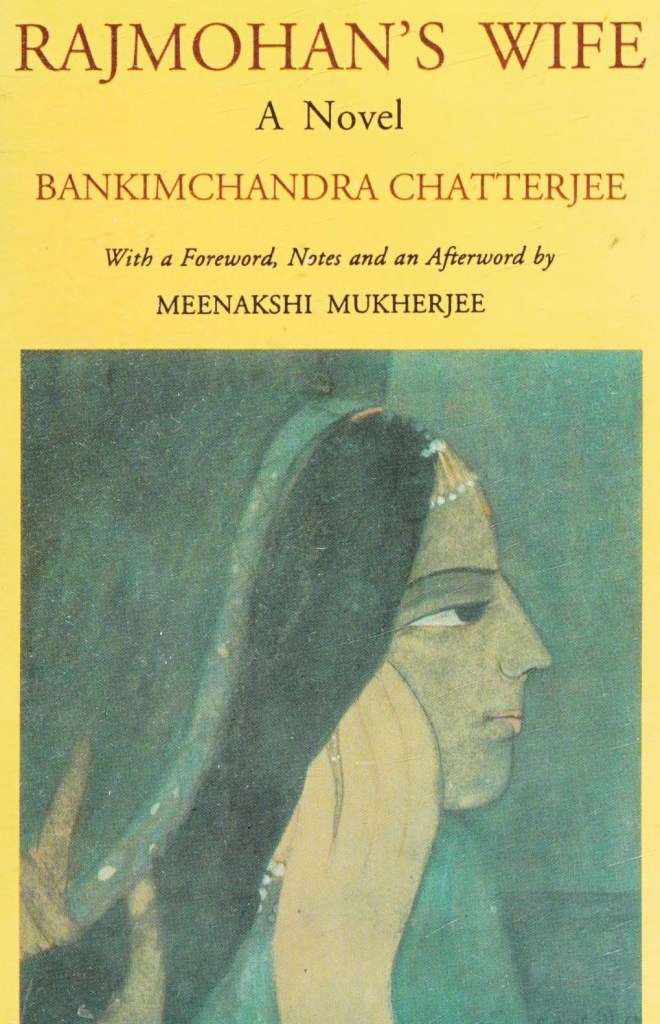
Last year, I talked a little about early Indian literature in English through the work of Toru Dutt, India’s first published woman writer in the language. But Dutt was not the first Indian novelist to write in English, and today I wanted to focus on what is largely believed to be the first novel written in English by an Indian, Rajmohan’s Wife, and its author, Bankim Chandra Chattopadhyay (1838-1894). Published in 1864, Rajmohan’s Wife, like Dutt’s writings, sits at a fascinating intersection of Anglicize Indian culture at arguably the height of the British Raj, and both its fixations and its shortcomings reveal the tension beneath the surface of British colonialism on the subcontinent that would eventually lead to the Indian independence movement. This alone I think makes it worthy of further investigation, so let’s get into some meat on the subject.
Like Toru Dutt and her family, Bankim Chandra Chattopadhyay (often Anglicized as Chatterjee, as you can see on the cover photo above) was the product of the native bourgeois civil servant class in Bengal. His father was a government official, but unlike the Dutts, who were Calcuttans born and bred, the Chattopadhyays were native Western Bengalis (modern Bangladesh), and much of Bankim Chattopadhyay’s early life revolves around the well-established intellectual life of Hooghly, where some of the oldest Indian schools and universities were. It is perhaps because of this initial remove from Calcutta that kept Chattopadhyay and his family faithful to their Brahmin caste and religion, whereas the cosmopolitan Dutts overwhelmingly converted to Christianity, as much as a social decision in order to move up the colonial civil service hierarchy as from religious conviction. But after matriculating at Hooghly Moshin College, Chattopadhyay was rated highly enough as a student to earn a place at the newly established University of Calcutta, becoming one of its first two graduates. His earlier studies were in literature and the arts, but like most Indian civil servants, he would also earn a law degree, but this would be much later in his life.

It was in mid-century Calcutta where Chattopadhyay would be exposed to contemporary Bengali intellectual circles, including many of Toru Dutt’s male relatives, who formed much of the scholarly and intellectual backbone of Calcutta’s significant literary society. Although once he began his career in the civil service and his positions often relocated him back to his native Western Bengal, Chattopadhyay would remain deeply involved in this milieu throughout his life. Like many of the Dutts, Chattopadhyay turned to literature as an appropriate off-hours pursuit, and like most of them, began his literary career as a poet publishing verse in local Bengali newspapers and periodicals. But like the iconoclastic Toru, Chattopadhyay would chafe against the limitations of poetry alone and turn to fiction as a way to expand his creative imagination. He wrote a novella in Bengali for a local competition, but it didn’t win and he never attempted to publish it later. Having seemingly abandoned this work, he, like Toru Dutt, decided to turn to English as the medium for his next project and the novella Rajmohan’s Wife was the result. Like many Victorian novels in England, Rajmohan’s Wife was serially published in the relatively obscure periodical, Indian Field, in 1864, making it the first novel by an Indian author published in English, beating out Dutt’s posthumous Bianca by roughly fourteen years.
But much like Dutt’s work, especially given her shift toward Hindu mythology in the poetry written closest to her death, Chattopadhyay’s betrays a distinct ambivalence toward the Anglo-Bengali culture that was ostensibly his life. This is borne out by the fact that while Rajmohan’s Wife would be his first English novel, it would also be his last. As he aged, Chattopadhyay became one of the earliest figures in the nascent Indian home rule movement, and like later figures such as the poet Rabindranath Tagore (1861-1941), he used his art as a vehicle to assert for independence. Specifically calling his foray into English language literature a “false start” (Rajmohan, foreword, v), his subsequent seventeen novels after Rajmohan’s Wife would all be written in Bengali, and it became his life’s work to advocate for writing in his native language about Indian themes as an act of patriotism. As we discussed in my entry about Chandrabati’s Sita-centric Ramayana retelling, Bengal has a long and rich literary tradition, with its written literature dating from deep in India’s medieval period, and Chattopadhyay tapped into this tradition to elevate his contemporaries. This advocacy, combined with his wide-ranging nonfiction essays on art, science, and religion, is why by the time of his death in 1894 at the age of fifty-five, Chattopadhyay was known in Bengali as Sahitya Samrat—the Emperor of Literature.

As influential as what eventually became known as the Bengali Renaissance was to both the local Calcutta scene and Indian literature across the subcontinent, one wonders how a writer as intellectually curious as Toru Dutt would have responded, had she lived long enough to see it. Her surviving works are mostly Eurocentric, but so are the early pieces of most Indian writers of her era, and her aforementioned shift toward ancient Hindu literature and her studies with Sanskrit at the end of her life seem to presage the same sort of metamorphosis her male peers would undergo in her absence. It is tempting to envision how the precarious status of women in the broader independence movement might have been changed for the better if they had possessed an established literary voice like Dutt from the beginning.
With this somewhat culturally schizophrenic background, combined with the usual teething problems of a debut novel, it probably comes as no surprise that Rajmohan’s Wife is a somewhat strange work with many flaws. But it is because these flaws come from the difficulties the author experienced as a man trying to survive in an alien, colonial system and culture that the overall novel becomes fascinating despite them—and as I said that the beginning—worthy of a closer look.
Unlike Toru Dutt, who sought to write European stories with European languages, Chattopadhyay’s divided loyalties are evident in his foundation, as he attempts to write a thoroughly Indian (specifically, Bengali) story in English. We don’t know his motives for this, but it implies that he might have originally intended the novella to have an Anglo-Indian—both white English and acculturated Indian—audience, though it is doubtful it received such a thing in its obscure initial print serialization. Indeed, Indian Field was such an obscure publication that even by the 1930s, when interest in the novel resurfaced among Chattopadhyay’s devotees, it turned out to be impossible to locate all of the issues in which Rajmohan’s Wife appeared. The first three chapters were missing, and compiler Brojendra Nath Banerjee had to translate into English those parts from an incomplete Bengali translation of the novel Chattopadhyay himself had begun during his lifetime, adding to the confusion of the whole, no doubt.
Rajmohan’s Wife’s plot is relatively straightforward, if somewhat obliquely told. Its structure and characterization have a lot of similarities to the stories from Indian theater that we talked about in my entry about The Little Clay Cart, with the disparate elements being the fingerprints of contemporary European literature on an Indian base. The characters, as a whole, are mostly single-note, stock figures. Although not the titular character, like in a classical Indian play, the plot largely revolves around the fortunes of a virtuous young man, Madhav Ghose, whose wealth and status are threatened by the jealous plotting of his villainous cousin, Mathur. The “Rajmohan” of the title is a henchman of Mathur, and his wife, Matangini, is the sister-in-law of Madhav. While strictly virtuous herself, Matangini otherwise plays the Vasantasenā-type character in this story: bound to her abusive husband, she is actually in love with her sister’s husband, Madhav—and he with her—and it’s this love that will make her the catalyst in the plot to avert the machinations of Rajmohan and Mathur, at great personal sacrifice to herself.

[Matangini and the other wives of the story are depicted in zenana, or inhabiting separate, women-only quarters within their houses. Zenana usually refers to a practice in Muslim households, but zenana/purdah was practiced in many Hindu families in the northern India that the author was familiar with. Chattopadhyay does not specify the religion of the characters in Rajmohan’s Wife, but since he doesn’t, it is probably more likely than not that they are representative of his own Bengali Hindu upbringing rather than a Muslim community. (Ladies of the zenana on a roof terrace, Ruknuddin Bikaner 1675)]
Matangini overhears her wicked husband plotting with an intelligent local bandit (another stock figure from the theater) about stealing a will in Madhav’s possession that will give Mathur legal leverage over Madhav’s estate. Even though what they are planning is a crime, Matangini is legally bound to her husband, and to alert her brother-in-law, she must not only violate her obligations to her husband, but also the zenana seclusion in which she, a virtuous woman, lives to meet with a man in the middle of the night to warn him. She is able to successfully warn Madhav, but Rajmohan figures out that she’s betrayed his plans, and much of the rest of the plot is devoted to her trying to escape his retribution while keeping her good name by concealing her actions from others, who would condemn her even if her motives were correct. For a while, this means avoiding her husband by staying with the wives of Mathur, who she doesn’t know is the man her husband is working for. She and Madhav are protected by Mathur’s elder wife, Tara, who is saved from actually betraying her husband as Matangini did by the timely confession of one of the bandit’s men to the local English police. The bandit escapes, Rajmohan and the confessing man are sent to prison, and Mathur hangs himself to avoid a similar fate. In a frankly jarring short concluding page, Chattopadhyay wraps up the story by telling us that Madhav’s estate is saved, Tara survives her husband’s ignoble demise to an old age where she is respected in the community, and Matangini, since her husband is sent away, returns to her father’s home and that he [Chattopadhyay] “knows nothing” of her subsequent fate, other than she dies young.
And it’s this arguably tragic ending that separates Rajmohan’s Wife from its classical Indian roots. When she goes to warn him of the plot against his estate, Matangini confesses her love to Madhav (and he reciprocates), but unlike the “impossible” loves of The Little Clay Cart or its Bollywood descendants, their love cannot overcome the obstacles in its path. Matangini loves her sister and would never betray her by acting on her feelings for her husband; and Madhav’s morals would never allow him to encroach on the marital rights of another man, no matter how odious Rajmohan is. Chattopadhyay employs this European-style realism to depict the real world situation of Bengali women—a situation he is sympathetic to, but ultimately, has no solutions for. The women of Rajmohan’s Wife are portrayed with nuance, and are the main movers of the plot and its resolution, but they are still largely confined by the society they inhabit, and there are distinct limits to how far Chattopadhyay, as a man in that patriarchal society, can envision them existing. Matangini’s actions are “radical,” but she is no feminist or revolutionary. Just as Dutt couldn’t fully imagine what female independence would look like for even her European protagonists, the twenty-six-year-old Chattopadhyay can’t see his Indian characters resolving their problems on their own without the intervention of a “good” local Anglo-Irish magistrate. As a young artist, Chattopadhyay is as bound by the colonial machine of the Raj at this point in his life as his women are by traditional Hindu-Muslim social codes.

As you can see, Rajmohan’s Wife, while a valiant first novel from a burgeoning author, is ultimately emblematic of the cultural contradictions in which its author, Bankim Chattopadhyay, came of age in. Its flaws are at least in part the result of an Indian attempting to conform himself to the dominant culture of a foreign overlord, and many scholars of his work would likely argue that for Chattopadhyay to come into his own as an artist, to become the Sahitya Samrat of modern Bengali letters, he had to give up mimicking English literature and find his own, Indian, voice. That is not to suggest that he (or anyone) should avoid foreign literature—Chattopadhyay was a pioneer of comparative literary studies in India, after all. But rather that colonized populations are often handicapped by the cultural methodologies of their colonizers, and the path toward independence is as much a cultural one as it is political. Bankim Chattopadhyay understood this, and his bibliography is as much a testament to the liberation of a people’s mind as it is the journey toward geographical home rule and the modern Indian/Pakistani/Bangladeshi state.

 Sarah Holz
Leave a comment